Frenking Jan H, Riedhammer Christine, Teipel Raphael, Bassermann Florian, Besemer Britta, Bewarder Moritz, Braune Jan, Brioli Annamaria, Brunner Franziska, Dampmann Maria, Fenk Roland, Gezer Deniz N, Goldman-Mazur Sarah, Hanoun Christine, Högner Marion, Khandanpour Cyrus, Kolditz Katja, Kos Igor, Krönke Jan, Kull Miriam, Landrin Valentine, Leitner Theo, Merz Maximilian, von Metzler Ivana, Michel Christian S, Müller-Tidow Carsten, Theurich Sebastian, Trautmann-Grill Karolin, Wäsch Ralph, Zukovs Romans, Hänel Mathias, Rasche Leo, Raab Marc S
Heidelberg Myeloma Center, Department of Medicine V University Hospital and Medical Faculty Heidelberg Heidelberg University Heidelberg Germany.
Clinical Cooperation Unit Molecular Hematology/Oncology German Cancer Research Center (DKFZ) Heidelberg Germany.
Hemasphere. 2025 Apr 17;9(4):e70114. doi: 10.1002/hem3.70114. eCollection 2025 Apr.
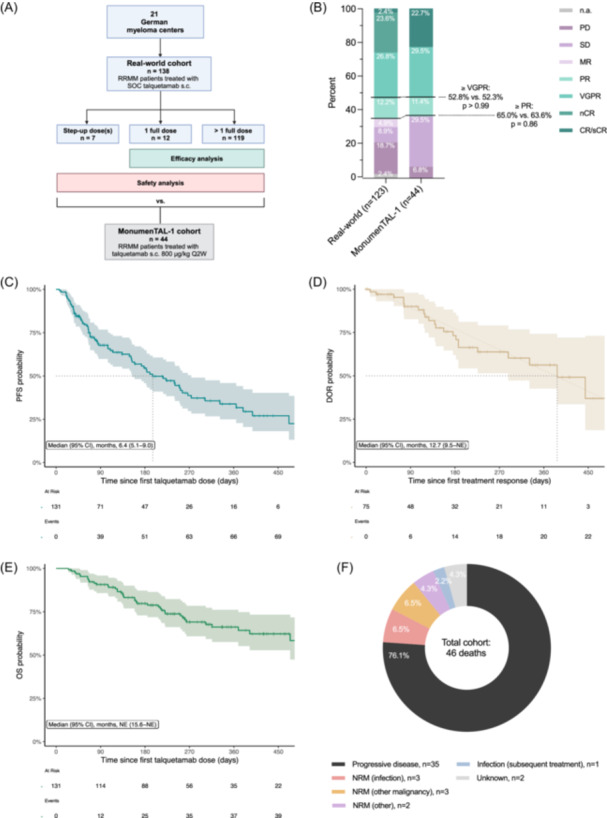
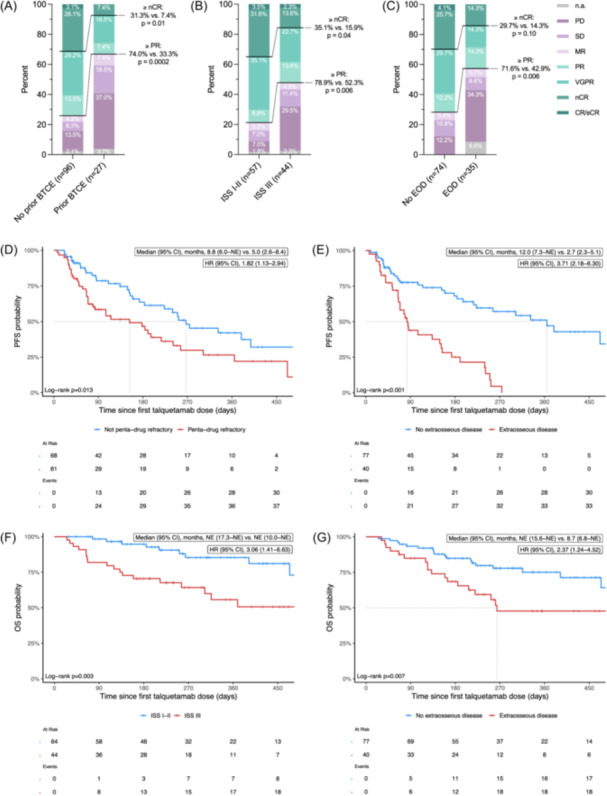
Bispecific T-cell engagers (BTCEs) represent a paradigm shift in the treatment of relapsed/refractory multiple myeloma (RRMM). Talquetamab, a GPRC5DxCD3 BTCE, has shown promising results in the MonumenTAL-1 trial and was recently approved by the Food and Drug Administration and the European Medicines Agency. However, treatment under real-world conditions may not represent patient characteristics in clinical trials with restricted enrollment criteria. We performed a retrospective real-world analysis including 138 RRMM patients treated with talquetamab at 21 German centers. Of evaluable patients, 43% had ISS stage III, 37% had extraosseous disease, and 48% had high-risk cytogenetics. After a median of six prior therapy lines, 58% of patients would not have been eligible for MonumenTAL-1. With a median follow-up of 8.2 months, we observed an overall response rate of 65% and a median progression-free survival of 6.4 months (95% confidence interval 5.1-9.0). Prior BTCE exposure, ISS stage III, extraosseous disease, and penta-drug refractory disease were associated with unfavorable outcomes. Grade ≥ 3 cytokine release syndrome and neurotoxicity occurred in 5.1% and 1.5% of patients, respectively. In summary, our real-world study confirms the efficacy and safety of talquetamab, despite a high proportion of patient- and disease-related risk factors. These results support its use as bridging or long-term treatment, even in advanced stages.
双特异性T细胞衔接器(BTCEs)代表了复发/难治性多发性骨髓瘤(RRMM)治疗的范式转变。Talquetamab是一种GPRC5DxCD3 BTCE,在MonumenTAL-1试验中显示出了有前景的结果,最近获得了美国食品药品监督管理局和欧洲药品管理局的批准。然而,现实世界中的治疗可能无法代表入组标准受限的临床试验中的患者特征。我们进行了一项回顾性真实世界分析,纳入了德国21个中心接受talquetamab治疗的138例RRMM患者。在可评估的患者中,43%为国际分期系统(ISS)III期,37%有骨外病变,48%有高危细胞遗传学特征。在经过中位数为6线的既往治疗后,58%的患者不符合MonumenTAL-1试验的入组标准。中位随访8.2个月时,我们观察到总体缓解率为65%,中位无进展生存期为6.4个月(95%置信区间5.1 - 9.0)。既往接受过BTCE治疗、ISS III期、骨外病变和五药难治性疾病与不良预后相关。≥3级细胞因子释放综合征和神经毒性分别发生在5.1%和1.5%的患者中。总之,我们的真实世界研究证实了talquetamab的疗效和安全性,尽管存在高比例的患者和疾病相关风险因素。这些结果支持其作为桥接治疗或长期治疗使用,即使在晚期阶段也是如此。