Marcolin Miranda Luccas, De Lima Pedro Emanuel Carneiro, Dias Miranda Nathalia De Carvalho, Margraf Giovanna Zaniolo, Riella Juliano
Department of Medicine and Health Sciences, Pontifical Catholic University of Paraná, Curitiba, Paraná, Brazil.
Department of Medicine, Federal University of Latin American Integration, Foz do Iguaçu, Paraná, Brazil.
Front Transplant. 2025 Apr 3;4:1564460. doi: 10.3389/frtra.2025.1564460. eCollection 2025.
The shortage of organs remains one of the most challenging global problems nowadays. Donor's therapeutic hypothermia was suggested to decrease kidney delayed graft function (DGF) when compared to normothermia in previous trials, but the role of such intervention is still controversial. To assess this, we performed a systematic review and meta-analysis of randomized clinical trials (RCTs) investigating the benefits of donor hypothermia in DGF rate and Graft Failure.
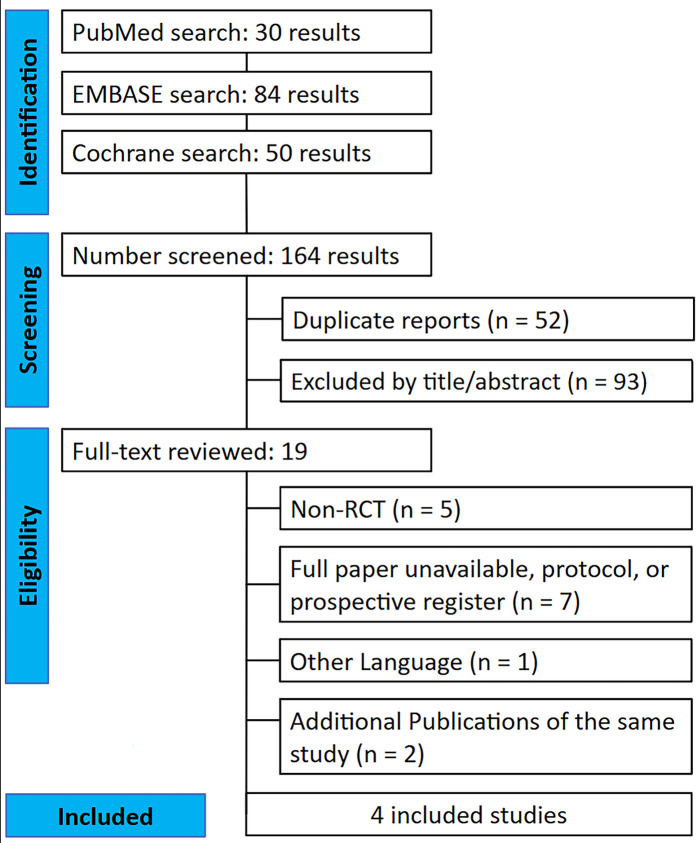
MEDLINE, Embase, and Cochrane databases were systematically searched for studies of deceased organ donors who underwent hypothermia or normothermia prior to kidney transplantation. Statistical analysis was performed using R Studio version 3.6. Heterogeneity was assessed using statistics and a Baujat Plot.
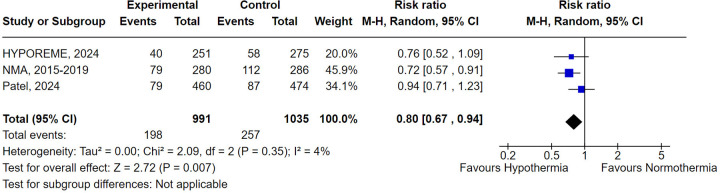
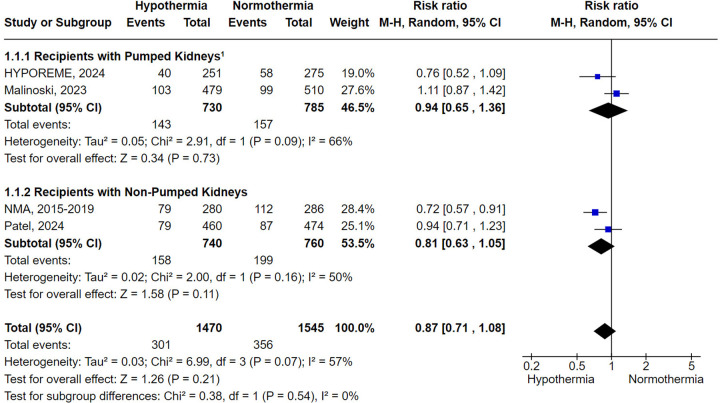
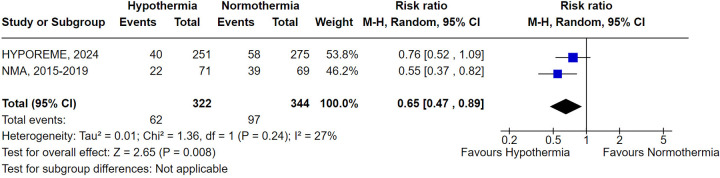
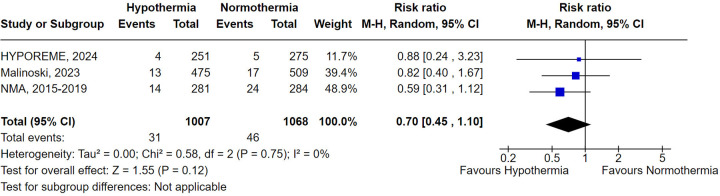
Four different RCTs were analyzed, including more than 3,000 recipients. Donor hypothermia was associated with a lower, but not statistically significant, rate of DGF (RR 0.87; 95% CI 0.71-1.08; = .21) and graft failure (RR 0.70; 95% CI 0.45-1.10; = .12). When analyzing only expanded criteria donors, a significantly lower rate of DGF was observed in the hypothermia-treated group (RR 0.65; 95% CI 0.47-0.89; = .008). Sensitivity analysis identified one study as an outlier, probably due to protocol deviation. When excluded from the analysis, a significant reduction in DGF rate was observed among the hypothermia-treated group (RR 0.80; 95% CI 0.67-0.94; = .007).
Our meta-analysis could not find a statistical difference between donor therapeutic hypothermia and normothermia in preventing DGF or Graft Failure. However, these results may be influenced by outliers and the limitations of the included studies. Further research is needed to clarify the role of donor hypothermia in kidney transplantation. If proven beneficial, it could be a promising alternative to sites where preservation techniques are limited, such as low-income countries.
https://www.crd.york.ac.uk/PROSPERO/view/CRD42024581665, PROSPERO (CRD42024581665).
器官短缺仍是当今全球最具挑战性的问题之一。在以往试验中,与常温相比,供体治疗性低温被认为可降低肾脏延迟移植功能(DGF),但这种干预措施的作用仍存在争议。为评估这一点,我们对研究供体低温在DGF发生率和移植失败方面益处的随机临床试验(RCT)进行了系统评价和荟萃分析。
系统检索MEDLINE、Embase和Cochrane数据库,以查找在肾脏移植前接受低温或常温处理的已故器官供体的研究。使用R Studio 3.6版本进行统计分析。使用I²统计量和Baujat图评估异质性。
分析了四项不同的RCT,包括3000多名接受者。供体低温与较低但无统计学意义的DGF发生率(RR 0.87;95% CI 0.71 - 1.08;I² = 0.21)和移植失败率(RR 0.70;95% CI 0.45 - 1.10;I² = 0.12)相关。仅分析扩大标准供体时,低温治疗组的DGF发生率显著较低(RR 0.65;95% CI 0.47 - 0.89;I² = 0.008)。敏感性分析确定一项研究为异常值,可能是由于方案偏差。从分析中排除该研究后,低温治疗组的DGF发生率显著降低(RR 0.80;95% CI 0.67 - 0.94;I² = 0.007)。
我们的荟萃分析未发现供体治疗性低温与常温在预防DGF或移植失败方面存在统计学差异。然而,这些结果可能受到异常值和纳入研究局限性的影响。需要进一步研究以阐明供体低温在肾脏移植中的作用。如果证明有益,它可能是保存技术有限地区(如低收入国家)的一种有前景的替代方法。
https://www.crd.york.ac.uk/PROSPERO/view/CRD42024581665,PROSPERO(CRD42024581665)