
预测胶质母细胞瘤患者总生存期和癌症特异性生存期的列线图模型的开发与验证
Development and validation of nomogram model predicting overall survival and cancer specific survival in glioblastoma patients.
作者信息
Mu Yingming, Luo Junchi, Xiong Tao, Zhang Junheng, Lan Jinhai, Zhang Jiqin, Tan Ying, Yang Sha
机构信息
Department of General Neurology, Ziyun Miao Buyi Autonomous County People's Hospital, Guiyang, China.
Department of Neurosurgery, Guizhou Provincial People's Hospital, Guiyang, China.
出版信息
Discov Oncol. 2025 Apr 18;16(1):562. doi: 10.1007/s12672-025-02331-7.
BACKGROUND
Identifying the incidence and risk factors of Glioblastoma (GBM) and establishing effective predictive models will benefit the management of these patients.
METHODS
Using GBM data from the Surveillance, Epidemiology, and End Results (SEER) database, we used Joinpoint software to assess trends in GBM incidence across populations of different age groups. Subsequently, we identified important prognostic factors by stepwise regression and multivariate Cox regression analysis, and established a Nomogram mathematical model. COX regression model combined with restricted cubic splines (RCS) model was used to analyze the relationship between tumor size and prognosis of GBM patients.
RESULTS
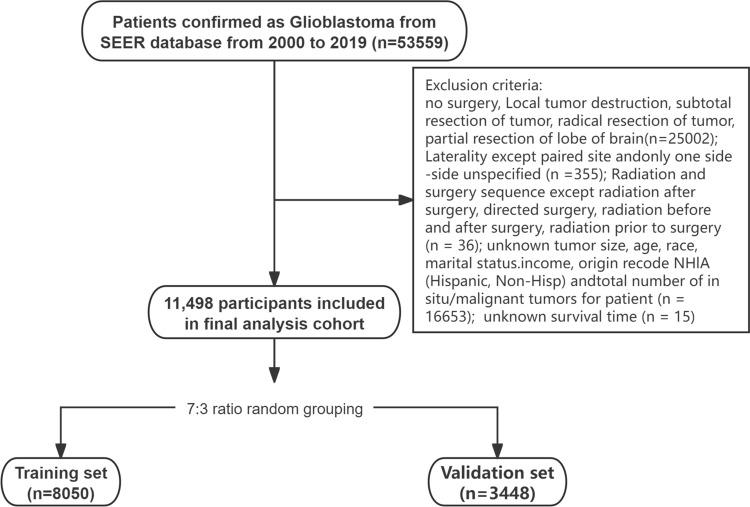
The incidence of GBM has been on the rise since 1978, especially in the age group of 65-84 years. 11498 patients with GBM were included in our study. The multivariate Cox analysis revealed that age, tumor size, sex, primary tumor site, laterality, number of primary tumors, surgery, chemotherapy, radiotherapy, systematic therapy, marital status, median household income, first malignant primary indicator were independent prognostic factors of overall survival (OS) for GBMs. For cancer-specific survival (CSS), race is also independent prognostic factors. Additionally, risk of poor prognosis increased significantly with tumor size in patients with tumors smaller than 49 mm. Moreover, our nomogram model showed favorable discriminative ability.
CONCLUSION
At the population level, the incidence of GBM is on the rise. The relationship between tumor size and patient prognosis is still worthy of further study. Moreover, the proposed nomogram with good performance was constructed and verified to predict the OS and CSS of patients with GBM.
背景
确定胶质母细胞瘤(GBM)的发病率和危险因素并建立有效的预测模型将有助于这些患者的管理。
方法
利用监测、流行病学和最终结果(SEER)数据库中的GBM数据,我们使用Joinpoint软件评估不同年龄组人群中GBM发病率的趋势。随后,我们通过逐步回归和多变量Cox回归分析确定重要的预后因素,并建立了列线图数学模型。使用Cox回归模型结合限制性立方样条(RCS)模型分析GBM患者肿瘤大小与预后的关系。
结果
自1978年以来,GBM的发病率一直在上升,尤其是在65 - 84岁年龄组。我们的研究纳入了11498例GBM患者。多变量Cox分析显示,年龄、肿瘤大小、性别、原发肿瘤部位、侧别、原发肿瘤数量、手术、化疗、放疗、系统治疗、婚姻状况、家庭收入中位数、首个恶性原发指标是GBM总生存期(OS)的独立预后因素。对于癌症特异性生存期(CSS),种族也是独立预后因素。此外,肿瘤小于49 mm的患者中,预后不良风险随肿瘤大小显著增加。而且,我们的列线图模型显示出良好的判别能力。
结论
在人群水平上,GBM的发病率在上升。肿瘤大小与患者预后的关系仍值得进一步研究。此外,构建并验证了性能良好的列线图以预测GBM患者的OS和CSS。



 Zotero 插件