• 文献检索
  • 文档翻译
  • 深度研究
  • 学术资讯
  • Suppr Zotero 插件Zotero 插件
  • 邀请有礼
  • 套餐&价格
  • 历史记录
应用&插件
Suppr Zotero 插件Zotero 插件浏览器插件Mac 客户端Windows 客户端微信小程序
定价
高级版会员购买积分包购买API积分包
服务
文献检索文档翻译深度研究API 文档MCP 服务
关于我们
关于 Suppr公司介绍联系我们用户协议隐私条款
关注我们

Suppr 超能文献

核心技术专利:CN118964589B侵权必究
粤ICP备2023148730 号-1Suppr @ 2026

文献检索

告别复杂PubMed语法,用中文像聊天一样搜索,搜遍4000万医学文献。AI智能推荐,让科研检索更轻松。

立即免费搜索

文件翻译

保留排版,准确专业,支持PDF/Word/PPT等文件格式,支持 12+语言互译。

免费翻译文档

深度研究

AI帮你快速写综述,25分钟生成高质量综述,智能提取关键信息,辅助科研写作。

立即免费体验

使用动态因素预测支气管肺发育不良的机器学习模型的开发与外部验证

Development and external validation of a machine learning model to predict bronchopulmonary dysplasia using dynamic factors.

作者信息

Choi Ho Jung, Lee Garam, Shin Seung Han, Lee Seung Mi, Lee Hyung-Chul, Sohn Jin A, Lee Jin A, Kim Han-Suk

机构信息

Department of Pediatrics, Seoul National University College of Medicine, Seoul, Korea.

Department of Pediatrics, Seoul Metropolitan Government Seoul National University Boramae Medical Center, Seoul, South Korea.

出版信息

Sci Rep. 2025 Apr 19;15(1):13620. doi: 10.1038/s41598-025-98087-9.

DOI:10.1038/s41598-025-98087-9
PMID:40253571
原文链接:https://pmc.ncbi.nlm.nih.gov/articles/PMC12009281/
Abstract

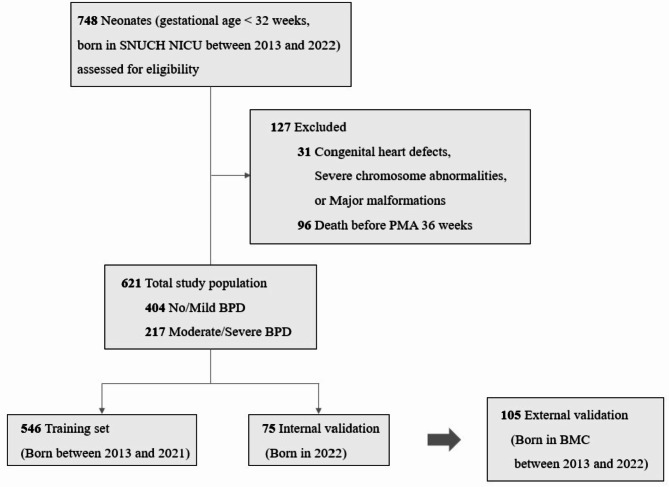
We hypothesized that incorporating postnatal dynamic factors would enhance the prediction accuracy of bronchopulmonary dysplasia in preterm infants. This retrospective cohort study included neonates born before 32 weeks of gestation at Seoul National University Hospital between 2013 and 2022. The primary outcome was moderate or severe bronchopulmonary dysplasia. We assessed both static perinatal risk factors and dynamic factors, such as respiratory support type, inspired oxygen concentration, and blood gas analysis results within the first 7 days. The model was developed using data from 546 infants born between 2013 and 2021, with internal validation on 75 infants born in 2022. External validation was based on 105 infants recruited at the Boramae Medical Center. The integrated prediction model, combining static and dynamic factors, showed superior predictive performance, with an area under the receiver operating characteristic curve (AUROC) of 0.841 in the development set, outperforming the static perinatal factor model. Internal validation confirmed the robustness of the integrated model (AUROC: 0.912 vs. 0.805, p < 0.0001). The performance was maintained in the external validation (AUROC: 0.814). Incorporating early respiratory support and blood gas analysis into predictive models substantially improved the accuracy of bronchopulmonary dysplasia prediction in preterm infants.

摘要

我们假设纳入出生后的动态因素会提高早产儿支气管肺发育不良的预测准确性。这项回顾性队列研究纳入了2013年至2022年期间在首尔国立大学医院出生的孕周小于32周的新生儿。主要结局是中度或重度支气管肺发育不良。我们评估了静态围产期危险因素和动态因素,如呼吸支持类型、吸入氧浓度以及出生后7天内的血气分析结果。该模型使用2013年至2021年出生的546例婴儿的数据开发,并在2022年出生的75例婴儿中进行了内部验证。外部验证基于在博拉梅医疗中心招募的105例婴儿。结合静态和动态因素的综合预测模型显示出卓越的预测性能,在开发集中受试者操作特征曲线下面积(AUROC)为0.841,优于静态围产期因素模型。内部验证证实了综合模型的稳健性(AUROC:0.912对0.805,p < 0.0001)。在外部验证中该性能得以维持(AUROC:0.814)。将早期呼吸支持和血气分析纳入预测模型可显著提高早产儿支气管肺发育不良预测的准确性。
https://cdn.ncbi.nlm.nih.gov/pmc/blobs/daf2/12009281/17fff5631d50/41598_2025_98087_Fig3_HTML.jpg
https://cdn.ncbi.nlm.nih.gov/pmc/blobs/daf2/12009281/41e2d75e86de/41598_2025_98087_Fig1_HTML.jpg
https://cdn.ncbi.nlm.nih.gov/pmc/blobs/daf2/12009281/17c3d1a39df4/41598_2025_98087_Fig2_HTML.jpg
https://cdn.ncbi.nlm.nih.gov/pmc/blobs/daf2/12009281/17fff5631d50/41598_2025_98087_Fig3_HTML.jpg
https://cdn.ncbi.nlm.nih.gov/pmc/blobs/daf2/12009281/41e2d75e86de/41598_2025_98087_Fig1_HTML.jpg
https://cdn.ncbi.nlm.nih.gov/pmc/blobs/daf2/12009281/17c3d1a39df4/41598_2025_98087_Fig2_HTML.jpg
https://cdn.ncbi.nlm.nih.gov/pmc/blobs/daf2/12009281/17fff5631d50/41598_2025_98087_Fig3_HTML.jpg

相似文献

1
Development and external validation of a machine learning model to predict bronchopulmonary dysplasia using dynamic factors.使用动态因素预测支气管肺发育不良的机器学习模型的开发与外部验证
Sci Rep. 2025 Apr 19;15(1):13620. doi: 10.1038/s41598-025-98087-9.
2
Comparison of lung ultrasound scores with clinical models for predicting bronchopulmonary dysplasia.肺超声评分与临床模型预测支气管肺发育不良的比较。
Eur J Pediatr. 2023 Apr;182(4):1697-1705. doi: 10.1007/s00431-023-04847-y. Epub 2023 Feb 9.
3
Machine learning for prediction of bronchopulmonary dysplasia-free survival among very preterm infants.机器学习预测极早产儿支气管肺发育不良无生存时间。
BMC Pediatr. 2022 Sep 13;22(1):542. doi: 10.1186/s12887-022-03602-w.
4
Correlation between early postnatal body weight changes and lung ultrasound scores as predictors of bronchopulmonary dysplasia in preterm infants: A secondary analysis of a prospective study.早产儿生后早期体质量变化与肺部超声评分的相关性及其对支气管肺发育不良的预测价值:一项前瞻性研究的二次分析。
Eur J Pediatr. 2024 May;183(5):2123-2130. doi: 10.1007/s00431-024-05464-z. Epub 2024 Feb 16.
5
Prediction of bronchopulmonary dysplasia by postnatal age in extremely premature infants.预测极早产儿支气管肺发育不良的出生后年龄。
Am J Respir Crit Care Med. 2011 Jun 15;183(12):1715-22. doi: 10.1164/rccm.201101-0055OC. Epub 2011 Mar 4.
6
[Establishment and efficiency test of a clinical prediction model of bronchopulmonary dysplasia associated pulmonary hypertension in very premature infants].[极早产儿支气管肺发育不良相关肺动脉高压临床预测模型的建立及效能验证]
Zhonghua Er Ke Za Zhi. 2024 Feb 2;62(2):129-137. doi: 10.3760/cma.j.cn112140-20230912-00178.
7
Clinical prediction models for bronchopulmonary dysplasia: a systematic review and external validation study.临床预测模型在支气管肺发育不良中的应用:系统评价和外部验证研究。
BMC Pediatr. 2013 Dec 17;13:207. doi: 10.1186/1471-2431-13-207.
8
Physiology and Predictors of Impaired Gas Exchange in Infants with Bronchopulmonary Dysplasia.支气管肺发育不良婴儿气体交换受损的生理学及预测因素。
Am J Respir Crit Care Med. 2019 Aug 15;200(4):471-480. doi: 10.1164/rccm.201810-2037OC.
9
Construction of early risk prediction models for bronchopulmonary dysplasia in preterm infants.建立早产儿支气管肺发育不良的早期风险预测模型。
Zhongguo Dang Dai Er Ke Za Zhi. 2021 Oct 15;23(10):994-1001. doi: 10.7499/j.issn.1008-8830.2107035.
10
Survival without Bronchopulmonary Dysplasia of Extremely Preterm Infants: A Predictive Model at Birth.极早产儿生存而无支气管肺发育不良:出生时的预测模型。
Neonatology. 2021;118(4):385-393. doi: 10.1159/000515898. Epub 2021 May 18.

本文引用的文献

1
Machine learning predictive models for grading bronchopulmonary dysplasia: umbilical cord blood IL-6 as a biomarker.用于支气管肺发育不良分级的机器学习预测模型:脐带血白细胞介素-6作为生物标志物
Front Pediatr. 2023 Dec 15;11:1301376. doi: 10.3389/fped.2023.1301376. eCollection 2023.
2
Postnatal Corticosteroids to Prevent or Treat Chronic Lung Disease Following Preterm Birth.早产儿出生后用皮质类固醇预防或治疗慢性肺病。
Pediatrics. 2022 Jun 1;149(6). doi: 10.1542/peds.2022-057530.
3
Two-stage learning-based prediction of bronchopulmonary dysplasia in very low birth weight infants: a nationwide cohort study.
基于两阶段学习的极低出生体重儿支气管肺发育不良预测:一项全国性队列研究
Front Pediatr. 2023 Jun 13;11:1155921. doi: 10.3389/fped.2023.1155921. eCollection 2023.
4
Cardiorespiratory Monitoring Data to Predict Respiratory Outcomes in Extremely Preterm Infants.心肺监测数据预测极早产儿的呼吸结局。
Am J Respir Crit Care Med. 2023 Jul 1;208(1):79-97. doi: 10.1164/rccm.202210-1971OC.
5
Prediction Models for Bronchopulmonary Dysplasia in Preterm Infants: A Systematic Review and Meta-Analysis.早产儿支气管肺发育不良的预测模型:一项系统评价和荟萃分析。
J Pediatr. 2023 Jul;258:113370. doi: 10.1016/j.jpeds.2023.01.024. Epub 2023 Apr 13.
6
Bronchopulmonary dysplasia prediction models: a systematic review and meta-analysis with validation.支气管肺发育不良预测模型:系统评价和荟萃分析及验证。
Pediatr Res. 2023 Jul;94(1):43-54. doi: 10.1038/s41390-022-02451-8. Epub 2023 Jan 9.
7
Machine learning for prediction of bronchopulmonary dysplasia-free survival among very preterm infants.机器学习预测极早产儿支气管肺发育不良无生存时间。
BMC Pediatr. 2022 Sep 13;22(1):542. doi: 10.1186/s12887-022-03602-w.
8
Online clinical tool to estimate risk of bronchopulmonary dysplasia in extremely preterm infants.评估极早产儿支气管肺发育不良风险的在线临床工具。
Arch Dis Child Fetal Neonatal Ed. 2022 Jun 21. doi: 10.1136/archdischild-2021-323573.
9
Prediction Models for Bronchopulmonary Dysplasia in Preterm Infants: A Systematic Review.早产儿支气管肺发育不良的预测模型:一项系统评价。
Front Pediatr. 2022 May 12;10:856159. doi: 10.3389/fped.2022.856159. eCollection 2022.
10
Association between bronchopulmonary dysplasia and early respiratory morbidity in children with respiratory distress syndrome: a case-control study using nationwide data.支气管肺发育不良与呼吸窘迫综合征患儿早期呼吸系统发病率的关系:基于全国数据的病例对照研究。
Sci Rep. 2022 May 9;12(1):7578. doi: 10.1038/s41598-022-11657-z.