
斯格明子袋的可控形成
Controlled Formation of Skyrmion Bags.
作者信息
Kern Lisa-Marie, Kuchkin Vladyslav M, Deinhart Victor, Klose Christopher, Sidiropoulos Themistoklis, Auer Maike, Gaebel Simon, Gerlinger Kathinka, Battistelli Riccardo, Wittrock Steffen, Karaman Tamer, Schneider Michael, Günther Christian M, Engel Dieter, Will Ingo, Wintz Sebastian, Weigand Markus, Büttner Felix, Höflich Katja, Eisebitt Stefan, Pfau Bastian
机构信息
Max Born Institute for Nonlinear Optics and Short Pulse Spectroscopy, 12489, Berlin, Germany.
Department of Physics and Materials Science, University of Luxembourg, Luxembourg, L-1511, Luxembourg.
出版信息
Adv Mater. 2025 Jul;37(29):e2501250. doi: 10.1002/adma.202501250. Epub 2025 Apr 21.
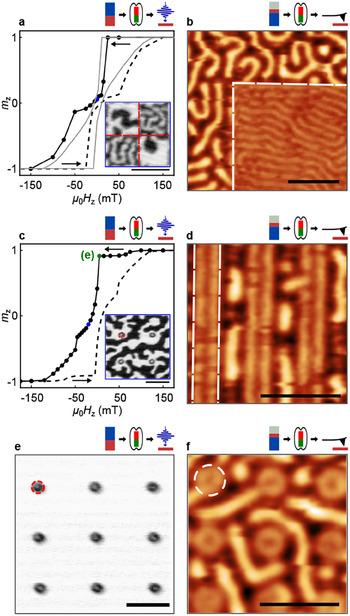
Topologically non-trivial magnetic solitons are complex spin textures with a distinct single-particle nature. Although magnetic skyrmions, especially those with unity topological charge, have attracted substantial interest due to their potential applications, more complex topological textures remain largely theoretical. In this work, the stabilization of isolated higher-order skyrmion bags beyond the prototypical π-skyrmion in ferromagnetic thin films is experimentally demonstrate, which has posed considerable challenges to date. Specifically, controlled generation of skyrmionium (2π-skyrmion), target skyrmion (3π-skyrmion), and skyrmion bags (with variable topological charge) are achieved through the introduction of artificially engineered anisotropy defects via local ion irradiation. They act as preferential sites for the field- or laser-induced nucleation of skyrmion bags. Remarkably, ultrafast laser pulses achieve a substantially higher conversion rate transforming skyrmions into higher-order skyrmion bags compared to their formation driven by magnetic fields. High-resolution x-ray imaging enables direct observation of the resulting skyrmion bags. Complementary micromagnetic simulations reveal the pivotal role of defect geometry-particularly diameter-in stabilizing closed-loop domain textures. The findings not only broaden the experimental horizon for skyrmion research, but also suggest strategies for exploiting complex topological spin textures within a unified material platform for practical applications.
拓扑非平凡磁孤子是具有独特单粒子性质的复杂自旋纹理。尽管磁斯格明子,尤其是那些拓扑电荷为1的磁斯格明子,因其潜在应用而引起了广泛关注,但更复杂的拓扑纹理在很大程度上仍停留在理论层面。在这项工作中,实验证明了铁磁薄膜中超越典型π斯格明子的孤立高阶斯格明子袋的稳定性,这在迄今为止一直是相当大的挑战。具体而言,通过局部离子辐照引入人工设计的各向异性缺陷,实现了斯格明子团(2π斯格明子)、目标斯格明子(3π斯格明子)和斯格明子袋(具有可变拓扑电荷)的可控生成。这些缺陷充当了场诱导或激光诱导斯格明子袋成核的优先位点。值得注意的是,与磁场驱动形成斯格明子袋相比,超快激光脉冲将斯格明子转化为高阶斯格明子袋的转化率要高得多。高分辨率x射线成像能够直接观察生成的斯格明子袋。补充的微磁模拟揭示了缺陷几何形状(特别是直径)在稳定闭环畴纹理中的关键作用。这些发现不仅拓宽了斯格明子研究的实验视野,还为在统一材料平台内利用复杂拓扑自旋纹理进行实际应用提供了策略。




 Zotero 插件