Jajosky Ryan P, Covington Mischa L, Liu Jun, Chai Li, Zerra Patricia E, Chonat Satheesh, Stowell Sean R, Arthur Connie M
Joint Program in Transfusion Medicine, Department of Pathology, Brigham and Women's Hospital, Harvard Medical School, Boston, MA, United States.
Harvard Glycomics Center, Harvard Medical School, Boston, MA, United States.
Front Immunol. 2025 Apr 4;16:1548548. doi: 10.3389/fimmu.2025.1548548. eCollection 2025.
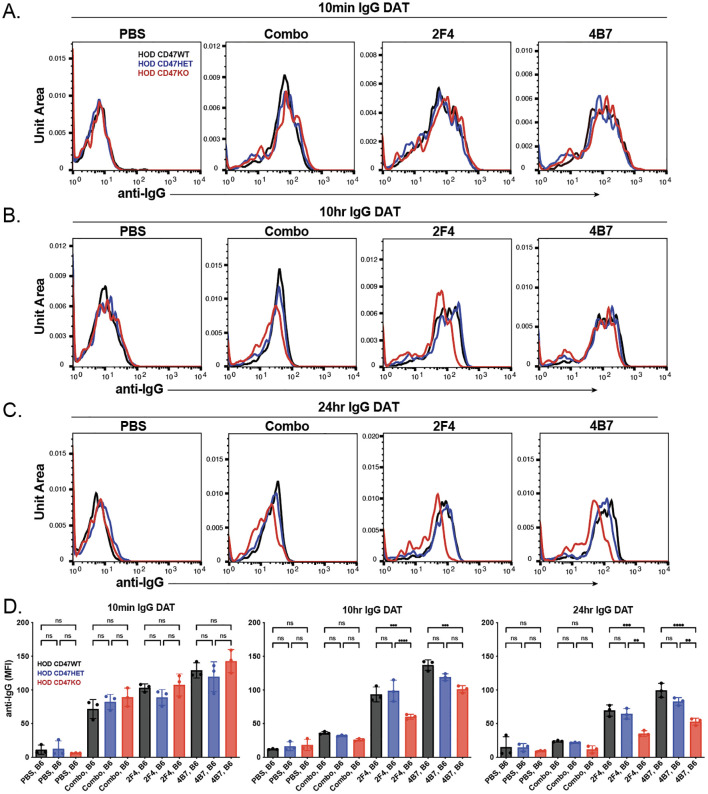
Red blood cell (RBC) alloantibodies can result in the rapid removal of incompatible RBCs following transfusion. However, antibody-mediated clearance of RBCs is not the inevitable outcome of an incompatible transfusion. Antibody engagement can also result in the modulation of the target antigen, often rendering RBCs resistant to antibody-mediated removal. Despite this, the factors that regulate antibody-induced RBC removal or antigen modulation remain incompletely understood. Given the ability of CD47 to regulate RBC survival in general, we examined the possible role of CD47 in governing antibody-mediated RBC clearance and antigen modulation. This was achieved by crossing the well-established HEL-OVA-Duffy (HOD) mouse model with CD47 knockout (KO) mice to generate offspring that express the HOD antigen and either WT (HOD CD47 WT), heterozygote (HOD CD47 HET) or KO (HOD CD47 KO) levels of CD47. Using the commonly employed anti-HEL immunization model, our results demonstrate that while antibody engagement of HOD CD47 WT RBCs resulted in rapid antigen modulation in the absence of detectable RBC clearance, antibody binding to HOD CD47 HET RBCs did result in detectable RBC removal despite similar rates and overall levels of antigen modulation. In contrast, despite accelerated clearance of HOD CD47 KO RBCs in the absence of anti-HEL antibodies, the rate of RBC removal and antigen modulation was enhanced in the presence of anti-HEL antibodies. Taken together, these results suggest a role for CD47 in regulating the overall consequence of an incompatible RBC transfusion.
红细胞(RBC)同种抗体可导致输血后不相容红细胞的快速清除。然而,抗体介导的红细胞清除并非不相容输血的必然结果。抗体结合也可导致靶抗原的调节,通常使红细胞对抗体介导的清除产生抗性。尽管如此,调节抗体诱导的红细胞清除或抗原调节的因素仍未完全了解。鉴于CD47总体上具有调节红细胞存活的能力,我们研究了CD47在控制抗体介导的红细胞清除和抗原调节中的可能作用。这是通过将成熟的HEL-OVA-达菲(HOD)小鼠模型与CD47基因敲除(KO)小鼠杂交,以产生表达HOD抗原且具有野生型(HOD CD47 WT)、杂合子(HOD CD47 HET)或KO(HOD CD47 KO)水平CD47的后代来实现的。使用常用的抗HEL免疫模型,我们的结果表明,虽然HOD CD47 WT红细胞的抗体结合在没有可检测到的红细胞清除的情况下导致快速的抗原调节,但与HOD CD47 HET红细胞的抗体结合尽管抗原调节的速率和总体水平相似,但确实导致了可检测到的红细胞清除。相比之下,尽管在没有抗HEL抗体的情况下HOD CD47 KO红细胞的清除加速,但在存在抗HEL抗体的情况下,红细胞清除率和抗原调节率均有所提高。综上所述,这些结果表明CD47在调节不相容红细胞输血的总体后果中发挥作用。