
猕猴膝下扣带回和背外侧前额叶皮质中突触外NMDAR-GluN2B表达的对比模式。
Contrasting patterns of extrasynaptic NMDAR-GluN2B expression in macaque subgenual cingulate and dorsolateral prefrontal cortices.
作者信息
Joyce Mary Kate P, Datta Dibyadeep, Arellano Jon I, Duque Alvaro, Morozov Yury M, Morrison John H, Arnsten Amy F T
机构信息
Department of Neuroscience, Yale Medical School, New Haven, CT, United States.
Department of Psychiatry, Yale Medical School, New Haven, CT, United States.
出版信息
Front Neuroanat. 2025 Apr 4;19:1553056. doi: 10.3389/fnana.2025.1553056. eCollection 2025.
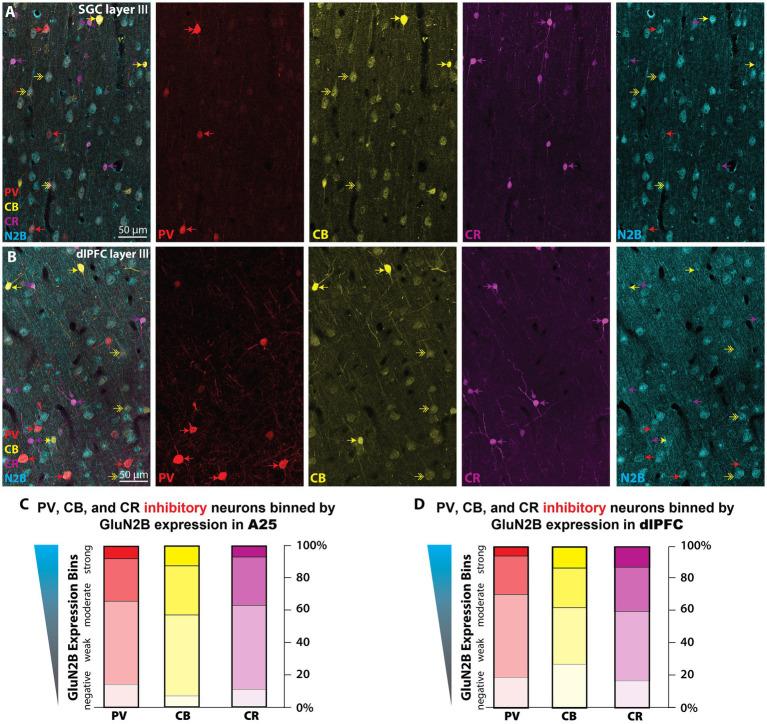
Expression of the N-methyl-D-aspartate receptor, particularly when containing the GluN2B subunit (NMDAR-GluN2B), varies across the prefrontal cortex (PFC). In humans, the subgenual cingulate cortex (SGC) contains among the highest levels of NMDAR-GluN2B expression, while the dorsolateral prefrontal cortex (dlPFC) exhibits a more moderate level of NMDAR-GluN2B expression. NMDAR-GluN2B are commonly associated with ionotropic synaptic function and plasticity and are essential to the neurotransmission underlying working memory in the macaque dlPFC in the layer III circuits, which in humans are afflicted in schizophrenia. However, NMDAR-GluN2B can also be found at extrasynaptic sites, where they may trigger distinct events, including some linked to neurodegenerative processes. The SGC is an early site of tau pathology in sporadic Alzheimer's disease (sAD), which mirrors its high NMDAR-GluN2B expression. Additionally, the SGC is hyperactive in depression, which can be treated with NMDAR antagonists. Given the clinical relevance of NMDAR in the SGC and dlPFC, the current study used immunoelectron microscopy (immunoEM) to quantitatively compare the synaptic and extrasynaptic expression patterns of NMDAR-GluN2B across excitatory and inhibitory neuron dendrites in rhesus macaque layer III SGC and dlPFC. We found a larger population of extrasynaptic NMDAR-GluN2B in dendrites of putative pyramidal neurons in SGC as compared to the dlPFC, while the dlPFC had a higher proportion of synaptic NMDAR-GluN2B. In contrast, in putative inhibitory dendrites from both areas, extrasynaptic expression of NMDAR-GluN2B was far more frequently observed over synaptic expression. These findings may provide insight into varying cortical vulnerability to alterations in excitability and neurodegenerative forces.
N-甲基-D-天冬氨酸受体(N-methyl-D-aspartate receptor,NMDAR)的表达,尤其是含有GluN2B亚基(NMDAR-GluN2B)时,在额叶前皮质(prefrontal cortex,PFC)中存在差异。在人类中,膝下扣带回皮质(subgenual cingulate cortex,SGC)含有最高水平的NMDAR-GluN2B表达,而背外侧前额叶皮质(dorsolateral prefrontal cortex,dlPFC)的NMDAR-GluN2B表达水平则较为适中。NMDAR-GluN2B通常与离子型突触功能和可塑性相关,并且对于猕猴dlPFC第III层回路中工作记忆的神经传递至关重要,而在人类中,该回路在精神分裂症中会受到影响。然而,NMDAR-GluN2B也可以在突触外位点被发现,在那里它们可能引发不同的事件,包括一些与神经退行性过程相关的事件。SGC是散发性阿尔茨海默病(sporadic Alzheimer's disease,sAD)中tau病理的早期位点,这反映了其高NMDAR-GluN2B表达。此外,SGC在抑郁症中表现为过度活跃,而抑郁症可以用NMDAR拮抗剂进行治疗。鉴于NMDAR在SGC和dlPFC中的临床相关性,本研究使用免疫电子显微镜(immunoelectron microscopy,immunoEM)定量比较了恒河猴第III层SGC和dlPFC中兴奋性和抑制性神经元树突上NMDAR-GluN2B的突触和突触外表达模式。我们发现,与dlPFC相比,SGC中假定锥体神经元树突上的突触外NMDAR-GluN2B数量更多,而dlPFC中突触NMDAR-GluN2B的比例更高。相反,在这两个区域的假定抑制性树突中,NMDAR-GluN2B的突触外表达远比突触表达更为常见。这些发现可能有助于深入了解不同皮质对兴奋性改变和神经退行性力量的易感性差异。


 Zotero 插件