Che Anluzi, Si Si, Liu Jing
Department of Obstetrics, Shunyi Women's and Children's Hospital of Beijing Children's Hospital, Beijing, China.
Department of Obstetrics, The First Hospital of China Medical University, No. 155 Nanjing North Street, Heping District, Shenyang, 110001, Liaoning Province, China.
BMC Pregnancy Childbirth. 2025 Apr 21;25(1):461. doi: 10.1186/s12884-025-07592-2.
Prelabor rupture of membranes (PROM) complicates 8% of pregnancies, often necessitating labor induction to prevent maternal and neonatal complications. Misoprostol, a cost-effective prostaglandin, has been proposed as an alternative to oxytocin for labor induction in PROM cases, but its efficacy and safety remain debated.
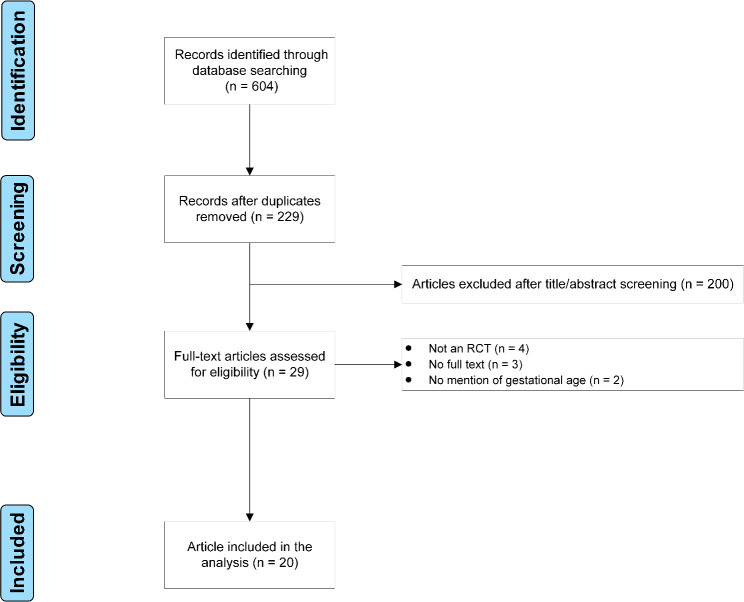
The PubMed, Web of science, Embase, Google scholar, ClinicalTrials.gov, and Cochrane Library databases were searched on January 25, 2025. Randomized controlled trials (RCTs) comparing misoprostol and oxytocin for labor induction in term PROM were eligible. The primary outcomes were vaginal birth within 24 h and the induction to delivery interval. Secondary outcomes included the duration of second stage of labor, the induction to active labor, cesarean section, postpartum hemorrhage (PPH), and other maternal/neonatal complications.
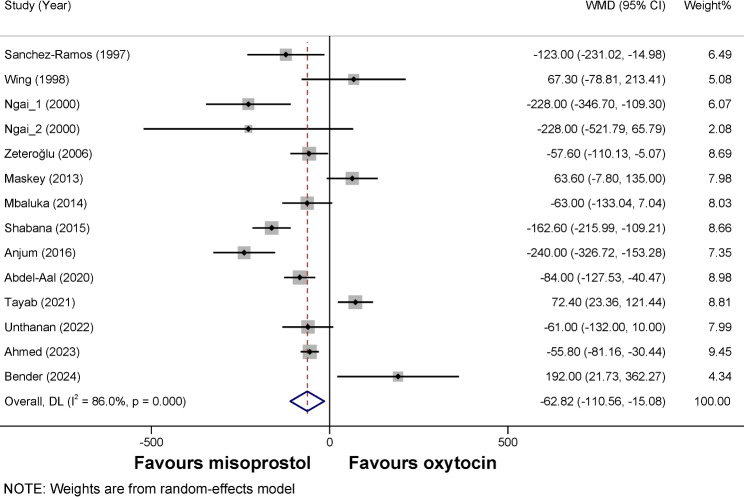
Data from 20 RCTs involving 2,980 participants were analyzed. Misoprostol significantly reduced the induction-to-delivery interval and the duration of the second stage of labor compared to oxytocin (WMD = -62.82, 95% CI (-110.56, -15.08); WMD = -4.29, 95% CI (-8.05, -0.52), respectively). It also lowered the risk of PPH (OR = 0.63, 95% CI (0.41, 0.98)). However, no significant differences were found in other outcomes between misoprostol and oxytocin.
Misoprostol is a viable alternative to oxytocin for labor induction in PROM, offering shorter labor durations and reduced PPH risk without compromising maternal and neonatal outcomes. Further researches are needed to optimize dosing, administration routes, and assess maternal satisfaction.
胎膜早破(PROM)使8%的妊娠复杂化,通常需要引产以预防母婴并发症。米索前列醇是一种具有成本效益的前列腺素,已被提议作为PROM病例引产时催产素的替代药物,但其疗效和安全性仍存在争议。
于2025年1月25日检索了PubMed、科学网、Embase、谷歌学术、ClinicalTrials.gov和Cochrane图书馆数据库。比较米索前列醇和催产素用于足月PROM引产的随机对照试验(RCT)符合纳入标准。主要结局为24小时内阴道分娩和引产至分娩间隔。次要结局包括第二产程持续时间、引产至活跃期、剖宫产、产后出血(PPH)以及其他母婴并发症。
分析了来自20项RCT的2980名参与者的数据。与催产素相比,米索前列醇显著缩短了引产至分娩间隔和第二产程持续时间(加权均数差分别为-62.82,95%置信区间(-110.56,-15.08);-4.29,95%置信区间(-8.05,-0.52))。它还降低了PPH的风险(比值比=0.63,95%置信区间(0.41,0.98))。然而,米索前列醇和催产素在其他结局方面未发现显著差异。
米索前列醇是PROM引产时催产素的一种可行替代药物,可缩短产程并降低PPH风险,且不影响母婴结局。需要进一步研究以优化给药剂量、给药途径并评估产妇满意度。