Ehret Felix, Yuan Ammy M, Marciscano Ariel E, Zieminski Stephen, Leland Peggy A, Khandekar Melin J, Oh Kevin S, Shih Helen A
Department of Radiation Oncology, Massachusetts General Hospital, Harvard Medical School, Boston, MA, USA.
Charité - Universitätsmedizin Berlin, Corporate Member of Freie Universität Berlin and Humboldt-Universität zu Berlin, Department of Radiation Oncology, Berlin, Germany.
Radiat Oncol. 2025 Apr 22;20(1):61. doi: 10.1186/s13014-025-02618-7.
Leptomeningeal disease (LMD) is a fatal complication of cancer linked to poor survival rates and limited treatment options. While photon involved-field radiotherapy is the standard of care for local palliation and symptom alleviation, it lacks durable disease control. Recent data suggest proton craniospinal irradiation (pCSI) to be a promising treatment option, potentially prolonging progression-free survival (PFS) and overall survival (OS). Herein, we report our initial experience with pCSI for treating LMD from solid malignancies.
Adult patients treated with pCSI for LMD were identified, with analysis of patient, tumor, and treatment characteristics as well as clinical outcomes.
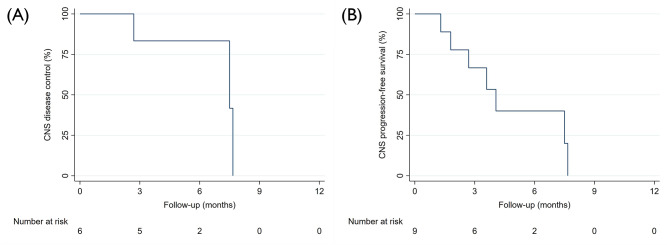
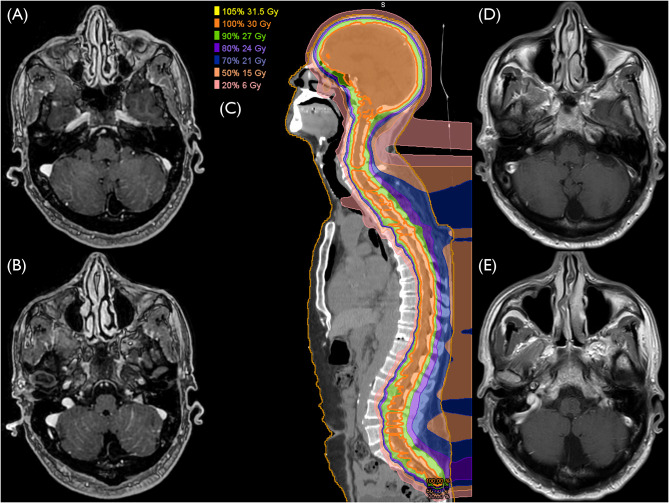
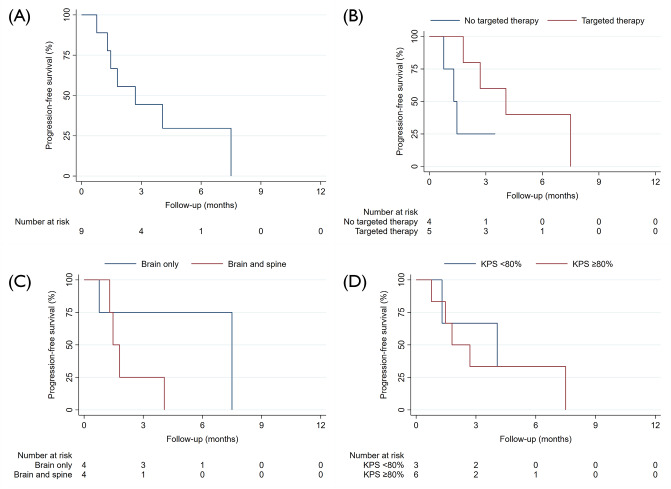
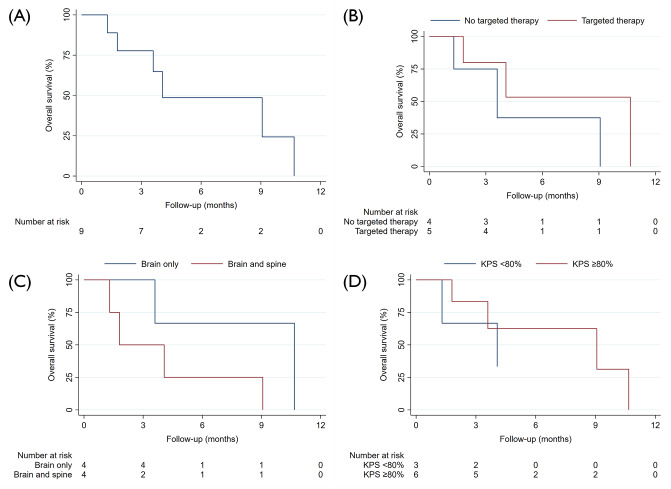
Nine patients were eligible for analysis who were treated between February 2023 and February 2024. The median age at pCSI and Karnofsky performance status (KPS) were 58.6 years and 80%, respectively. The primary disease was breast cancer in 33.3%, and LMD involved both the brain and spine in 55.5%. Approximately half of the patients (55.5%) had a cerebrospinal fluid diversion before treatment, and nearly all patients underwent pCSI with 30 Gy (relative biological effectiveness) in 10 fractions. All patients completed pCSI as planned. The median clinical and central nervous system (CNS) radiographic follow-up periods were both 3.5 months. Six deaths were observed during the available follow-up. The median PFS, CNS PFS, and OS were 2.7, 4.0, and 4.0 months, respectively. Younger age, higher KPS, and concurrent treatment with targeted therapy were associated with longer OS, while cases with LMD involving both the brain and spine had shorter survival. The observed toxicity was manageable, without any occurrence of grade 4 or 5 toxicity.
pCSI can be an effective and safe treatment option for a highly selected population of patients with LMD. Further data and prospective studies are warranted to clarify its role in the management of LMD.
软脑膜疾病(LMD)是癌症的一种致命并发症,与生存率低和治疗选择有限相关。虽然光子累及野放射治疗是局部姑息治疗和症状缓解的标准治疗方法,但它缺乏持久的疾病控制效果。最近的数据表明,质子颅脊柱照射(pCSI)是一种有前景的治疗选择,可能会延长无进展生存期(PFS)和总生存期(OS)。在此,我们报告我们使用pCSI治疗实体恶性肿瘤引起的LMD的初步经验。
确定接受pCSI治疗LMD的成年患者,并分析患者、肿瘤和治疗特征以及临床结局。
9例患者符合分析条件,他们于2023年2月至2024年2月期间接受治疗。pCSI时的中位年龄和卡诺夫斯基性能状态(KPS)分别为58.6岁和80%。原发性疾病为乳腺癌的占33.3%,LMD累及脑和脊柱的占55.5%。大约一半的患者(55.5%)在治疗前进行了脑脊液分流,几乎所有患者都接受了10次分割、30 Gy(相对生物效应)的pCSI。所有患者均按计划完成了pCSI。临床和中枢神经系统(CNS)影像学随访的中位时间均为3.5个月。在可用的随访期间观察到6例死亡。中位PFS、CNS PFS和OS分别为2.7个月、4.0个月和4.0个月。年龄较小、KPS较高以及同时接受靶向治疗与较长的OS相关,而LMD累及脑和脊柱的病例生存期较短。观察到的毒性是可控的,没有发生任何4级或5级毒性。
对于高度选择的LMD患者群体,pCSI可以是一种有效且安全的治疗选择。需要进一步的数据和前瞻性研究来阐明其在LMD管理中的作用。