
睡眠质量对早期肌萎缩侧索硬化症疾病进展的影响
Impact of sleep quality on disease progression in early-stage amyotrophic lateral sclerosis.
作者信息
Zhang Gan, Chen Yong, Tang Lu, Bai Linna, Zhang Hui, Liu Hong, Fan Dongsheng
机构信息
Department of Neurology, Peking University Third Hospital, Beijing, China.
Beijing Key Laboratory of Biomarker and Translational Research in Neurodegenerative Diseases, Beijing, China.
出版信息
Front Neurol. 2025 Apr 10;16:1545463. doi: 10.3389/fneur.2025.1545463. eCollection 2025.
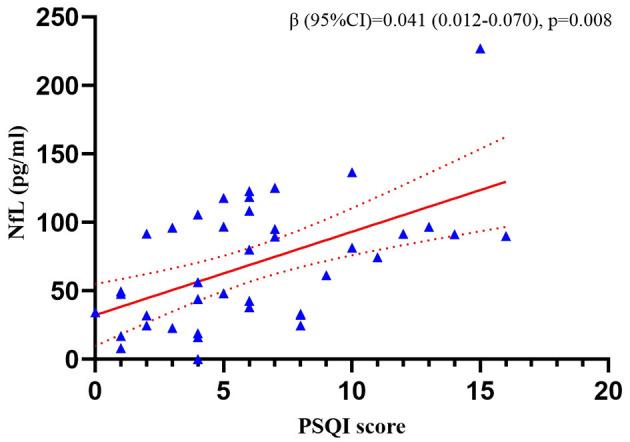
Non-motor symptoms are clinical manifestations of amyotrophic lateral sclerosis (ALS). However, few studies have examined these symptoms in patients with early-stage ALS. We conducted a cross-sectional study to explore non-motor symptoms in 69 patients with ALS within 18 months of disease onset. The Pittsburgh Sleep Quality Index (PSQI), the Epworth Sleepiness Scale (ESS), and the Hospital Anxiety and Depression Scale (HADS) were used to evaluate sleep quality, daytime sleepiness, and anxiety and depression, respectively. Differences in the abovementioned non-motor symptoms between ALS patients and age-/sex-matched caregivers were examined, and correlations between these symptoms and the clinical features of ALS were analyzed. Compared to caregivers, ALS patients were more likely to report poor sleep [odds ratio (OR) and 95% confidence interval (95% CI) = 2.664, 1.276-5.560; = 0.009] and excessive daytime sleepiness (EDS) [OR and 95% CI = 5.135, 1.640-16.072; = 0.005]. The PSQI scores in ALS patients correlated significantly with the disease progression rate [ΔFS = (48-score on the Amyotrophic Lateral Sclerosis Functional Rating Scale-Revised, ALSFRS-R)/disease duration] [β(95% CI) = 2.867 (0.397, 5.336), = 0.024] and plasma neurofilament light chain (NfL) levels [β (95% CI) = 0.041 (0.012, 0.070), = 0.008). Our results revealed that the patients with early-stage ALS experienced poor sleep quality and daytime sleepiness and suggested that low sleep quality may be related to more rapid disease progression. Confounders were not obvious in the early stage of ALS, and our results suggested that these symptoms may be related to more severe and extensive pathological changes in the central nervous system.
非运动症状是肌萎缩侧索硬化症(ALS)的临床表现。然而,很少有研究对早期ALS患者的这些症状进行调查。我们开展了一项横断面研究,以探究69例发病18个月内的ALS患者的非运动症状。匹兹堡睡眠质量指数(PSQI)、爱泼华嗜睡量表(ESS)和医院焦虑抑郁量表(HADS)分别用于评估睡眠质量、日间嗜睡情况以及焦虑和抑郁状况。我们研究了ALS患者与年龄及性别匹配的照料者在上述非运动症状方面的差异,并分析了这些症状与ALS临床特征之间的相关性。与照料者相比,ALS患者更有可能报告睡眠质量差[比值比(OR)及95%置信区间(95%CI)=2.664,1.276 - 5.560;P = 0.009]和日间过度嗜睡(EDS)[OR及95%CI = 5.135,1.640 - 16.072;P = 0.005]。ALS患者的PSQI得分与疾病进展率[ΔFS =(48 - 修订版肌萎缩侧索硬化功能评定量表,ALSFRS - R得分)/病程]显著相关[β(95%CI)= 2.867(0.397,5.336),P = 0.024],且与血浆神经丝轻链(NfL)水平相关[β(95%CI)= 0.041(0.012,0.070),P = 0.008]。我们的研究结果显示,早期ALS患者存在睡眠质量差和日间嗜睡的情况,并表明睡眠质量低可能与疾病进展更快有关。在ALS早期,混杂因素并不明显,我们的研究结果表明这些症状可能与中枢神经系统更严重、更广泛的病理变化有关。
 Zotero 插件