
人类手指去细胞化:迈向现成复合异体移植的一步。
Decellularization of Human Digits: A Step Towards Off-the-Shelf Composite Allograft Transplantation.
作者信息
McCarthy Michelle E, Filz von Reiterdank Irina, Parfitt van Pallandt Oliver H, Taggart McLean S, Charlès Laura, Uygun Korkut, Lellouch Alexandre G, Cetrulo Curtis L, Uygun Basak E
机构信息
Center for Engineering for Medicine and Surgery, Department of Surgery, Massachusetts General Hospital, Harvard Medical School, Boston, MA 02114, USA.
Shriners Children's Boston, Boston, MA 02114, USA.
出版信息
Bioengineering (Basel). 2025 Apr 3;12(4):383. doi: 10.3390/bioengineering12040383.
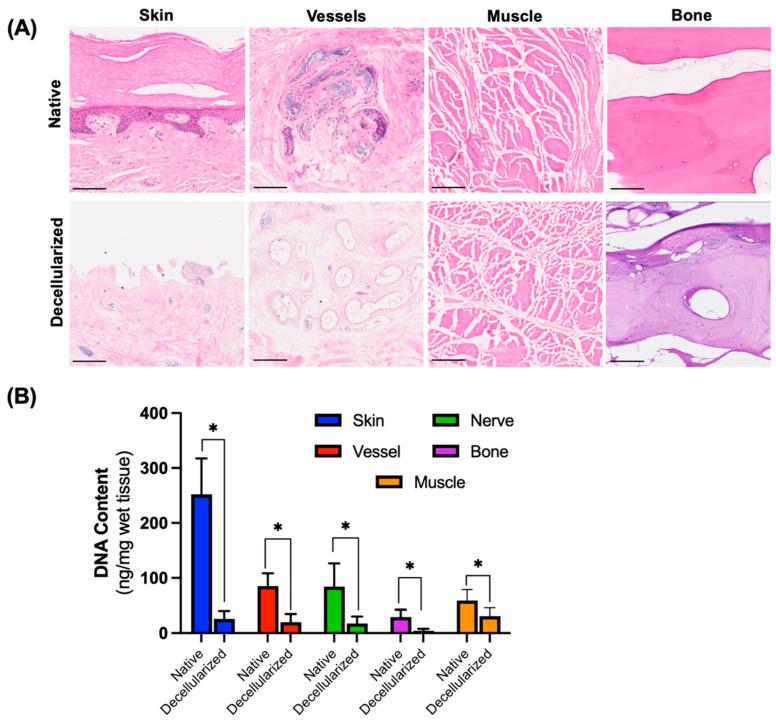
The field of reconstructive surgery faces significant challenges in addressing limb loss and disfigurement, with current organ preservation methods limited by short storage times. Decellularization offers a promising solution for generating engineered alternatives for reconstructive surgery by removing cellular material while preserving the extracellular matrix (ECM) and providing scaffolds for tissue regeneration. In this study, we developed a robust protocol for decellularizing whole digits from long-term freezer storage, achieving the successful removal of cellular material with intact ECM. Digit angiography confirmed the preservation of vascular integrity, facilitating future perfusion for recellularization. Quantitative analysis revealed significantly lower DNA content in decellularized tissues, indicating effective decellularization. Furthermore, extracellular matrix analysis showed the preservation of collagen, elastin, and glycosaminoglycans (GAGs) contents. Histological examination confirmed the reduction in cellularity and maintenance of tissue architecture in decellularized digits. Mechanical strength testing of decellularized digit tendons proved consistent with that of native digits. Our findings highlight the potential of decellularized digits as versatile platforms for tissue engineering and regenerative medicine. Moving forward, further optimization of protocols and collaborative efforts are essential for translating these findings into clinical practice, offering innovative solutions for reconstructive surgery and limb transplantation.
重建外科领域在应对肢体缺失和毁容方面面临重大挑战,目前的器官保存方法受限于较短的储存时间。去细胞化提供了一种有前景的解决方案,通过去除细胞物质同时保留细胞外基质(ECM)并为组织再生提供支架,来生成用于重建外科的工程替代物。在本研究中,我们开发了一种强大的方案,用于对长期冷冻保存的整个手指进行去细胞化处理,成功去除细胞物质并保留完整的ECM。手指血管造影证实了血管完整性的保留,便于未来进行再细胞化的灌注。定量分析显示去细胞化组织中的DNA含量显著降低,表明去细胞化有效。此外,细胞外基质分析显示胶原蛋白、弹性蛋白和糖胺聚糖(GAGs)含量得以保留。组织学检查证实去细胞化手指中的细胞数量减少且组织结构得以维持。去细胞化手指肌腱的力学强度测试结果与天然手指一致。我们的研究结果突出了去细胞化手指作为组织工程和再生医学通用平台的潜力。展望未来,进一步优化方案以及开展合作对于将这些研究结果转化为临床实践至关重要,可为重建外科和肢体移植提供创新解决方案。




 Zotero 插件