Li Mengmeng, Xiong Ke, Jin Wen, Hu Yumeng
Beijing Engineering and Technology Research Centre of Food Additives, Beijing Technology & Business University (BTBU), Beijing 100048, China.
Beijing Laboratory for Food Quality and Safety, Beijing Technology & Business University (BTBU), Beijing 100048, China.
Foods. 2025 Apr 8;14(8):1291. doi: 10.3390/foods14081291.
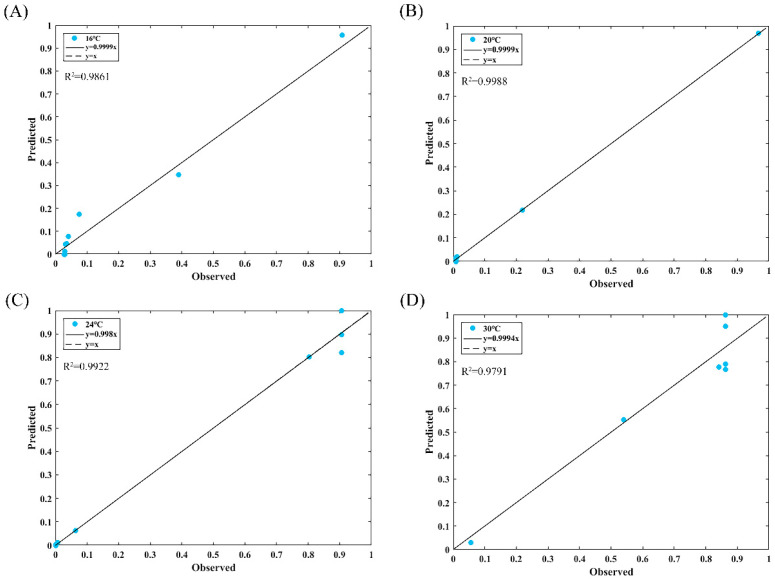
(BGC) is a highly lethal foodborne pathogen responsible for outbreaks of food poisoning with the highest recorded mortality rates among bacterial foodborne illnesses in China. In this study, the ecological behavior of BGC and its Bongkrekic Acid (BA) production dynamics in fresh wet rice noodles (FWRN) were investigated under isothermal conditions ranging from 4 °C to 37 °C. Growth kinetics were modeled using the Huang, Baranyi, and modified Gompertz primary models, with secondary models (Huang square root model and Ratkowsky square root model) describing the influence of temperature on growth parameters. Among these, the Huang-Huang model combination exhibited the best performance, with a root mean square error (RMSE) of 0.009 and bias factor () and accuracy factor () values close to 1. Additionally, we examined the impact of BGC contamination on the quality attributes of FWRN, including pH, color (L*, a*, b*), hardness, and moisture content. The results indicated that BGC growth significantly increased pH and yellowing (b*) values, while changes in texture and moisture were less pronounced. A probabilistic model was further developed to predict BA production under various temperature scenarios, revealing that BA formation was most likely to occur between 24 °C and 30 °C. While this study provides valuable predictive tools for microbial risk assessment and quality control of FWRN, limitations include the exclusion of additional environmental factors such as oxygen and relative humidity, as well as the lack of direct investigation into the degradation behavior of BA. Future research will expand model parameters and include sensory evaluations and advanced microbiological analyses to enhance applicability under real-world storage and transportation conditions.
伯克霍尔德氏菌(BGC)是一种高致死性食源性病原体,在中国细菌性食源性疾病中,它导致的食物中毒爆发死亡率最高。在本研究中,研究了伯克霍尔德氏菌在4℃至37℃等温条件下在新鲜湿米粉(FWRN)中的生态行为及其棒曲霉素(BA)的产生动态。使用Huang、Baranyi和修正的Gompertz一级模型对生长动力学进行建模,并用二级模型(Huang平方根模型和Ratkowsky平方根模型)描述温度对生长参数的影响。其中,Huang-Huang模型组合表现最佳,均方根误差(RMSE)为0.009,偏差因子()和准确度因子()值接近1。此外,我们还研究了伯克霍尔德氏菌污染对新鲜湿米粉品质属性的影响,包括pH值、颜色(L*、a*、b*)、硬度和水分含量。结果表明,伯克霍尔德氏菌的生长显著提高了pH值和黄度(b*)值,而质地和水分的变化则不太明显。进一步开发了一个概率模型来预测不同温度情景下棒曲霉素的产生,结果表明棒曲霉素最有可能在24℃至30℃之间形成。虽然本研究为新鲜湿米粉的微生物风险评估和质量控制提供了有价值的预测工具,但局限性包括未考虑氧气和相对湿度等其他环境因素,以及缺乏对棒曲霉素降解行为的直接研究。未来的研究将扩展模型参数,并纳入感官评价和先进的微生物分析,以提高在实际储存和运输条件下的适用性。