Chen Xu, Jiang Jianshuang, Li Fengling, Lei Wen, Li Juan, Wang Xiaoting, Wenhua Ayiben, Xia Jingjing, He Jiang
Key Laboratory of Uygur Medicine, Xinjiang Institute of Materia Medica, No. 140, Xinhua North Road, Tianshan District, Urumqi 830004, China.
School of Pharmaceutical Sciences and Institute of Materia Medica, Xinjiang University, Urumqi 830046, China.
Foods. 2025 Apr 21;14(8):1434. doi: 10.3390/foods14081434.
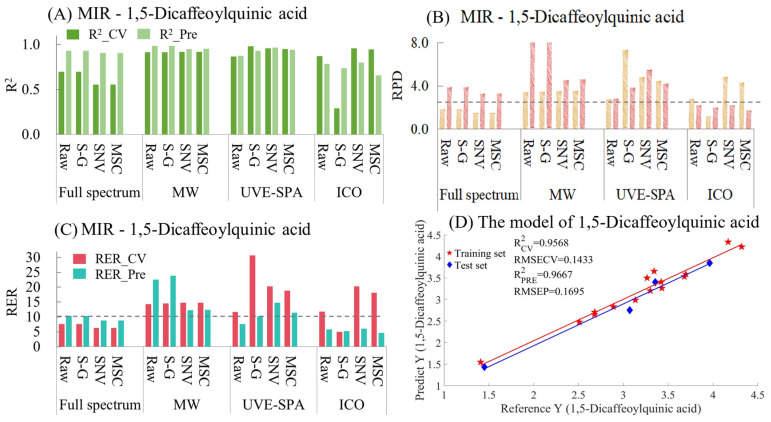
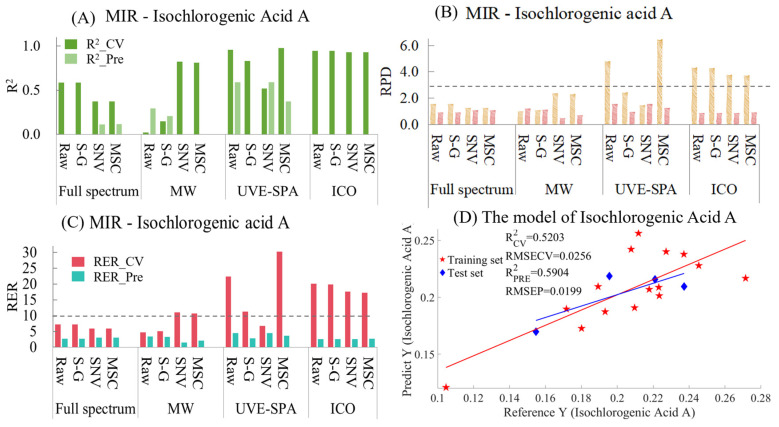
The seeds of (CS) are known for various effects. However, the research on the establishment of quality evaluation standards for CS is currently limited. Therefore, this study employed Ultra Performance Liquid Chromatography-Tandem Mass Spectrometry (UPLC-MS/MS) to analyze the components of CS. Forty-nine compounds were identified through manual analysis and database comparison. The components were then verified using HPLC and standards. Additionally, 19 batches were collected to establish the fingerprint chromatogram. Five major chemical components were selected for subsequent analysis. MIR, combined with three variable selection algorithms and three preprocessing methods, was used to build prediction models. For the three indexes of Chlorogenic Acid, 1,4-Dicaffeoylquinic Acid, and 1,5-Dicaffeoylquinic Acid, the R values for both the training set and test set were above 0.9, the RPD values were all greater than 2.5, and the RER values were greater than 10. This indicated that the combination of mid-infrared spectroscopy and chemometrics had excellent model applicability and prediction performance for these three indexes. A quality evaluation system has been initially established, laying a foundation for research on quality evaluation of CS.
金樱子(CS)种子具有多种功效。然而,目前关于金樱子质量评价标准建立的研究有限。因此,本研究采用超高效液相色谱 - 串联质谱法(UPLC - MS/MS)分析金樱子的成分。通过人工分析和数据库比对鉴定出49种化合物。然后使用高效液相色谱法(HPLC)和标准品对这些成分进行验证。此外,收集了19批次样品以建立指纹图谱。选择了5种主要化学成分进行后续分析。采用中红外光谱(MIR)结合三种变量选择算法和三种预处理方法构建预测模型。对于绿原酸、1,4 - 二咖啡酰奎宁酸和1,5 - 二咖啡酰奎宁酸这三个指标,训练集和测试集的R值均高于0.9,RPD值均大于2.5,RER值大于10。这表明中红外光谱与化学计量学相结合对这三个指标具有优异的模型适用性和预测性能。初步建立了质量评价体系,为金樱子质量评价研究奠定了基础。