
丙型肝炎抗体阳性或RNA阳性供体器官在肾移植中的应用:一项关于结局和安全性的单中心回顾性分析
Utilization of Organs from Hepatitis C-Antibody-Positive or RNA-Positive Donors in Kidney Transplantation: A Single-Center Retrospective Analysis of Outcomes and Safety.
作者信息
Ploeger Lara, Elshoff Philipp Luetke, Kortus-Goetze Birgit, Hoyer Joachim, Russwurm Martin, Wild Johannes
机构信息
Department of Internal Medicine and Nephrology, University Hospital Marburg, 35043 Marburg, Germany.
Pharmacological Institute, University Marburg, 35043 Marburg, Germany.
出版信息
J Clin Med. 2025 Apr 12;14(8):2653. doi: 10.3390/jcm14082653.
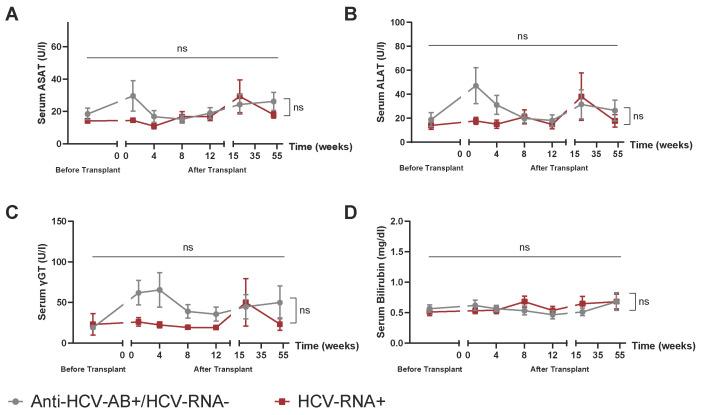
: The shortage of donor organs in transplant medicine remains a challenge. Kidney transplantation from Hepatitis C (HCV)-positive donors to HCV-negative recipients expands the donor pool. Limited data suggest this approach as safe when combined with modern antiviral therapies. This study evaluates the safety of such transplantations in terms of viral transmission and graft function. : A retrospective analysis of 205 kidney transplantations at the University Medical Center Marburg (January 2017-January 2024) was conducted. Eight recipients received kidneys from HCV-antibody-positive (HCV-Antibody+) and RNA-negative donors (HCV-RNA-), and five received kidneys from HCV-RNA-positive (HCV-RNA+) donors. Recipient demographics, donor factors, and transplantation parameters were analyzed. Repeated virological surveillance as well as graft function and complications were assessed within the first year after transplantation. : HCV-RNA+ donor recipients received Glecaprevir/Pibrentasvir for three months starting immediately at transplantation, while HCV-Antibody+ and HCV-RNA- donor recipients did not receive antiviral therapy. After 12 months, both groups exhibited comparable graft function (serum creatinine: HCV-Antibody+/RNA- 1.3 ± 0.4 mg/dL vs. HCV-RNA+ 1.8 ± 0.5 mg/dL, = 0.6) without proteinuria. No hepatic complications or significant inflammation occurred. No HCV-RNA was detected in any patient at any time under the selected treatment regimen. : This single-center study supports the safety of kidney transplantation from HCV-positive donors. Preemptive Glecaprevir/Pibrentasvir therapy effectively prevents HCV transmission, offering a viable option to expand the donor pool.
移植医学中供体器官短缺仍是一项挑战。从丙型肝炎病毒(HCV)阳性供体向HCV阴性受体进行肾移植可扩大供体库。有限的数据表明,与现代抗病毒疗法联合使用时,这种方法是安全的。本研究从病毒传播和移植物功能方面评估此类移植的安全性。:对马尔堡大学医学中心2017年1月至2024年1月期间的205例肾移植进行了回顾性分析。8名受体接受了来自HCV抗体阳性(HCV抗体+)且RNA阴性供体(HCV-RNA-)的肾脏,5名受体接受了来自HCV-RNA阳性(HCV-RNA+)供体的肾脏。分析了受体人口统计学、供体因素和移植参数。在移植后的第一年内评估了重复的病毒学监测以及移植物功能和并发症。:HCV-RNA+供体受体在移植后立即开始接受格卡瑞韦/哌仑他韦治疗三个月,而HCV抗体+和HCV-RNA-供体受体未接受抗病毒治疗。12个月后,两组的移植物功能相当(血清肌酐:HCV抗体+/RNA-为1.3±0.4mg/dL,HCV-RNA+为1.8±0.5mg/dL,P=0.6),且无蛋白尿。未发生肝脏并发症或明显炎症。在选定的治疗方案下,任何患者在任何时间均未检测到HCV-RNA。:这项单中心研究支持了从HCV阳性供体进行肾移植的安全性。抢先使用格卡瑞韦/哌仑他韦治疗可有效预防HCV传播,为扩大供体库提供了一个可行的选择。


 Zotero 插件