Salybekov Amankeldi A, Yerkos Ainur, Sedlmayr Martin, Wolfien Markus
Regenerative Medicine Division, Cell and Gene Therapy Department, Qazaq Institute of Innovative Medicine, Astana 020000, Kazakhstan.
Department of Computer Science, Al-Farabi Kazakh National University, Almaty 050040, Kazakhstan.
J Clin Med. 2025 Apr 17;14(8):2775. doi: 10.3390/jcm14082775.
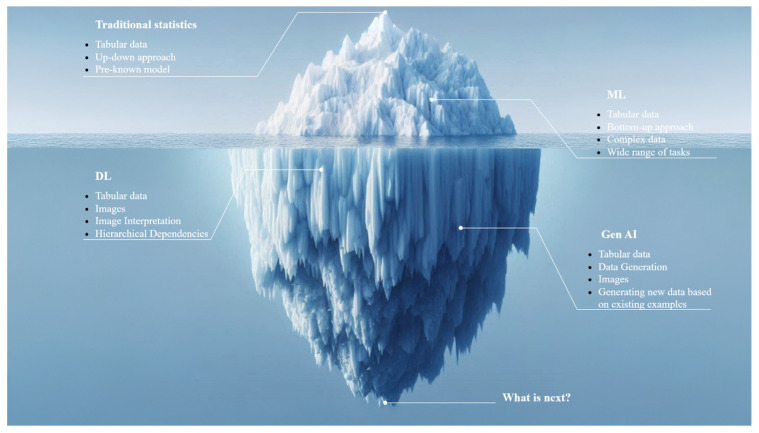
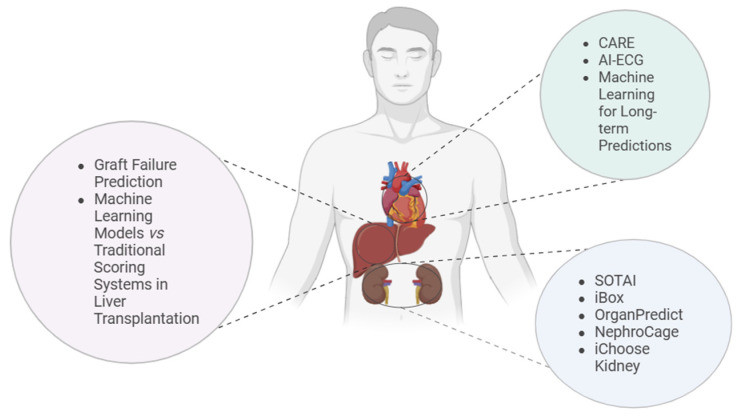
: Solid organ transplantation remains a critical life-saving treatment for end-stage organ failure, yet it faces persistent challenges, such as organ scarcity, graft rejection, and postoperative complications. Artificial intelligence (AI) has the potential to address these challenges by revolutionizing transplantation practices. : This review article explores the diverse applications of AI in solid organ transplantation, focusing on its impact on diagnostics, treatment, and the evolving market landscape. We discuss how machine learning, deep learning, and generative AI are harnessing vast datasets to predict transplant outcomes, personalized immunosuppressive regimens, and optimize patient selection. Additionally, we examine the ethical implications of AI in transplantation and highlight promising AI-driven innovations nearing FDA evaluation. : AI improves organ allocation processes, refines predictions for transplant outcomes, and enables tailored immunosuppressive regimens. These advancements contribute to better patient selection and enhance overall transplant success rates. : By bridging the gap in organ availability and improving long-term transplant success, AI holds promise to significantly advance the field of solid organ transplantation.
实体器官移植仍然是治疗终末期器官衰竭的关键救命疗法,但它面临着诸如器官短缺、移植物排斥和术后并发症等持续存在的挑战。人工智能有潜力通过变革移植实践来应对这些挑战。 :这篇综述文章探讨了人工智能在实体器官移植中的各种应用,重点关注其对诊断、治疗以及不断演变的市场格局的影响。我们讨论了机器学习、深度学习和生成式人工智能如何利用大量数据集来预测移植结果、个性化免疫抑制方案以及优化患者选择。此外,我们研究了人工智能在移植中的伦理影响,并强调了接近美国食品药品监督管理局评估的有前景的人工智能驱动的创新。 :人工智能改善了器官分配过程,完善了对移植结果的预测,并实现了量身定制的免疫抑制方案。这些进展有助于更好地选择患者并提高整体移植成功率。 :通过弥合器官可获得性方面的差距并提高长期移植成功率,人工智能有望显著推动实体器官移植领域的发展。