Vittor Dante G, Wilson Jeffrey S, Crouter Scott E, Ethier Benjamin G, Shi Ling, Camhi Sarah M, Troped Philip J
Manning College of Nursing and Health Sciences, University of Massachusetts Boston, Boston, MA 02125, USA.
Department of Geography, Indiana University Indianapolis, Indianapolis, IN 46202, USA.
Int J Environ Res Public Health. 2025 Apr 4;22(4):566. doi: 10.3390/ijerph22040566.
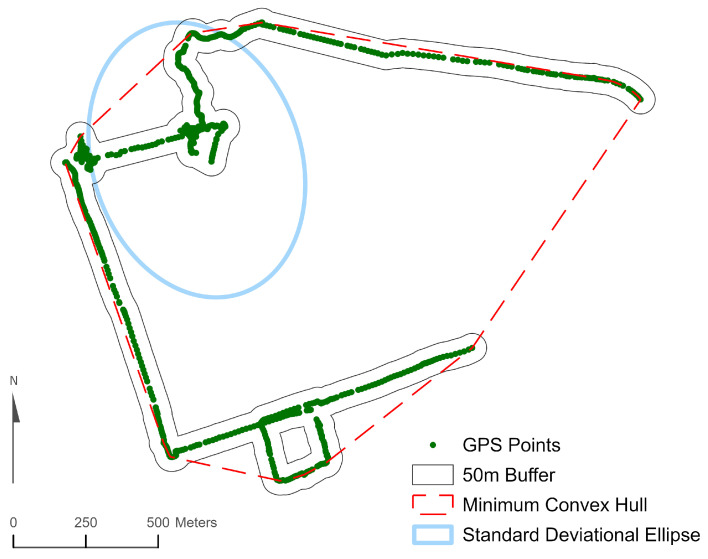
Built environment and physical activity (PA) studies have predominantly used fixed or home-centric approaches to identify environmental exposures. In this study, GPS-derived daily activity spaces were used to examine the relationships between the built environment and sedentary behavior (SB), light PA (LPA), and moderate-to-vigorous PA (MVPA). Thirty-one adults were assessed with activity monitors and GPS units. Three types of activity spaces were created: 50 m buffered GPS tracks, minimum convex hulls (MCHs), and standard deviational ellipses (SDEs). The environmental variables included land use mix, greenness, and intersection, multi-use trail, bike infrastructure, and bike station densities. Repeated measures regression was used to test the associations for 141 person-days, controlling for age, gender, income, body mass index, crime, precipitation, and temperature. Greenness within MCH activity spaces was positively associated with LPA ( = 0.02). The bike infrastructure density within SDE spaces had a significant positive association with MVPA ( = 0.04). Multi-use trail, bike infrastructure, and bike station densities had significant negative associations with LPA ( ≤ 0.05). There were no significant adjusted associations with SB. The few significant associations in this study varied by outcome and type of activity space. Further studies are needed to determine optimal, yet flexible methods for activity spaces in built environment and PA research.
建筑环境与身体活动(PA)研究主要采用固定或以家庭为中心的方法来识别环境暴露因素。在本研究中,利用全球定位系统(GPS)得出的日常活动空间来检验建筑环境与久坐行为(SB)、轻度身体活动(LPA)以及中度至剧烈身体活动(MVPA)之间的关系。对31名成年人使用活动监测器和GPS设备进行了评估。创建了三种类型的活动空间:50米缓冲GPS轨迹、最小凸包(MCH)和标准差椭圆(SDE)。环境变量包括土地利用混合度、绿化程度、交叉路口、多用途步道、自行车基础设施以及自行车站密度。采用重复测量回归分析对141人日的数据进行关联性检验,并对年龄、性别、收入、体重指数、犯罪率、降水量和温度进行了控制。MCH活动空间内的绿化程度与LPA呈正相关( = 0.02)。SDE空间内的自行车基础设施密度与MVPA呈显著正相关( = 0.04)。多用途步道、自行车基础设施和自行车站密度与LPA呈显著负相关( ≤ 0.05)。与SB无显著的校正关联性。本研究中少数显著的关联性因结果和活动空间类型而异。需要进一步研究以确定建筑环境和PA研究中活动空间的最佳且灵活的方法。