Fayed Sabry, Badawi Moataz, Ghalla Mohamed, Mlybari Ehab A, Iskander Yahia, Yehia Saad A
Department of Civil Engineering, Faculty of Engineering, Kafrelsheikh University, Kafrelsheikh, Egypt.
Department of Civil Engineering, College of Engineering and Architecture, Umm Al-Qura University, Makkah, Saudi Arabia.
Sci Rep. 2025 Apr 26;15(1):14632. doi: 10.1038/s41598-025-94227-3.
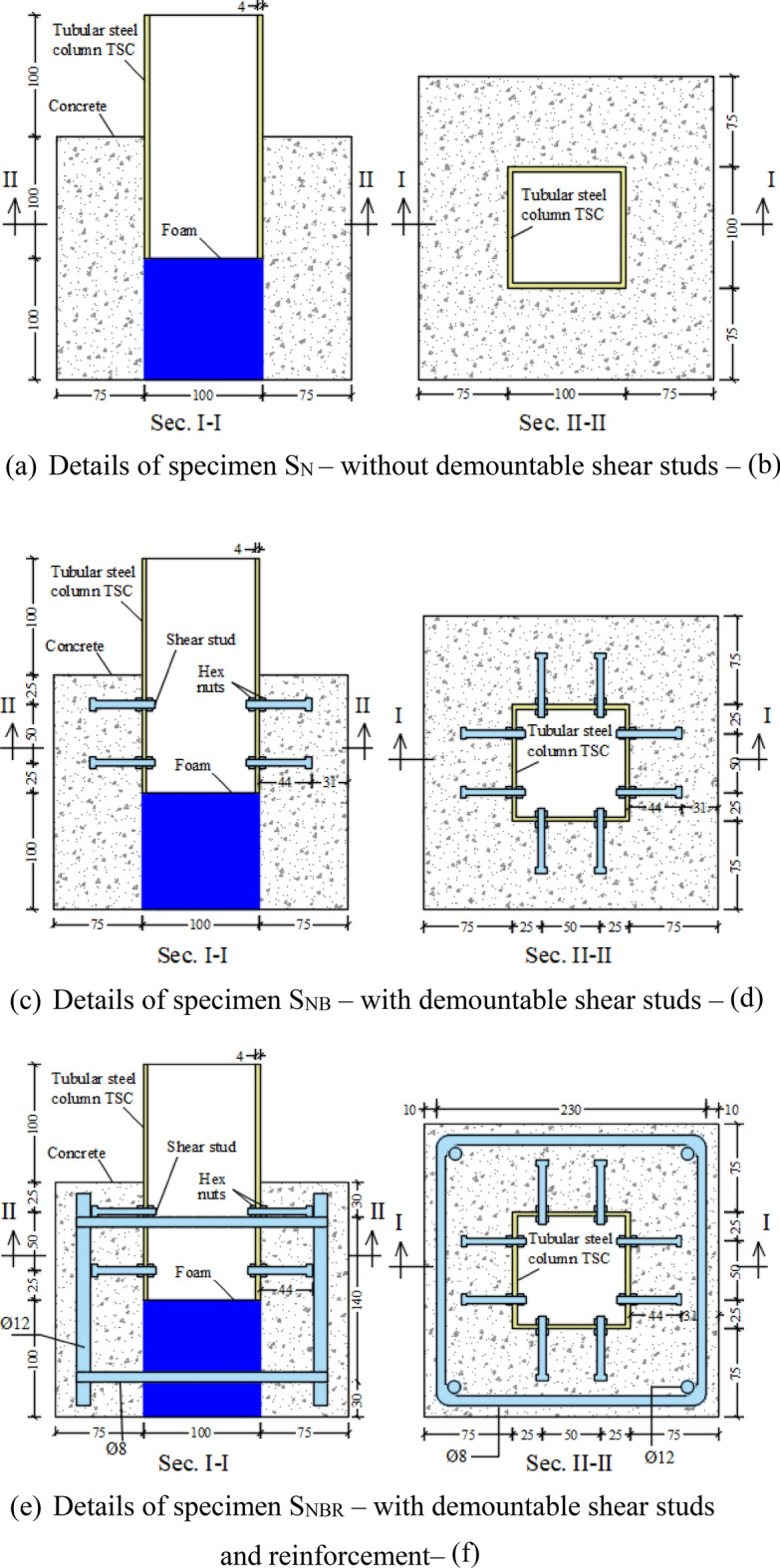
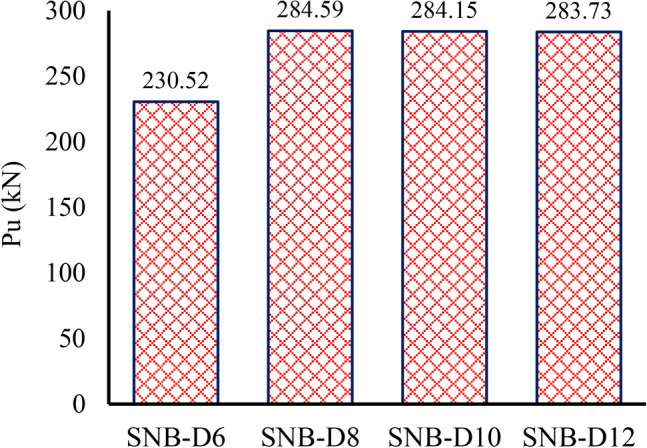
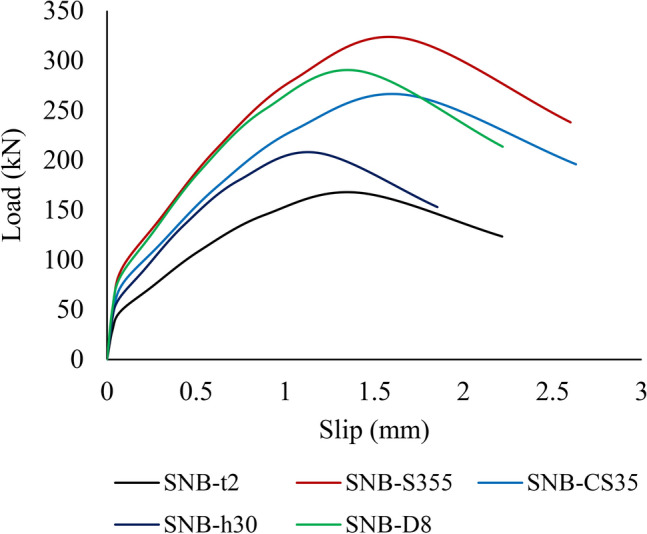
Three push-out specimens were experimentally tested to investigate the behavior of tubular steel columns (TSC) with and without bolted shear connectors embedded in normal concrete (NC). Each specimen consisted of a tubular steel column (TSC) encased in a 250 × 250 × 200 mm concrete cube The embedment/the prominent height of TSC was 100 mm. Foam was used underneath the TSC to form free space. The study considered variables such as the presence of demountable shear studs and reinforcement. The failure modes, load-slip response, peak load/slip, and shear stiffness of the specimens were analyzed. Furthermore, a finite element model (FEM) was developed using ABAQUS software to simulate the behavior of the tested specimens and validated against the experimental results. The FEM was also employed to conduct further parametric investigations. The results indicate that demountable shear studs significantly improve shear capacity, with specimens exhibiting a 217% higher peak load than those without studs. Reinforcing the concrete block had a negligible effect on peak load but increased peak slip by 37.7% and shear stiffness by 18.7% compared to the unreinforced specimen. Furthermore, increasing the TSC thickness significantly enhances peak load, with a 154.31% increase observed as the thickness increases from one-third of the bolt diameter to the full bolt diameter. Additionally, using TSC thicknesses greater than half the bolt diameter helps prevent bearing failure. Increasing the concrete compressive strength from 25 to 50 MPa leads to a 24.6% increase in peak load, while slip capacity decreases by 19.77%. For applications requiring high ductility, excessively high-strength concrete should be avoided, as it reduces slip capacity. The results also demonstrate that the bolt diameter should not exceed twice the TSC web thickness to prevent bearing failure.
通过对三个推出试件进行试验测试,研究了在普通混凝土(NC)中嵌入和未嵌入螺栓抗剪连接件的钢管柱(TSC)的性能。每个试件由一个包裹在250×250×200mm混凝土立方体中的钢管柱(TSC)组成。TSC的埋入深度/突出高度为100mm。在TSC下方使用泡沫形成自由空间。该研究考虑了可拆卸抗剪栓钉和配筋等变量。分析了试件的破坏模式、荷载-滑移响应、峰值荷载/滑移以及抗剪刚度。此外,使用ABAQUS软件建立了有限元模型(FEM)来模拟测试试件的性能,并与试验结果进行了验证。该有限元模型还用于进行进一步的参数研究。结果表明,可拆卸抗剪栓钉显著提高了抗剪承载力,有栓钉的试件峰值荷载比无栓钉的试件高217%。与未配筋试件相比,对混凝土块进行配筋对峰值荷载的影响可忽略不计,但峰值滑移增加了37.7%,抗剪刚度增加了18.7%。此外,增加TSC厚度可显著提高峰值荷载,当厚度从螺栓直径的三分之一增加到螺栓全直径时,峰值荷载增加了154.31%。此外,使用大于螺栓直径一半的TSC厚度有助于防止承压破坏。将混凝土抗压强度从25MPa提高到50MPa会使峰值荷载增加24.6%,而滑移能力降低19.77%。对于需要高延性的应用,应避免使用过高强度的混凝土,因为它会降低滑移能力。结果还表明,螺栓直径不应超过TSC腹板厚度的两倍,以防止承压破坏。