Zhao Tao, Zheng Liting, Feng Yiyun, Lao Min, Huang Yongmei, Wu Guosong
Baiyun Branch, Nanfang Hospital, Southern Medical University, Guangzhou, 510599, China.
Guangzhou Baiyun District People's Hospital, Guangzhou, 510599, China.
BMC Ophthalmol. 2025 Apr 28;25(1):248. doi: 10.1186/s12886-025-04096-7.
This study systematically compares the risk of long-term ocular adverse events between subcutaneous and oral semaglutide preparations to assess pathway-specific safety differences.
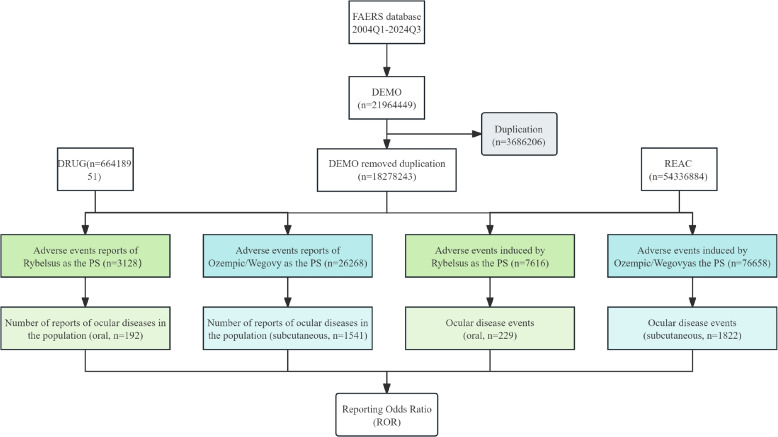
In this study, the Report odds ratio (ROR) technique was employed to detect signals of adverse drug reactions (ADRs) associated with the use of semaglutide. Analysis was conducted on data extracted from the FDA Adverse Event Reporting System (FAERS) database, covering the period from 2004(Q1) through 2024(Q3). This investigation encompasses a descriptive analysis focused on the administration of semaglutide through various routes, encompassing a broad range of demographics including gender (male and female), age groups, along with other demographic data and the timing of disease onset. Following this, the study employs the ROR methodology to assess the differential adverse event signals across distinct semaglutide formulations.
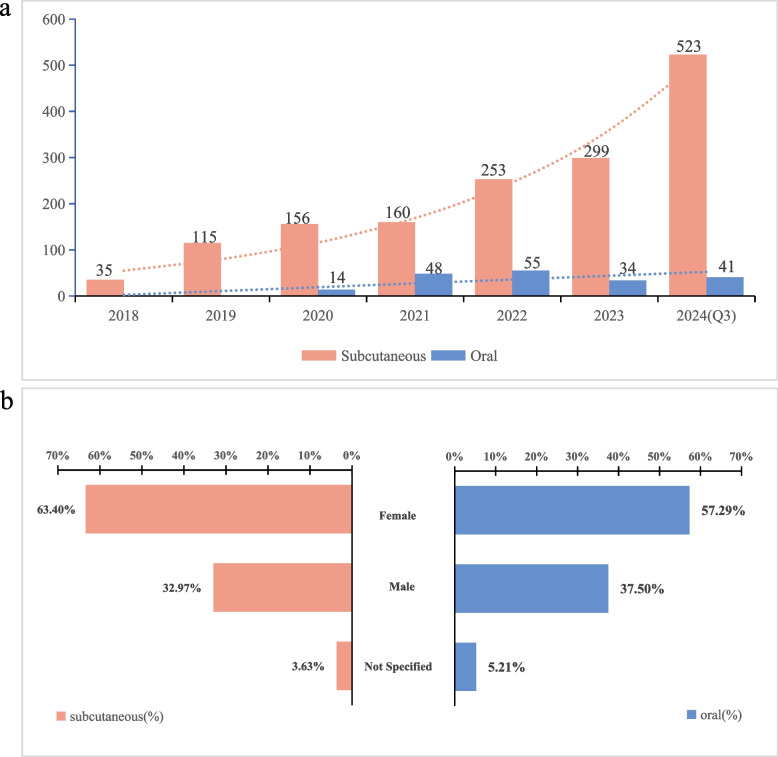
We categorized the eye as the System Organ Class (SOC) and obtained 1733 ADE reports related to it from the FAERS database. Of these, 1541 reports were associated with injectables, while tablets were linked to 192 ADE reports. In both dosage forms, most cases occurred within the first month of administration, although the median time to onset (TTO) differed, with injectables identified at 7.00 [IQR 0.00-56.00] days and tablets at only 3.50 [IQR 0.00-35.00] days. It is worth noting that 5.41% of patients administered subcutaneous injections and 2.17% of those receiving oral medications reported ADEs following one year of treatment with semaglutide. Furthermore, female patients exhibited a higher susceptibility to ocular adverse reactions compared to their male counterparts. Regarding the primary preferred terms (PTs), blurred vision constitutes 34.33% of the total ADEs associated with tablet formulations. This incidence is marginally higher than that observed with injectable formulations. This investigation further discerned ocular ADEs signals associated with specific formulations: subcutaneous injections have a higher frequency of reports concerning retinal complications, such as diabetic retinopathy, ischemic optic neuropathy, retinal detachment, retinal tear, and retinal hemorrhage.
The results of this study identified a significant difference between subcutaneous and oral semaglutide in ocular ADE risk, providing some evidence for dosage form selection and risk monitoring for clinical use.
本研究系统比较了皮下注射和口服司美格鲁肽制剂的长期眼部不良事件风险,以评估特定途径的安全性差异。
在本研究中,采用报告比值比(ROR)技术来检测与司美格鲁肽使用相关的药物不良反应(ADR)信号。对从美国食品药品监督管理局不良事件报告系统(FAERS)数据库中提取的数据进行分析,涵盖2004年第一季度至2024年第三季度。这项调查包括一项描述性分析,重点是司美格鲁肽的各种给药途径,涵盖广泛的人口统计学特征,包括性别(男性和女性)、年龄组以及其他人口数据和疾病发病时间。在此之后,该研究采用ROR方法来评估不同司美格鲁肽制剂的不良事件差异信号。
我们将眼部归类为系统器官分类(SOC),并从FAERS数据库中获得了1733份与之相关的药物不良反应事件(ADE)报告。其中,1541份报告与注射剂有关,而片剂与192份ADE报告相关。在两种剂型中,大多数病例发生在给药的第一个月内,尽管中位发病时间(TTO)有所不同,注射剂为7.00[四分位间距0.00 - 56.00]天,片剂仅为3.50[四分位间距0.00 - 35.00]天。值得注意的是,接受皮下注射的患者中有5.41%以及接受口服药物的患者中有2.17%在使用司美格鲁肽治疗一年后报告了ADEs。此外,女性患者比男性患者对眼部不良反应表现出更高的易感性。关于主要首选术语(PTs),视力模糊占与片剂制剂相关的总ADEs的34.33%。这一发生率略高于注射剂制剂。这项调查进一步识别了与特定制剂相关的眼部ADEs信号:皮下注射有关视网膜并发症(如糖尿病性视网膜病变、缺血性视神经病变、视网膜脱离、视网膜裂孔和视网膜出血)的报告频率更高。
本研究结果确定了皮下注射和口服司美格鲁肽在眼部ADE风险方面存在显著差异,为临床使用中的剂型选择和风险监测提供了一些证据。