Robin Austin, Padmanabhan Vaishnavi, Swaminathan Kavitha, Kc Vignesh, K Vivek, Haridoss Selvakumar
Dentistry, Sri Ramachandra Institute of Higher Education and Research, Chennai, IND.
Pediatric and Preventive Dentistry, Sri Ramachandra Institute of Higher Education and Research, Chennai, IND.
Cureus. 2025 Mar 28;17(3):e81348. doi: 10.7759/cureus.81348. eCollection 2025 Mar.
Screen time refers to the duration spent on digital devices, including televisions, computers, and mobile devices. Increased screen exposure among children raises concerns about its psychological, physical, and social health effects. Excessive screen time has been linked to poor dietary habits, reduced physical activity, and oral health issues such as dental caries. However, the association between screen time, dietary patterns, and oral health remains inadequately explored.
This study aimed to assess the association between screen time and children's dietary patterns, oral hygiene practices, and oral health status.
A cross-sectional observational study was conducted in a hospital-based setting in the Departments of Pediatric & Preventive Dentistry and Pediatrics over two months (December 2023-January 2024). A total of 353 children aged 6-13 years were recruited using convenience sampling. Screen time data were collected through parental interviews, while oral health status was assessed using the International Caries Detection and Assessment System II (ICDAS II) index. Dietary patterns were evaluated using a seven-day dietary recall. Data were analyzed using SPSS v23.0 (IBM Corp., Armonk, NY), with statistical significance set at p ≤ 0.05.
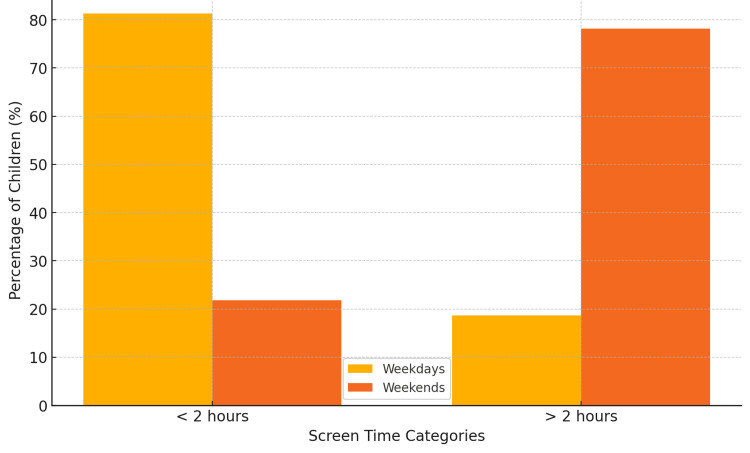
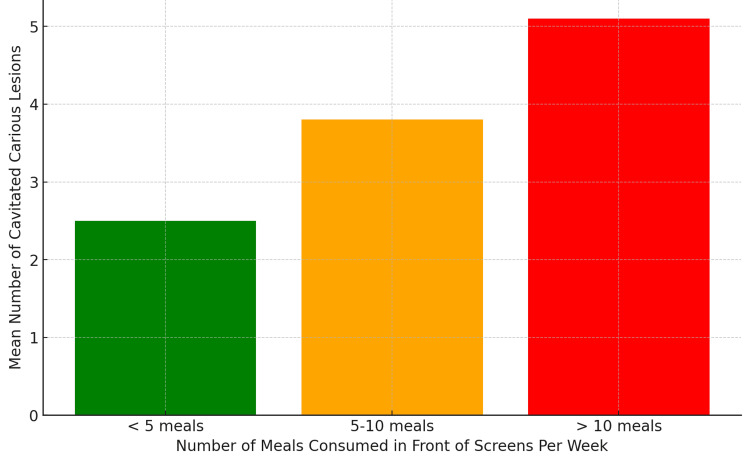
Among the 353 participants, 187 (53.0%) were female. Nearly 66 (18.7%) children exceeded two hours of screen time per day on weekdays, while 276 (78.2%) exceeded this threshold on weekends. Only 60 (17.0%) reported brushing twice daily. The mean number of non-cavitated carious lesions was 0.7, while cavitated carious lesions averaged 3.8. Children who frequently watched screens while eating consumed approximately 22% of their meals in front of a screen. A statistically significant correlation was found between cavitated carious lesions and screen-related eating habits (p < 0.05), though the correlation coefficients were low.
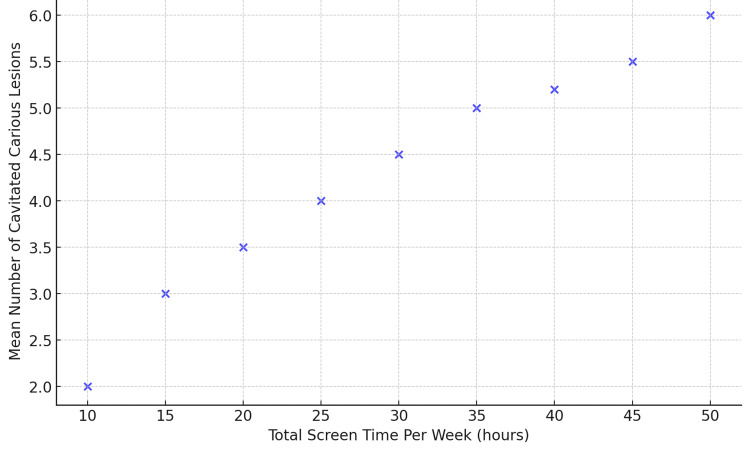
The study identified a significant increase in screen time during weekends compared to weekdays. Higher screen use was associated with a greater number of cavitated carious lesions and total caries. Additionally, frequent screen use during meals was linked to unhealthy dietary patterns. Our findings highlight the importance of parental monitoring and structured screen time limits to encourage healthier dietary habits and improved oral hygiene among children.
屏幕使用时间是指花在数字设备上的时长,包括电视、电脑和移动设备。儿童接触屏幕的时间增加引发了人们对其对心理、身体和社会健康影响的担忧。过多的屏幕使用时间与不良饮食习惯、身体活动减少以及诸如龋齿等口腔健康问题有关。然而,屏幕使用时间、饮食模式和口腔健康之间的关联仍未得到充分探索。
本研究旨在评估屏幕使用时间与儿童饮食模式、口腔卫生习惯及口腔健康状况之间的关联。
在一家医院的儿科与预防牙科及儿科部门进行了一项为期两个月(2023年12月至2024年1月)的横断面观察性研究。采用便利抽样法招募了353名6至13岁的儿童。通过家长访谈收集屏幕使用时间数据,同时使用国际龋病检测与评估系统II(ICDAS II)指数评估口腔健康状况。通过七天饮食回顾评估饮食模式。使用SPSS v23.0(IBM公司,纽约州阿蒙克)对数据进行分析,设定统计学显著性为p≤0.05。
在353名参与者中,187名(53.0%)为女性。近66名(18.7%)儿童工作日每天的屏幕使用时间超过两小时,而276名(78.2%)儿童在周末超过了这个阈值。只有60名(17.0%)报告每天刷牙两次。非龋性龋损的平均数量为0.7,而龋性龋损平均为3.8。吃饭时经常看屏幕的儿童约22%的餐食是在屏幕前食用的。龋性龋损与与屏幕相关的饮食习惯之间存在统计学显著相关性(p<0.05),尽管相关系数较低。
该研究发现,与工作日相比,周末的屏幕使用时间显著增加。更高的屏幕使用频率与更多的龋性龋损和总龋数相关。此外,吃饭时频繁使用屏幕与不健康的饮食模式有关。我们的研究结果凸显了家长监督和设定有组织的屏幕使用时间限制对于鼓励儿童养成更健康的饮食习惯和改善口腔卫生的重要性。