
计算机断层扫描对颈动脉斑块及血管周围脂肪组织衰减的定量分析
Quantification of carotid artery plaque and peri-vascular adipose tissue attenuation on computed tomography.
作者信息
Whittington Beth, Thiagarajah Viswan, Tzolos Evangelos, Kaczynski Jakub, Taggart Caelan, Vesey Alex, Dey Damini, Forsythe Rachael O, Tambyraja Andrew, van Beek Edwin J R, Dweck Marc R, Newby David E, Williams Michelle C
机构信息
BHF Centre for Cardiovascular Science, University of Edinburgh, 47 Little France Crescent, Edinburgh EH16 4TJ, UK.
Department of Medicine (Division of Artificial Intelligence in Medicine) and Biomedical Imaging Research Institute, Cedars-Sinai Medical Centre, Los Angeles, CA 90048, USA.
出版信息
Eur Heart J Imaging Methods Pract. 2025 Apr 8;3(1):qyaf040. doi: 10.1093/ehjimp/qyaf040. eCollection 2025 Jan.
AIMS
Quantitative assessment of carotid artery plaque on computed tomography (CT) may identify high-risk phenotypes associated with culprit lesions and subsequent ischaemic stroke or transient ischaemic attack.
METHODS AND RESULTS
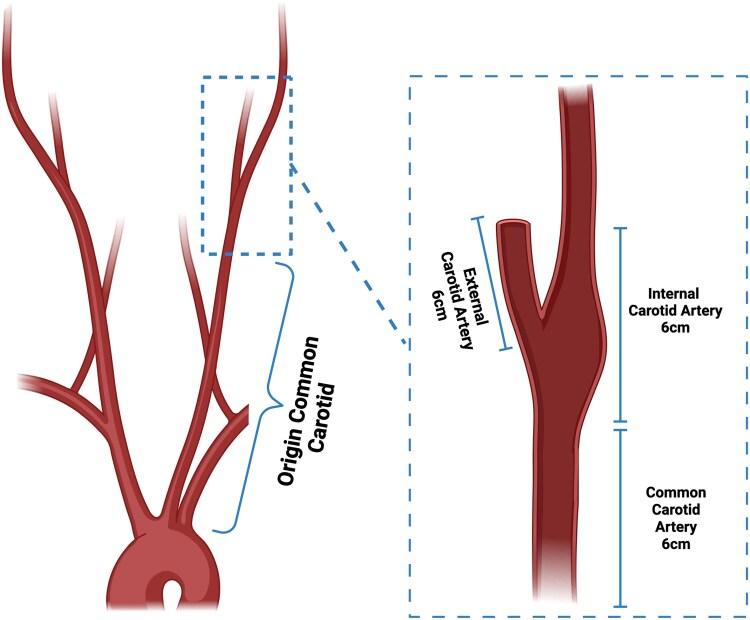
Carotid CT angiography was performed in 48 patients with acute ischaemic stroke or transient ischaemic attack within 21 days. Quantitative plaque assessment was performed in the proximal 6 cm of the internal and external carotid artery, distal 6 cm of the common carotid artery, and residual common carotid artery. Semi-automated quantification included assessment of non-calcified, calcified, low-attenuation, and total plaque, area and diameter stenosis, and peri-vascular adipose tissue attenuation. In 48 patients (mean age 71 ± 11 years, 67% male), 96 vessels were assessed with 30 (31%) identified as culprit vessels. Culprit internal carotid arteries had greater area [83 (65, 94) vs. 64 (55, 77)%] and diameter [56 (39, 74) vs. 32 (21, 48)%] stenosis and more non-calcified [563 (413, 965) vs. 428 (283 649) mm, = 0.04], low-attenuation [33.7 (6.9, 72.4) vs. 16.3 (3.35, 54.3) mm, = 0.01], and total [699 (455, 1057) vs. 492 (311, 809), = 0.04] plaque. There was no difference in calcified plaque or peri-vascular adipose tissue attenuation between culprit and non-culprit internal carotid arteries. There were no differences in quantitative plaque or peri-vascular adipose tissue attenuation in the external carotid artery or common carotid artery.
CONCLUSION
Carotid atherosclerotic plaque characteristics are the principal features associated with culprit plaques with little or no demonstrable relationship with calcified plaque or increased peri-vascular adipose tissue attenuation.
目的
通过计算机断层扫描(CT)对颈动脉斑块进行定量评估,可能识别出与罪犯病变以及随后的缺血性中风或短暂性脑缺血发作相关的高危表型。
方法与结果
对48例在21天内发生急性缺血性中风或短暂性脑缺血发作的患者进行颈动脉CT血管造影。对颈内动脉和颈外动脉近端6厘米、颈总动脉远端6厘米以及剩余的颈总动脉进行斑块定量评估。半自动定量包括对非钙化、钙化、低衰减和总斑块、面积和直径狭窄以及血管周围脂肪组织衰减的评估。在48例患者(平均年龄71±11岁,67%为男性)中,对96条血管进行了评估,其中30条(31%)被确定为罪犯血管。罪犯颈内动脉的面积[83(65,94)%对64(55,77)%]和直径[56(39,74)%对32(21,48)%]狭窄程度更高,非钙化斑块更多[563(413,965)毫米对428(283,649)毫米,P = 0.04],低衰减斑块更多[33.7(6.9,72.4)毫米对16.3(3.35,54.3)毫米,P = 0.01],总斑块更多[699(455,1057)对492(311,809),P = 0.04]。罪犯和非罪犯颈内动脉之间的钙化斑块或血管周围脂肪组织衰减没有差异。颈外动脉或颈总动脉的斑块定量或血管周围脂肪组织衰减没有差异。
结论
颈动脉粥样硬化斑块特征是与罪犯斑块相关的主要特征,与钙化斑块或血管周围脂肪组织衰减增加几乎没有或没有明显关系。


 Zotero 插件