
发射积分对使用中红外被动光谱成像进行的无创血糖测量的影响
Emission Integral Effect on Non-Invasive Blood Glucose Measurements Made Using Mid-Infrared Passive Spectroscopic Imaging.
作者信息
Anabuki Daichi, Tahara Shiori, Yano Hibiki, Nishiyama Akira, Wada Kenji, Nishimura Akiko, Ishimaru Ichiro
机构信息
Graduate School of Science for Creative Emergence, Kagawa University, 2217-20 Hayashi-cho, Takamatsu, Kagawa 761-0396, Japan.
Faculty of Medicine, Kagawa University, 1750-1 Miki-cho, Kita, Kagawa 761-0793, Japan.
出版信息
Sensors (Basel). 2025 Mar 8;25(6):1674. doi: 10.3390/s25061674.
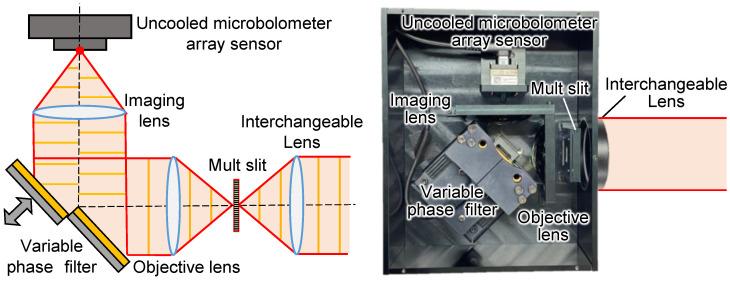
Living bodies emit mid-infrared light (wavelength band centered at approximately 10 µm) with a temperature-dependent intensity. Several studies have shown the possibility of measuring blood glucose levels using the mid-infrared emission of living bodies, and we have demonstrated non-invasive blood glucose measurements through distant wrist measurements (wavelength 8-14 µm) by mid-infrared passive spectroscopic imaging. However, it is not clear why blood glucose is detectable, as there is no formula that shows the effect of material thickness and concentration on emission intensity. In this study, we developed a principle for understanding glucose detection by proposing that an emission integral effect underpins the changes in emission intensity with substance thickness and absorption coefficient. We demonstrate the emission integral effect by measuring the spectral radiance of polypropylene with different thicknesses using mid-infrared passive spectroscopic imaging. The simulation results based on the emission integral effect indicate that in living bodies, dilute components such as glucose are easier to identify than components with high concentrations. Mid-infrared passive spectroscopic imaging offers potential innovative solutions for measuring various substances from a distance, with the emission integral effect acting as the basic working principle.
活体发出与温度相关强度的中红外光(波长带以约10微米为中心)。多项研究表明利用活体的中红外发射来测量血糖水平的可能性,并且我们已经通过中红外被动光谱成像对远距离手腕测量(波长8 - 14微米)进行了无创血糖测量。然而,尚不清楚为何能够检测出血糖,因为没有公式表明材料厚度和浓度对发射强度的影响。在本研究中,我们通过提出发射积分效应是发射强度随物质厚度和吸收系数变化的基础,从而建立了一种理解葡萄糖检测的原理。我们使用中红外被动光谱成像测量不同厚度聚丙烯的光谱辐射率来证明发射积分效应。基于发射积分效应的模拟结果表明,在活体中,诸如葡萄糖等稀释成分比高浓度成分更容易识别。中红外被动光谱成像为远距离测量各种物质提供了潜在的创新解决方案,发射积分效应作为其基本工作原理。




 Zotero 插件