Machorrinho Joana, Marmeleira José, Santos Graça Duarte, Veiga Guida
Comprehensive Health Research Center (CHRC), Universidade de Évora, Évora, Portugal.
Departamento de Desporto e Saúde, Escola de Saúde e Desenvolvimento Humano, Universidade de Évora, Évora, Portugal.
Womens Health (Lond). 2025 Jan-Dec;21:17455057251326013. doi: 10.1177/17455057251326013. Epub 2025 Apr 28.
Somatic complaints are a critical burden to women, particularly to those women who survived intimate partner violence (IPV). The way women feel, perceive, and relate to their own body, that is, interoception, seems to have a significant role in the pathway to somatic complaints. However, to the best of our knowledge, no study has yet explored the relationship between interoception and somatic complaints of women survivors of IPV.
To deepen the understanding of the underlying interoceptive mechanisms of somatic complaints experienced by women survivors of IPV.
Cross-sectional study.
Women with ( = 44) and without ( = 52) history of IPV were assessed regarding interoceptive accuracy, interoceptive sensibility, and somatic complaints. Associations between both variables in each group were examined, and a hierarchical regression analysis assessed to what extent somatic complaints were explained by the interoceptive abilities, with the mediating role of IPV group membership.
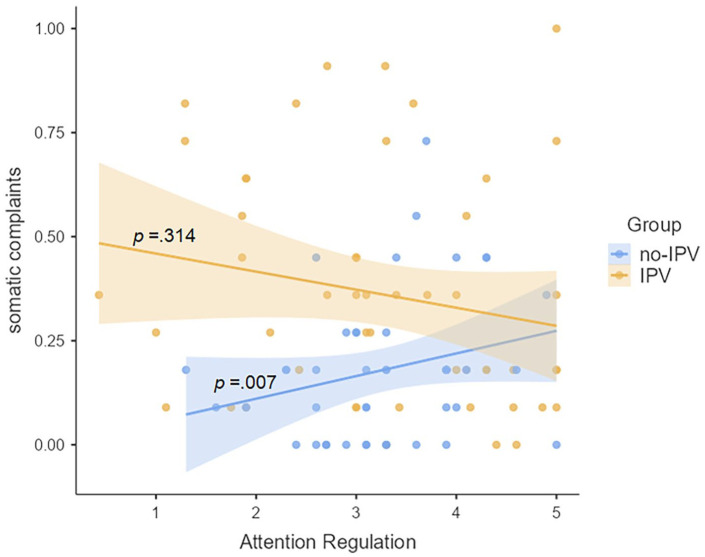
Women survivors of IPV reported more somatic complaints ( < 0.001), which were negatively associated with interoceptive attention regulation. The opposite association was found in women who have never experienced IPV. For the IPV group, the interoceptive attention regulation, added to age and the index of the violence suffered, explains 43% of the variance in somatic complaints.
The findings suggest that for women with history of IPV, but not for those without, the ability to regulate the attention given to bodily sensations is a mediator of women' somatic complaint. Thereby we suggest that interoceptive attention regulation can be a promising therapeutic aim, for women recovering from IPV.
躯体不适对女性来说是一项沉重负担,尤其是对那些曾遭受亲密伴侣暴力(IPV)的女性而言。女性感受、认知自身身体的方式,即内感受,似乎在导致躯体不适的过程中发挥着重要作用。然而,据我们所知,尚无研究探讨IPV女性幸存者的内感受与躯体不适之间的关系。
深入了解IPV女性幸存者躯体不适潜在的内感受机制。
横断面研究。
对有(n = 44)和无(n = 52)IPV史的女性进行内感受准确性、内感受敏感性和躯体不适方面的评估。检查每组中两个变量之间的关联,并进行分层回归分析,以评估内感受能力在多大程度上可解释躯体不适,同时考虑IPV组别的中介作用。
IPV女性幸存者报告的躯体不适更多(p < 0.001),且与内感受注意力调节呈负相关。在从未经历过IPV的女性中发现了相反的关联。对于IPV组,内感受注意力调节,加上年龄和遭受暴力的指数,可解释躯体不适变异的43%。
研究结果表明,对于有IPV史的女性,而不是没有IPV史的女性,调节对身体感觉的注意力的能力是女性躯体不适的一个中介因素。因此,我们认为内感受注意力调节对于从IPV中恢复的女性可能是一个有前景的治疗目标。