Qi Jiaojiao, Sun Yu, Chen Zeqing, Gao Ruipeng, Song Miao, Zou Tong, Gong Xuelin, Wang Shuang, Zhang Qing, Liu Chengyang, Xing Shichao
Department of Pathogeny Biology, College of Basic Medicine, Qingdao University, Qingdao, 266071, P. R. China.
Municipal Center for Disease Control and Prevention of Qingdao, Qingdao, 266033, China.
Sci Rep. 2025 Apr 28;15(1):14757. doi: 10.1038/s41598-025-95846-6.
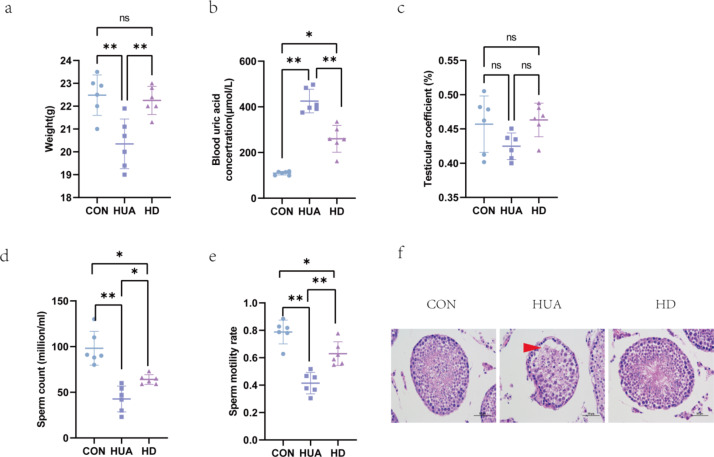
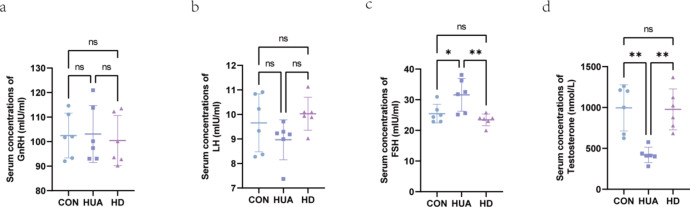
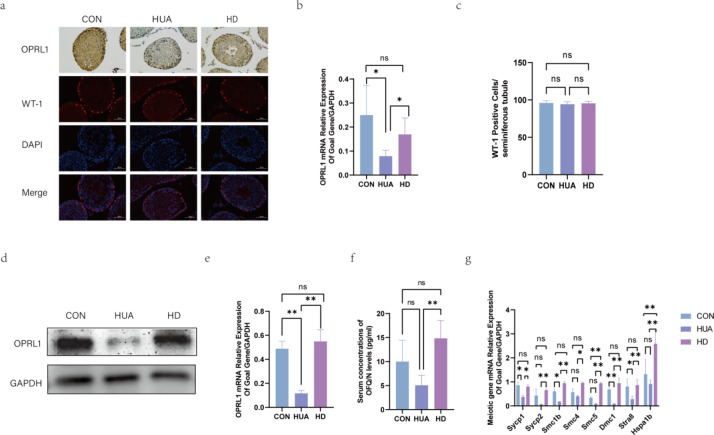
Hyperuricemia (HUA) impaires spermatogenesis. This study was carried out, aiming to determine whether butyric acid (NaB) avoids the HUA-induced decline of sperm quality HUA mice were developed through intra-peritoneal injection of the potassium oxalate combined with intragastric uric acid (UA) and by tube feeding 300 mg·kg-1·d-1NaB. The effect of NaB on the reproduction of HUA male mice was determined by measuring sperm count, sperm motility and testosterone content. In addition, TM3 and GC-2 cells were treated with a solution containing 30 mg/dl UA and 1mM NaB. The effects of NaB on the sperm quality were evaluated with the expression level of the genes involving in LH/cAMP/PKA signaling pathway and meiosis, and that encoding OPRL1 receptor protein. Results showed that NaB improved sperm count, sperm motility, testosterone synthesis, and impaired spermatocyte meiosis via HUA. In addition, in vitro analysis showed that NaB activated the LH/cAMP/PKA signaling pathway of TM3 cells, promoted the synthesis of testosterone, up-regulated the content of pain-sensitive peptide receptor (OPRL1) on the surface of GC-2 cells, and promoted meiosis. NaB also promoted the utilization of ATP by GC-2 cells. We illustrated a close relationship between HUA and spermatogenesis defects. NaB-promoted the expression of the genes functioning in testis meiosis, and the testosterone content may aid to improving spermatogenesis quality.
高尿酸血症(HUA)会损害精子发生。本研究旨在确定丁酸钠(NaB)是否能避免HUA诱导的精子质量下降。通过腹腔注射草酸钾联合灌胃尿酸(UA)来建立HUA小鼠模型,并通过管饲法给予300mg·kg-1·d-1的NaB。通过测量精子数量、精子活力和睾酮含量来确定NaB对HUA雄性小鼠生殖的影响。此外,用含有30mg/dl UA和1mM NaB的溶液处理TM3和GC-2细胞。通过涉及LH/cAMP/PKA信号通路和减数分裂的基因以及编码OPRL1受体蛋白的基因的表达水平来评估NaB对精子质量的影响。结果表明,NaB改善了精子数量、精子活力、睾酮合成,并通过HUA损害了精母细胞减数分裂。此外,体外分析表明,NaB激活了TM3细胞的LH/cAMP/PKA信号通路,促进了睾酮的合成,上调了GC-2细胞表面痛觉敏感肽受体(OPRL1)的含量,并促进了减数分裂。NaB还促进了GC-2细胞对ATP的利用。我们阐明了HUA与精子发生缺陷之间的密切关系。NaB促进了在睾丸减数分裂中起作用的基因的表达,睾酮含量可能有助于提高精子发生质量。