Deng Kai, Feng Shangang, Cheng Fangyu, Zhang Xinyu, Li Yueyuan, Ju Jiyu, Wang Zengwu, Wang Peng, Wang Chunping
Department of Occupational and Environmental Health, School of Public Health, Shandong Second Medical University, Weifang, 261053, China.
Department of Clinical Neurosurgery, The First Affiliated Hospital of Shandong Second Medical University, Weifang, 261000, China.
Sci Rep. 2025 Apr 28;15(1):14762. doi: 10.1038/s41598-025-99158-7.
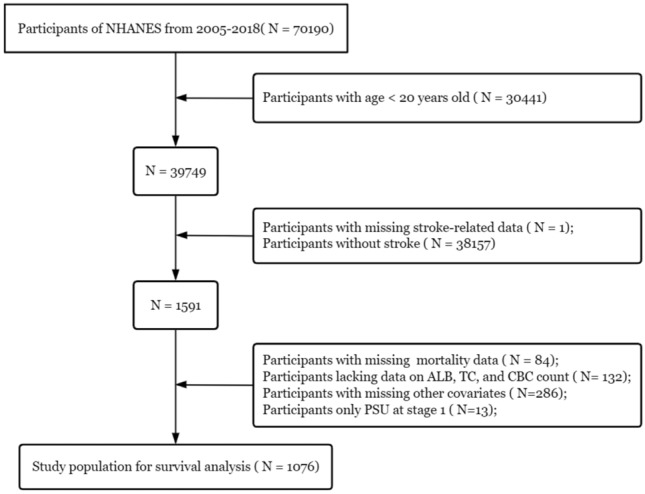
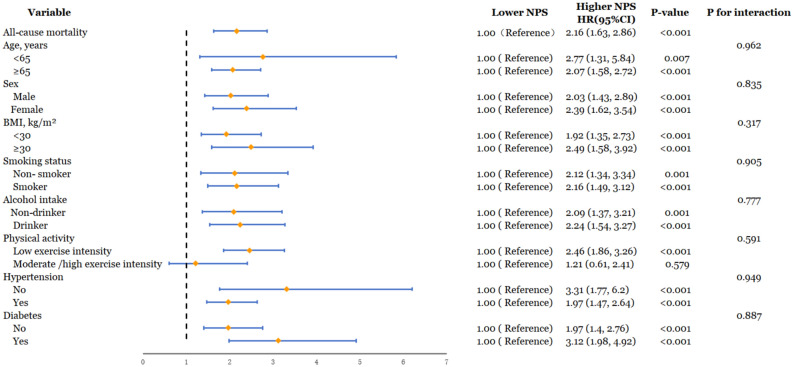
The study aimed to evaluate the relationship between immunonutritional indicators such as the systemic immune-inflammation index (SII), the Naples prognostic score (NPS), nutritional risk index (NRI), serum albumin (ALB), total cholesterol (TC) and all-cause mortality in adult stroke patients. Data were obtained from the National Health and Nutrition Examination Survey (NHANES) databases for 2005-2018. To determine mortality outcomes, participants were matched with National Death Index records until December 31, 2019. Spearman's correlation analysis and the random survival forest (RSF) were employed to assess the relationships among NPS, NRI, SII, ALB, and TC, and to determine the most predictive indicator for all-cause mortality in stroke patients. For the selected prognostic indicator, Kaplan-Meier survival analysis and Cox proportional hazards regression models were subsequently utilized to evaluate their associations with all-cause mortality in stroke patients. The study included 1076 stroke patients, with a median (IQR) age of 67 (56, 77) years. During a median follow-up of 67 months, a total of 372 (weighted 31%) stroke participants died from all causes. Among the immunonutritional indicators evaluated, NPS had the strongest predictive power for all-cause mortality in stroke patients. The Kaplan-Meier curve and Log-rank test showed that all-cause mortality was higher in the higher NPS group (3-4) compared to the lower NPS group (0-2) (P < 0.001). After adjusting for multiple potential confounders, the Cox regression model indicated that the higher NPS (3-4) group remained an independent predictor for higher all-cause mortality risk (HR = 1.89, 95% CI 1.44-2.47, P < 0.001). As a comprehensive evaluation index of inflammation and nutrition, NPS is a powerful predictor of all-cause mortality in stroke patients.
该研究旨在评估全身免疫炎症指数(SII)、那不勒斯预后评分(NPS)、营养风险指数(NRI)、血清白蛋白(ALB)、总胆固醇(TC)等免疫营养指标与成年中风患者全因死亡率之间的关系。数据来自2005 - 2018年的美国国家健康与营养检查调查(NHANES)数据库。为确定死亡结局,将参与者与截至2019年12月31日的国家死亡指数记录进行匹配。采用Spearman相关性分析和随机生存森林(RSF)来评估NPS、NRI、SII、ALB和TC之间的关系,并确定中风患者全因死亡率的最具预测性指标。对于选定的预后指标,随后使用Kaplan - Meier生存分析和Cox比例风险回归模型来评估它们与中风患者全因死亡率的关联。该研究纳入了1076例中风患者,年龄中位数(IQR)为67(56,77)岁。在中位随访67个月期间,共有372例(加权31%)中风参与者死于各种原因。在评估的免疫营养指标中,NPS对中风患者全因死亡率具有最强的预测能力。Kaplan - Meier曲线和对数秩检验显示,与较低NPS组(0 - 2)相比,较高NPS组(3 - 4)的全因死亡率更高(P < 0.001)。在调整多个潜在混杂因素后,Cox回归模型表明,较高NPS(3 - 4)组仍然是全因死亡风险较高的独立预测因素(HR = 1.89,95% CI 1.44 - 2.47,P < 0.001)。作为炎症和营养的综合评估指标,NPS是中风患者全因死亡率的有力预测因素。