
在B细胞清除疗法期间,自身抗体的Fab糖基化水平升高得以维持。
Elevated Fab glycosylation of autoantibodies maintained during B cell depletion therapy.
作者信息
Valk Anika M, Koers Jana, Derksen Ninotska I L, Hogenboom Laura, van Kempen Zoé, Killestein Joep, Rutgers Abraham, Heeringa Peter, Horváth Barbara, Kuijpers Taco W, van Ham S Marieke, Brinke Anja Ten, van der Woude Diane, Toes René E M, Bos Nicolaas A, Rispens Theo
机构信息
Department of Immunopathology, Sanquin Research and Landsteiner Laboratory, Amsterdam University Medical Center, Plesmanlaan 125, 1066 CX, Amsterdam, The Netherlands.
Swammerdam Institute of Life Sciences, University of Amsterdam, Amsterdam, The Netherlands.
出版信息
Sci Rep. 2025 Apr 28;15(1):14770. doi: 10.1038/s41598-025-99226-y.
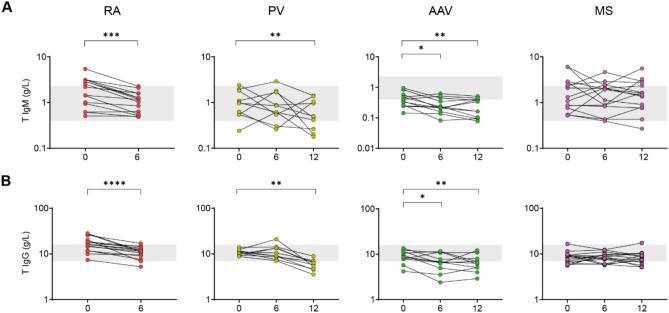
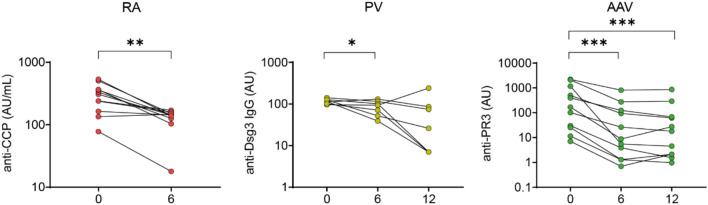
Several chronic autoimmune diseases are characterized by elevated autoantibody Fab glycosylation. Whether Fab glycans link to disease state or development remains unclear, yet may serve as a marker thereof. Many autoimmune diseases are treated with B cell depletion therapies that particularly result in a decline of autoantibodies. The question arises whether B cell depletion therapy may have an impact on Fab glycosylation. Here, we investigated the longitudinal effects of B cell depletion therapy on Fab glycosylation of total IgG and IgG autoantibodies in rheumatoid arthritis (RA), pemphigus vulgaris (PV), ANCA-associated vasculitis (AAV), and multiple sclerosis (MS). Baseline Fab glycosylation was compared to 6-12 months into therapy by lectin affinity chromatography, determining Fab sialylation as an estimate of Fab glycosylation. We observed a modest decrease in Fab glycosylation of total IgG for RA (median 13.8%[IQR 11.7-16.3] - 9.1%[IQR8-11]) and PV (16.4%[IQR14.9-17.5] - 13.01%[IQR10.8-15.5]) after 6 months, whereas for AAV Fab glycosylation slightly increased (11.6%[IQR7.4-15] - 14.9%[IQR11.4-19.3]), and no changes were found for MS. Autoantibody titers (anti-CCP, anti-PR3, anti-Dsg3) had declined following B cell depletion therapy, yet their elevated Fab glycosylation levels were maintained. Taken together, Fab glycosylation levels of autoantibodies do not decrease upon B cell depletion therapy, thereby retaining their predictive potential as biomarker.
几种慢性自身免疫性疾病的特征是自身抗体Fab糖基化升高。Fab聚糖是否与疾病状态或发展相关尚不清楚,但可能作为其标志物。许多自身免疫性疾病采用B细胞耗竭疗法治疗,这尤其会导致自身抗体减少。问题是B细胞耗竭疗法是否会对Fab糖基化产生影响。在这里,我们研究了B细胞耗竭疗法对类风湿性关节炎(RA)、寻常型天疱疮(PV)、抗中性粒细胞胞浆抗体相关性血管炎(AAV)和多发性硬化症(MS)中总IgG和IgG自身抗体的Fab糖基化的纵向影响。通过凝集素亲和色谱法将基线Fab糖基化与治疗6至12个月后的情况进行比较,将Fab唾液酸化作为Fab糖基化的估计值。我们观察到,6个月后,RA(中位数13.8%[四分位间距11.7 - 16.3] - 9.1%[四分位间距8 - 11])和PV(16.4%[四分位间距14.9 - 17.5] - 13.01%[四分位间距10.8 - 15.5])的总IgG的Fab糖基化略有下降,而AAV的Fab糖基化略有增加(11.6%[四分位间距7.4 - 15] - 14.9%[四分位间距11.4 - 19.3]),MS则未发现变化。B细胞耗竭疗法后自身抗体滴度(抗环瓜氨酸肽抗体、抗蛋白酶3抗体、抗桥粒芯糖蛋白3抗体)下降,但其升高的Fab糖基化水平得以维持。综上所述,B细胞耗竭疗法后自身抗体的Fab糖基化水平不会降低,从而保留了其作为生物标志物的预测潜力。

 Zotero 插件