Qi Tong-Tong, Zhou Si-Jiang, Yu Zhu, Li Yong, Chen Jun-Qiang
Department of Gastrointestinal Surgery, The First Affiliated Hospital of Guangxi Medical University, Nanning, Guangxi Zhuang Autonomous Region, China.
Guangxi Key Laboratory of Enhanced Recovery After Surgery for Gastrointestinal Cancer, Nanning, China.
BMC Gastroenterol. 2025 Apr 28;25(1):303. doi: 10.1186/s12876-025-03920-0.
The differentiation characteristics of neutrophils within the gastric cancer (GC) tumor microenvironment (TME) and their interactions with malignant gastric epithelial cells require further investigation. Furthermore, the therapeutic potential of tumor-associated neutrophils (TANs) in immunotherapy remains inadequately explored.
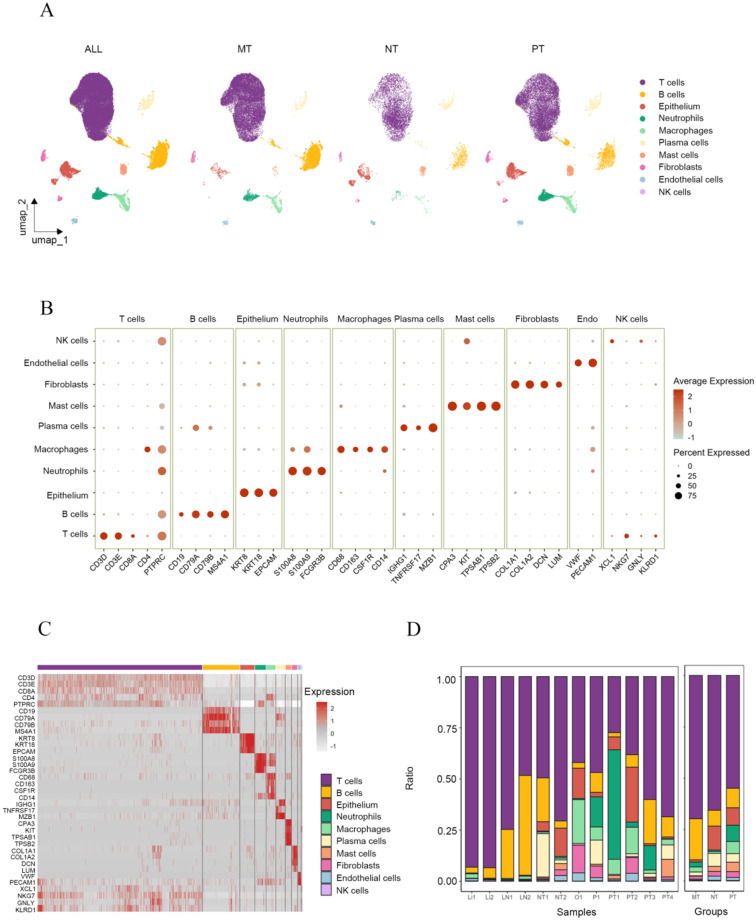
We integrated two single-cell transcriptome datasets comprising 12 samples, including gastric primary tumors, non-tumor tissues, and metastatic tumors, to profile the epithelial cells and TANs atlas within the TME and examine their interaction modules. In addition, these data were integrated with the bulk transcriptomic including the Cancer Genome Atlas - Stomach Adenocarcinoma (TCGA-STAD) and Asian Cancer Research Group (ACRG) datasets to analyze the expression levels of neutrophil-associated genes across the tumor-associated neutrophil subsets.
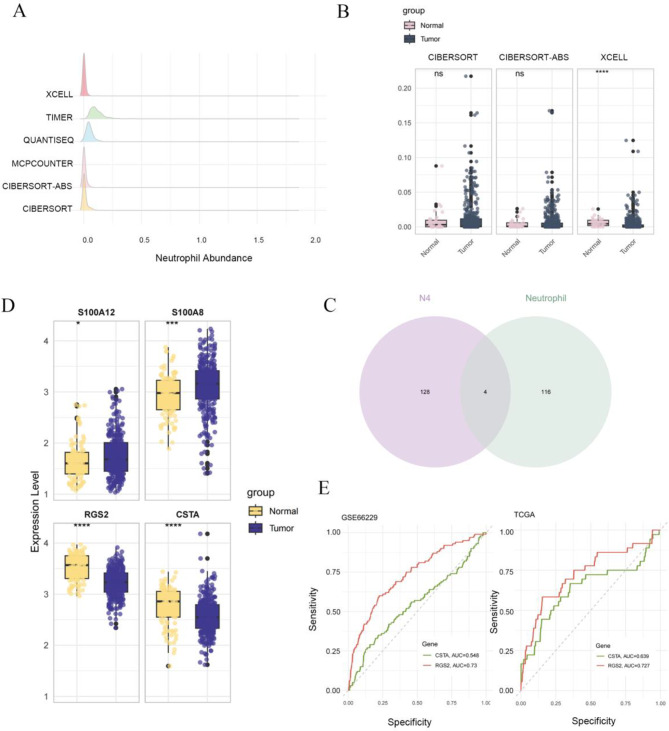
We analyzed 3,118 gastric epithelial cells and 2,365 TANs from all samples. Epithelial cells were classified into ten subclusters, while TANs were grouped into five subclusters. In gastric primary tumors, epithelial cell subtypes included primarily MUC16 + and stem-like populations. In metastatic tumors, the epithelial cell subset with high CXCL5 expression was a characteristic subtype. TANs mainly interacted with epithelial cells via the LGALS9-CD45 and CD46-JAG1 pathways. And RGS2 was highly expressed in N4, a tumor-associated neutrophils subcluster characterized by high MMP9 expression, highlighting its potential as an immunotherapy target.
TANs exhibit robust interactions with gastric malignant epithelial cell subsets. Furthermore, RGS2, which is highly expressed in N4, could serve as a promising target for immunotherapy.
胃癌(GC)肿瘤微环境(TME)中中性粒细胞的分化特征及其与恶性胃上皮细胞的相互作用有待进一步研究。此外,肿瘤相关中性粒细胞(TANs)在免疫治疗中的治疗潜力仍未得到充分探索。
我们整合了两个包含12个样本的单细胞转录组数据集,包括胃原发性肿瘤、非肿瘤组织和转移性肿瘤,以描绘TME内的上皮细胞和TANs图谱,并检查它们的相互作用模块。此外,这些数据与包括癌症基因组图谱-胃腺癌(TCGA-STAD)和亚洲癌症研究组(ACRG)数据集在内的批量转录组数据相结合,以分析肿瘤相关中性粒细胞亚群中中性粒细胞相关基因的表达水平。
我们分析了所有样本中的3118个胃上皮细胞和2365个TANs。上皮细胞被分为十个亚群,而TANs被分为五个亚群。在胃原发性肿瘤中,上皮细胞亚型主要包括MUC16+和干细胞样群体。在转移性肿瘤中,CXCL5表达高的上皮细胞亚群是一种特征性亚型。TANs主要通过LGALS9-CD45和CD46-JAG1途径与上皮细胞相互作用。RGS2在N4中高表达,N4是一个以高MMP9表达为特征的肿瘤相关中性粒细胞亚群,突出了其作为免疫治疗靶点的潜力。
TANs与胃恶性上皮细胞亚群表现出强烈的相互作用。此外,在N4中高表达的RGS2可能成为免疫治疗的一个有前景的靶点。