Zhang Zhihui, Wang Meizhen, Yang Zhaoping, Comes Hans Peter, Zhong Xin, Folk Ryan A, Song Yigang, York Dana A, Cameron Kenneth M, Li Pan
Systematic & Evolutionary Botany and Biodiversity Group, State Key Laboratory for Vegetation Structure, Function and Construction, College of Life Sciences, Zhejiang University, Hangzhou, 310058, China.
College of Biology and Environmental Engineering, Zhejiang Shuren University, Hangzhou, Zhejiang, China.
BMC Biol. 2025 Apr 28;23(1):113. doi: 10.1186/s12915-025-02204-z.
Phylogenetic research in Tulipa (Liliaceae), a genus of significant economic and horticultural value, has relied on limited nuclear (mostly nuclear ribosomal internal transcribed spacer, nrITS) and plastid DNA sequences, resulting in low-resolution phylogenetic trees and uncertain intrageneric classifications. The genus, noted for its large genome, presents discordant relationships among Amana, Erythronium, and Tulipa, likely due to incomplete lineage sorting (ILS) and/or reticulate evolution. Thus, phylogenomic approaches are needed to clarify these relationships and the conflicting signals within the tribe Tulipeae.
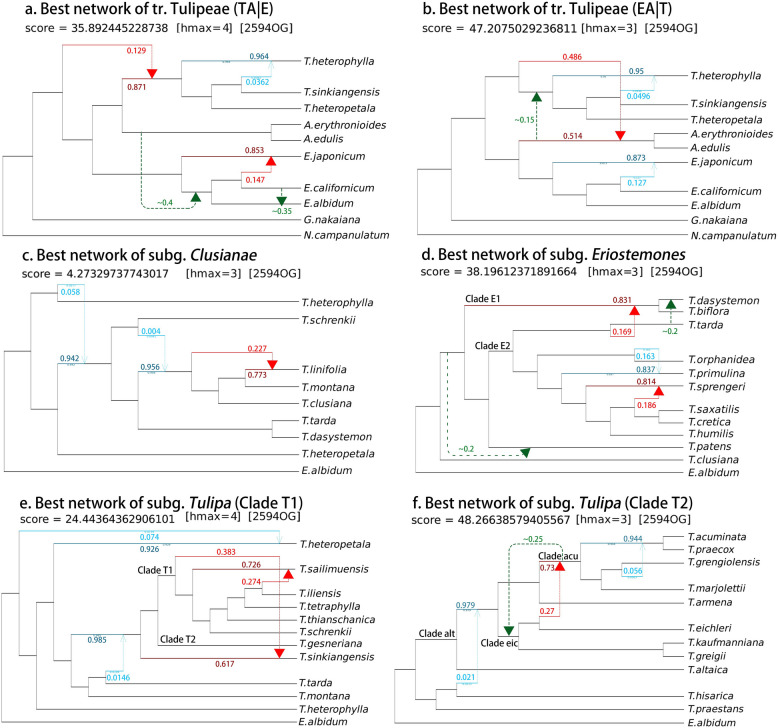
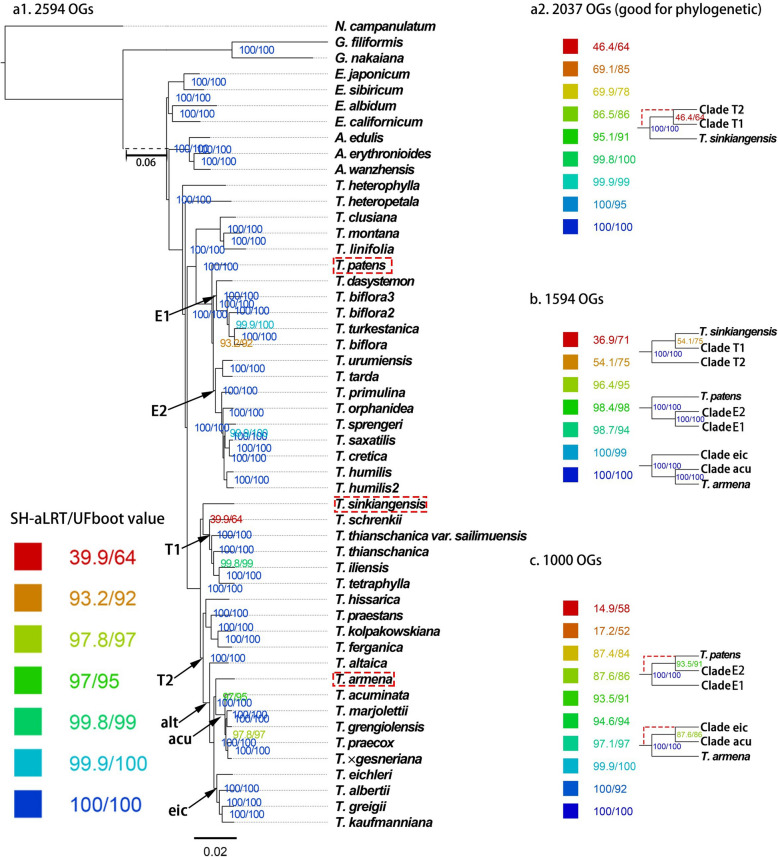
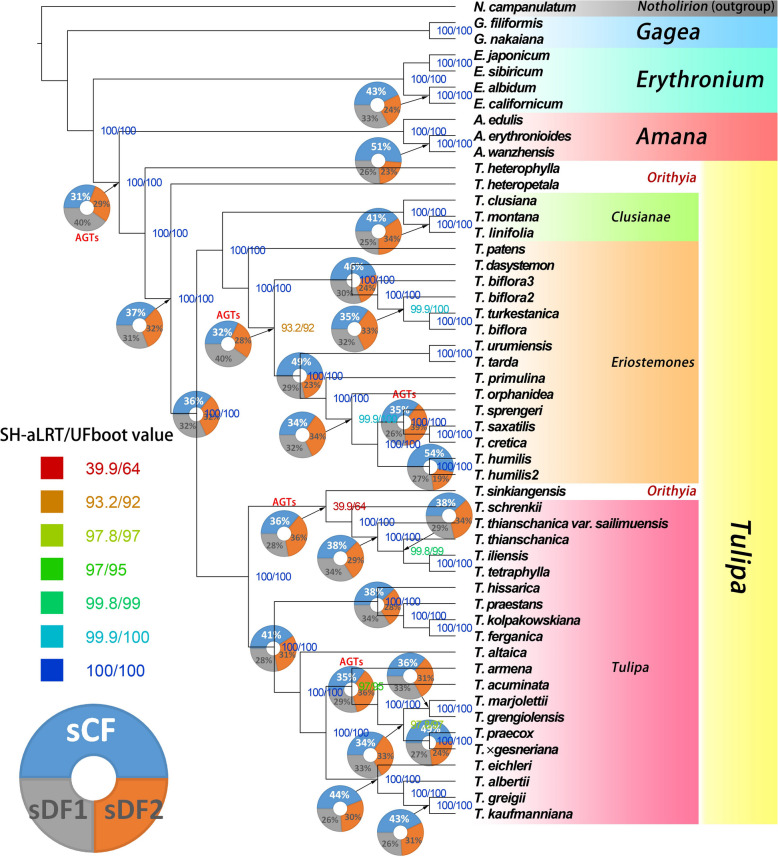
We newly sequenced 50 transcriptomes of 46 species of tribe Tulipeae (including multiple accessions of all four genera) and one outgroup species of the sister tribe Lilieae (Notholirion campanulatum), and downloaded 15 previously published transcriptomes of tribe Tulipeae to supplement the sampling. One plastid dataset (74 plastid protein-coding genes, PCGs) and one nuclear dataset (2594 nuclear orthologous genes, OGs) were constructed, with the latter used for species tree inference based on maximum likelihood (ML) and multi-species coalescent (MSC) methods. To investigate causes of gene tree discordance, "site con/discordance factors" (sCF and sDF1/sDF2) were calculated first, after which phylogenetic nodes displaying high or imbalanced sDF1/2 were selected for phylogenetic network analyses and polytomy tests to determine whether ILS or reticulate evolution best explain incongruence. Key relationships not resolved by this technique, especially those among Amana, Erythronium, and Tulipa, were further investigated by applying D-statistics and QuIBL.
We failed to reconstruct a reliable and unambiguous evolutionary history among Amana, Erythronium, and Tulipa due to especially pervasive ILS and reticulate evolution, likely caused either by obscured minority phylogenetic signal or differing signals among genomic compartments. However, within Tulipa we confirmed the monophyly of most subgenera, with the exception of two species in the small subgenus Orithyia, of which Tulipa heterophylla was recovered as sister to the remainder of the genus, whereas T. sinkiangensis clustered within subgenus Tulipa. In contrast, most traditional sections of Tulipa were found to be non-monophyletic.
郁金香属(百合科)具有重要的经济和园艺价值,其系统发育研究依赖于有限的核基因(主要是核核糖体内部转录间隔区,nrITS)和质体DNA序列,导致系统发育树分辨率较低且属内分类不明确。该属以其庞大的基因组而闻名,在顶冰花属、猪牙花属和郁金香属之间呈现出不一致的关系,这可能是由于不完全谱系分选(ILS)和/或网状进化所致。因此,需要采用系统基因组学方法来阐明这些关系以及郁金香族内相互冲突的信号。
我们新测序了郁金香族46个物种(包括所有四个属的多个样本)和姐妹族百合族(钟花假百合)的一个外类群物种的50个转录组,并下载了15个先前发表的郁金香族转录组以补充样本。构建了一个质体数据集(74个质体蛋白编码基因,PCGs)和一个核数据集(2594个核直系同源基因,OGs),后者用于基于最大似然(ML)和多物种溯祖(MSC)方法的物种树推断。为了研究基因树不一致的原因,首先计算了“位点一致/不一致因子”(sCF和sDF1/sDF2),之后选择显示高或不平衡sDF1/2的系统发育节点进行系统发育网络分析和多歧检验,以确定ILS或网状进化是否最能解释不一致性。通过应用D统计和QuIBL进一步研究了该技术未解决的关键关系,特别是顶冰花属、猪牙花属和郁金香属之间的关系。
由于特别普遍的ILS和网状进化,可能是由于少数系统发育信号模糊或基因组区域之间的信号不同,我们未能重建顶冰花属、猪牙花属和郁金香属之间可靠且明确的进化历史。然而,在郁金香属内,我们确认了大多数亚属的单系性,但小亚属山慈姑亚属中的两个物种除外,其中异叶郁金香被发现是该属其余部分的姐妹种,而新疆郁金香则聚类在郁金香亚属内。相比之下,郁金香属的大多数传统组被发现不是单系的。