Kayar İlkan, Birge Özer, Çetin Ferhat
Department of Obstetrics and Gynecology, Osmaniye State Hospital, Turkey.
Department of Gynecological Oncology, Niger Turkey Friendship Hospital, Niger.
J Int Med Res. 2025 Apr;53(4):3000605251335796. doi: 10.1177/03000605251335796. Epub 2025 Apr 29.
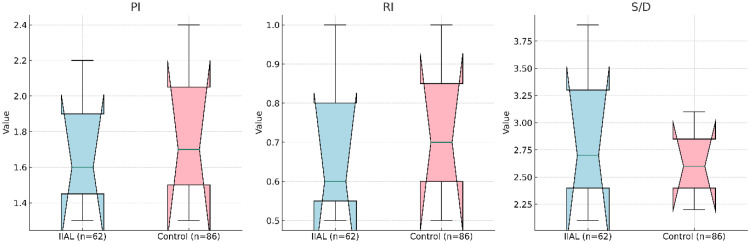
ObjectiveInternal iliac artery ligation due to severe postpartum hemorrhage has several pathophysiological consequences in terms of blood supply of the uterus. In this context, this study aimed to evaluate the sonographic changes in the uterine arteries after internal iliac artery ligation.MethodsThe population of this case-control study consisted of women unresponsive to conservative medical treatment who underwent internal iliac artery ligation for severe postpartum hemorrhage between January 2022 and December 2022. Women who underwent internal iliac artery ligation were included in the internal iliac artery ligation group, and those with similar postpartum age, parity, and body mass index were included in the control group. This retrospective case-control study included 62 patients with postpartum hemorrhage and ongoing bleeding despite all conservative medical treatments who underwent internal iliac artery ligation as well as 86 patients who were also in the postpartum period and had similar age, body mass index, and parity but did not have a history of postpartum hemorrhage at birth and did not undergo internal iliac artery ligation. The pulsatility index, resistance index, and maximal-to-minimal diastolic flow of the uterine arteries were calculated using color and pulsed Doppler imaging at the 6-month follow-up and compared between the two groups.ResultsThere were 62 and 86 women in the internal iliac artery ligation and control groups, respectively. There was no significant difference between the two groups in terms of demographic and clinical characteristics and obstetric history (p > 0.05). There was also no significant difference between the two groups in terms of the pulsatility index, resistance index, and maximal-to-minimal diastolic flow of the uterine arteries determined at the 6-month follow-up (p > 0.05).ConclusionThe study's findings demonstrated that internal iliac artery ligation has no adverse effect on the sonographic blood flow indexes of the uterine arteries in women with postpartum hemorrhage.
因严重产后出血而行髂内动脉结扎术对子宫血供会产生多种病理生理后果。在此背景下,本研究旨在评估髂内动脉结扎术后子宫动脉的超声变化。
本病例对照研究的对象为2022年1月至2022年12月期间因严重产后出血接受髂内动脉结扎术且对保守药物治疗无反应的女性。接受髂内动脉结扎术的女性纳入髂内动脉结扎组,产后年龄、产次和体重指数相似的女性纳入对照组。这项回顾性病例对照研究包括62例产后出血且经所有保守药物治疗后仍持续出血并接受髂内动脉结扎术的患者,以及86例同样处于产后阶段、年龄、体重指数和产次相似但出生时无产后出血史且未接受髂内动脉结扎术的患者。在6个月随访时使用彩色和脉冲多普勒成像计算子宫动脉的搏动指数、阻力指数和舒张期最大血流与最小血流之比,并在两组之间进行比较。
髂内动脉结扎组和对照组分别有62例和86例女性。两组在人口统计学和临床特征以及产科病史方面无显著差异(p>0.05)。两组在6个月随访时测定的子宫动脉搏动指数、阻力指数和舒张期最大血流与最小血流之比也无显著差异(p>0.05)。
该研究结果表明,髂内动脉结扎术对产后出血女性子宫动脉的超声血流指标无不良影响。