Cheng Lufeng, Jia Bingyang, Wang Chuanlei, Fu Qingxi, Zhou Lingyan
Department of Neurology, Linyi People's Hospital, Linyi, Shandong, China.
Department of Cardiothoracic Surgery, Linyi People's Hospital, Linyi, Shandong, China.
Cell Death Discov. 2025 Apr 29;11(1):207. doi: 10.1038/s41420-025-02459-z.
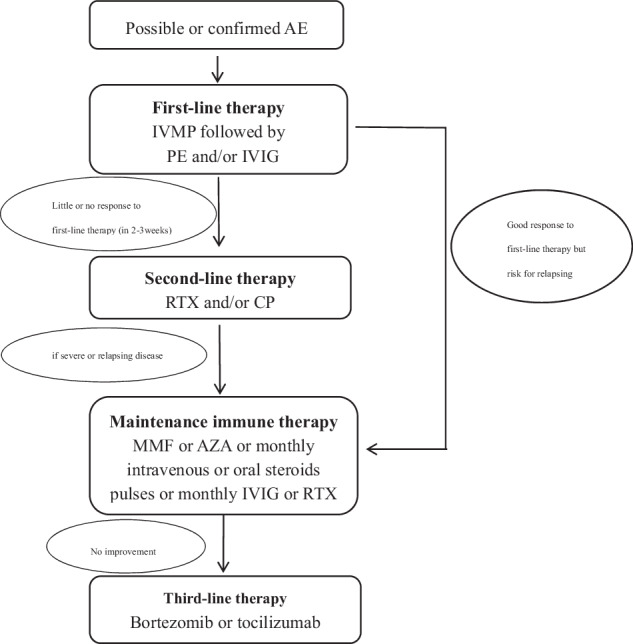
Autoimmune encephalitis (AE) is increasingly recognized as a cause of brain disorders that greatly benefit from immunotherapy. Starting treatment quickly and increasing the use of immunotherapy can lead to better results for AE patients. Currently, there are standardized treatment guidelines for treating AE. First-line therapy includes intravenous corticosteroids, plasma exchange, and intravenous immunoglobulin. Second-line therapy involves rituximab, cyclophosphamide, mycophenolate mofetil, and azathioprine. Third-line therapy uses agents that deplete plasma cells (bortezomib, daratumumab, and obinutuzumab), drugs that modulate cytokines (tocilizumab, anakinra, tofacitinib, and interleukin-2), and treatments that target intrathecal immune cells (intrathecal methotrexate). This review aims to summarize the immunotherapeutic strategies available for treating AE and provide an update on refractory AE.
自身免疫性脑炎(AE)越来越被认为是一种可从免疫治疗中大大获益的脑部疾病病因。迅速开始治疗并增加免疫治疗的使用可使AE患者获得更好的疗效。目前,针对AE的治疗有标准化的治疗指南。一线治疗包括静脉注射皮质类固醇、血浆置换和静脉注射免疫球蛋白。二线治疗涉及利妥昔单抗、环磷酰胺、霉酚酸酯和硫唑嘌呤。三线治疗使用消耗浆细胞的药物(硼替佐米、达雷妥尤单抗和奥滨尤妥珠单抗)、调节细胞因子的药物(托珠单抗、阿那白滞素、托法替布和白细胞介素-2)以及靶向鞘内免疫细胞的治疗方法(鞘内注射甲氨蝶呤)。本综述旨在总结可用于治疗AE的免疫治疗策略,并提供难治性AE的最新情况。