Ping Xinxin, Chen Yuan, Wang Hui, Jin Zhuoya, Duan Qianting, Ren Zhanjun, Dong Xianggui
Key Laboratory of Animal Genetics, Breeding and Reproduction of Shaanxi Province, College of Animal Science and Technology, Northwest A&F University, Yangling, 712100, China.
BMC Genomics. 2025 Apr 29;26(1):425. doi: 10.1186/s12864-025-11616-8.
Runs of homozygosity (ROH) are continuous segments of homozygous genotypes inherited from both parental lineages. These segments arise due to the transmission of identical haplotypes. The genome-wide patterns and hotspot regions of ROH provide valuable insights into genetic diversity, demographic history, and selection trends. In this study, we analyzed whole-genome resequencing data from 117 rabbits to identify ROH patterns and inbreeding level across eleven rabbit breeds, including seven Chinese indigenous breeds and four exotic breeds, and to uncover selective signatures based on ROH islands.
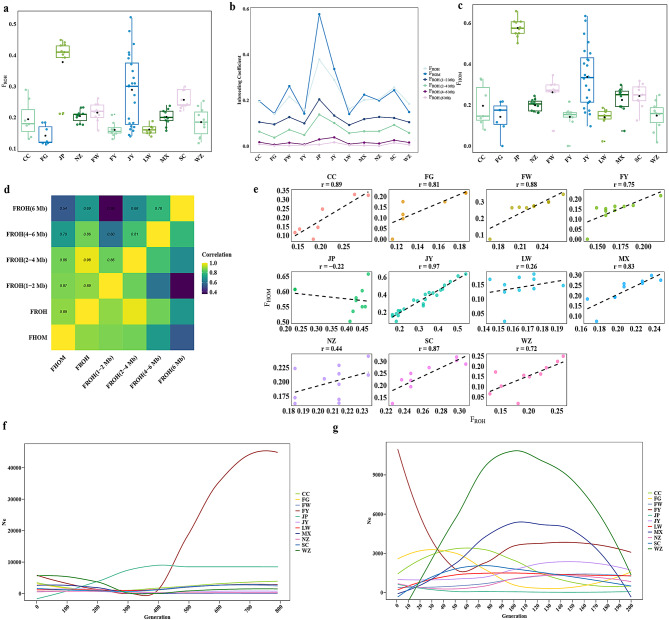
We detected a total of 31,429 ROHs across the autosomes of all breeds, with the number of ROHs (N) per breed ranging from 1316 to 7476. The mean sum of ROHs length (S) per individual was 493.84 Mb, covering approximately 22.79% of the rabbit autosomal genome. The majority of the detected ROHs ranged from 1 to 2 Mb in length, with an average ROH length (L) of 1.84 Mb. ROHs longer than 6 Mb constituted only 0.83% of the detected ROHs. The average inbreeding coefficient derived from ROHs (F) was 0.23, with F values ranging from 0.14 to 0.38 across breeds. Among Chinese indigenous breeds, the Jiuyishan rabbit exhibited the highest values of N, S, L, and F, whereas the Fujian Yellow rabbit had the lowest F values. In exotic rabbit breeds, the Japanese White rabbit displayed the highest values for N, S, L, and F, while the Flemish Giant rabbit had the lowest values for these metrics. Additionally, we identified 17 ROH islands in Chinese indigenous breeds and 22 ROH islands in exotic rabbit breeds, encompassing 124 and 186 genes, respectively. In Chinese indigenous breeds, we identified prominent genes associated with reproduction, including CFAP206, RNF133, CPNE4, ASTE1, and ATP2C1, as well as genes related to adaptation, namely CADPS2, FEZF1, and EPHA7. In contrast, the exotic breeds exhibited a prevalence of genes associated with fat deposition, such as ELOVL3 and NPM3, as well as growth and body weight related genes, including FAM184B, NSMCE2, and TWNK.
This study enhances our understanding of genetic diversity and selection pressures in domestic rabbits, offering valuable implications for breeding management and conservation strategies.
纯合子片段(ROH)是从双亲谱系遗传而来的纯合基因型的连续片段。这些片段由于相同单倍型的传递而产生。全基因组范围内的ROH模式和热点区域为遗传多样性、种群历史和选择趋势提供了有价值的见解。在本研究中,我们分析了117只兔子的全基因组重测序数据,以确定11个兔品种(包括7个中国本土品种和4个外来品种)的ROH模式和近亲繁殖水平,并基于ROH岛揭示选择特征。
我们在所有品种的常染色体上共检测到31429个ROH,每个品种的ROH数量(N)从1316到7476不等。每个个体的ROH长度总和(S)平均为493.84Mb,覆盖了兔常染色体基因组的约22.79%。检测到的大多数ROH长度在1至2Mb之间,平均ROH长度(L)为1.84Mb。长度超过6Mb的ROH仅占检测到的ROH的0.83%。由ROH得出的平均近亲繁殖系数(F)为0.23,各品种的F值在0.14至0.38之间。在中国本土品种中,九嶷山兔的N、S、L和F值最高,而福建黄兔的F值最低。在外来兔品种中,日本白兔的N、S、L和F值最高,而弗拉芒巨兔的这些指标值最低。此外,我们在中国本土品种中鉴定出17个ROH岛,在外来兔品种中鉴定出22个ROH岛,分别包含124个和186个基因。在中国本土品种中,我们鉴定出与繁殖相关的重要基因,包括CFAP206、RNF133、CPNE4、ASTE1和ATP2C1,以及与适应性相关的基因,即CADPS2、FEZF1和EPHA7。相比之下,外来品种中与脂肪沉积相关的基因,如ELOVL3和NPM3,以及与生长和体重相关的基因,包括FAM184B、NSMCE2和TWNK更为普遍。
本研究增进了我们对家兔遗传多样性和选择压力的理解,为育种管理和保护策略提供了有价值的启示。