Li Yang, Ni Yunfeng, Lv Feng, Shi Yan, Chen Yedan, Wu Xiaoying, Pang Jiaohui, Huang Long, Shao Yang, Wang Tao, Min Jie, Song Yang
Department of Respiratory and Critical Care Medicine, The First Affiliated Hospital of Xi'an Jiaotong University, Xi'an, Shaanxi, China.
Department of Thoracic Surgery, Tangdu Hospital, Fourth Military Medical University, Xi'an, Shaanxi, China.
BMC Med. 2025 Apr 29;23(1):249. doi: 10.1186/s12916-025-04075-1.
Epidermal growth factor receptor (EGFR) exon 19 insertions (19ins) represent a unique subclass of exon 19 alterations that has a relatively low frequency. Here, we aimed to elucidate the molecular characteristics and response to EGFR tyrosine kinase inhibitors (EGFR-TKIs) in lung cancer patients with EGFR 19ins.
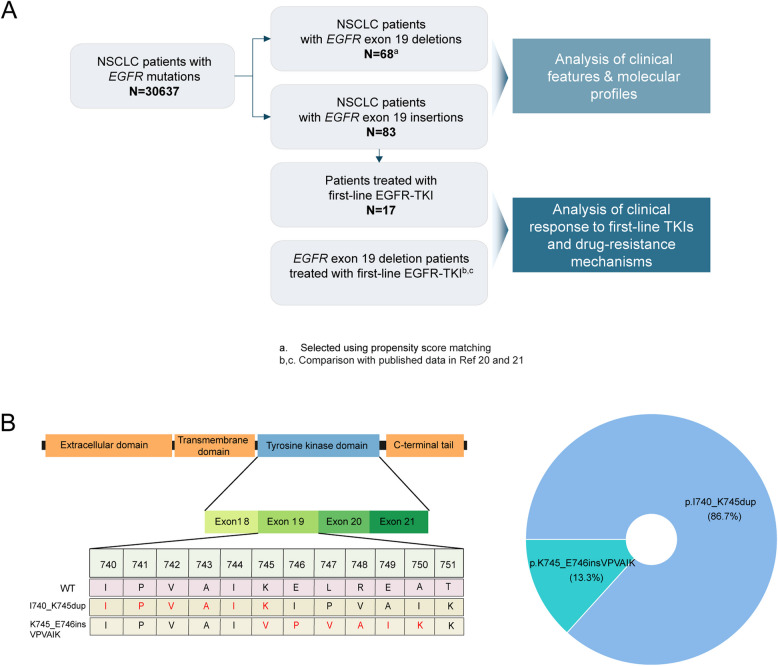
Next-generation sequencing was performed to profile the molecular characteristics of 83 non-small cell lung cancer (NSCLC) patients with EGFR 19ins. Detailed molecular profiling and efficacy analyses were performed on these patients, with comparisons to 68 EGFR 19 deletion (19del) patients. Potential resistance mechanisms were also explored.
The prevalence of EGFR 19ins mutations was 0.17% of all the primary NSCLC patients. EGFR 19ins variants identified were I740_K745dup (86.7%) and K745_E746insVPVAIK (13.3%). Concurrent mutations frequently observed were in TP53 (50.6%), CDKN2A (12.0%), PIK3CA (10.8%), LRP1B (8.4%), and SMAD4 (8.4%). Notably, CTNNB1 was significantly associated with 19ins (p = 0.043). Efficacy analysis showed median progression-free survival (mPFS) for EGFR 19ins patients receiving first-line EGFR-TKI treatment was significantly shorter than for EGFR 19del patients (hazard ratio (HR) 1.98, p = 0.005). Gefitinib was significantly less effective compared to other first-generation TKIs (HR 19.86, p < 0.001). Furthermore, osimertinib did not generate favorable outcomes as 19dels in the first-line setting either (p = 0.025). Post-treatment samples revealed higher occurrences of TP53 mutations (84.6%) and presence of EGFR T790M (23.1%) at progression, with case studies highlighting osimertinib's limited efficacy post-first-line treatment.
Comprehensive analysis of EGFR 19ins in lung cancer patients revealed genomic characteristics and clinical response, helping better inform clinical action and might facilitate the development of more precise therapeutic options for patients with these uncommon driver mutations.
表皮生长因子受体(EGFR)外显子19插入(19ins)代表外显子19改变的一个独特亚类,其发生频率相对较低。在此,我们旨在阐明携带EGFR 19ins的肺癌患者的分子特征及对EGFR酪氨酸激酶抑制剂(EGFR-TKIs)的反应。
对83例携带EGFR 19ins的非小细胞肺癌(NSCLC)患者进行下一代测序,以分析其分子特征。对这些患者进行详细的分子分析和疗效分析,并与68例EGFR 19缺失(19del)患者进行比较。同时还探索了潜在的耐药机制。
EGFR 19ins突变在所有原发性NSCLC患者中的发生率为0.17%。鉴定出的EGFR 19ins变体为I740_K745dup(86.7%)和K745_E746insVPVAIK(13.3%)。常见的并发突变发生在TP53(50.6%)、CDKN2A(12.0%)、PIK3CA(10.8%)、LRP1B(8.4%)和SMAD4(8.4%)。值得注意的是,CTNNB1与19ins显著相关(p = 0.043)。疗效分析显示,接受一线EGFR-TKI治疗的EGFR 19ins患者的中位无进展生存期(mPFS)显著短于EGFR 19del患者(风险比(HR)1.98,p = 0.005)。与其他第一代TKIs相比,吉非替尼的疗效显著较差(HR 19.86,p < 0.001)。此外,在一线治疗中,奥希替尼也未产生与19del患者相似的良好疗效(p = 0.025)。治疗后样本显示,进展时TP53突变的发生率较高(84.6%),且存在EGFR T790M(23.1%),病例研究突出了奥希替尼一线治疗后的疗效有限。
对肺癌患者EGFR 19ins的综合分析揭示了基因组特征和临床反应,有助于更好地指导临床决策,并可能促进为这些罕见驱动基因突变患者开发更精确的治疗方案。