Demetriou Aphrodite, Lindqvist Birgitta, Ali Heba G, Shamekh Mohamed M, Varshney Mukesh, Inzunza Jose, Maioli Silvia, Nilsson Per, Nalvarte Ivan
Department of Neurobiology, Care Sciences and Society, Division of Neurogeriatrics, Karolinska Institutet, Visionsgatan 4, J9:20, 171 64, Solna, Sweden.
Department of Biosciences and Nutrition, Karolinska Institutet, 141 57, Huddinge, Sweden.
Biol Sex Differ. 2025 Apr 29;16(1):29. doi: 10.1186/s13293-025-00711-w.
Menopausal loss of neuroprotective estrogen is thought to contribute to the sex differences in Alzheimer's disease (AD). Activation of estrogen receptor beta (ERβ) can be clinically relevant since it avoids the adverse systemic effects of ERα activation. However, very few studies have explored ERβ-mediated neuroprotection in AD, and no information on its contribution to the sex differences in AD exists. In the present study, we specifically explored the role of ERβ in mediating sex-specific protection against AD pathology in the App knock-in mouse model of amyloidosis, and if surgical menopause (ovariectomy) modulates pathology in this model.
We treated male and female App knock-in mice with the clinically relevant and selective ERβ agonist LY500307. A subset of the females was ovariectomized prior to treatment. Y-maze and contextual fear conditioning tests were used to assess memory performance, and biochemical assays such as qPCR, immunohistochemistry, Western blot, and multiplex immunoassays, were used to evaluate amyloid pathology.
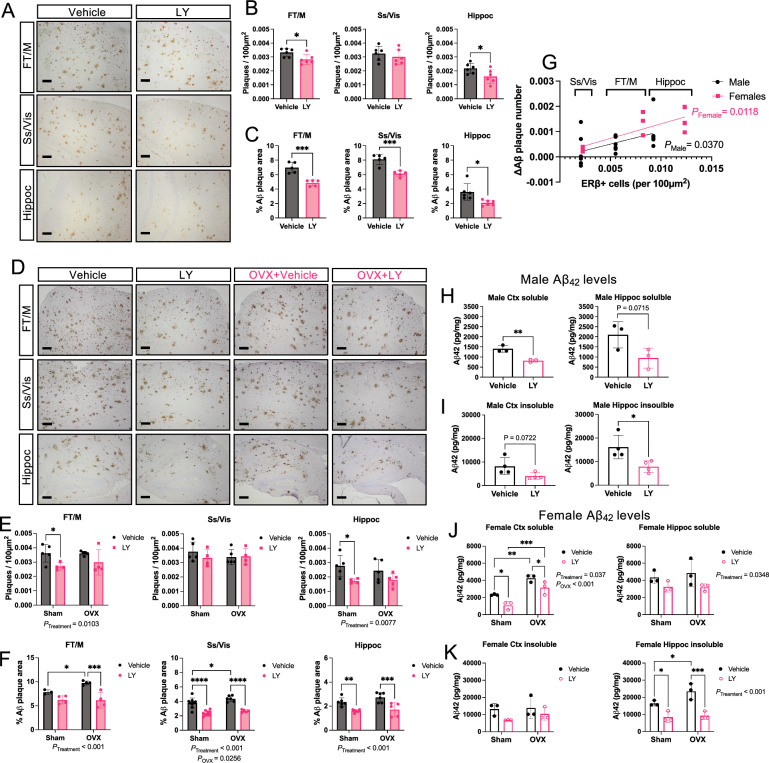
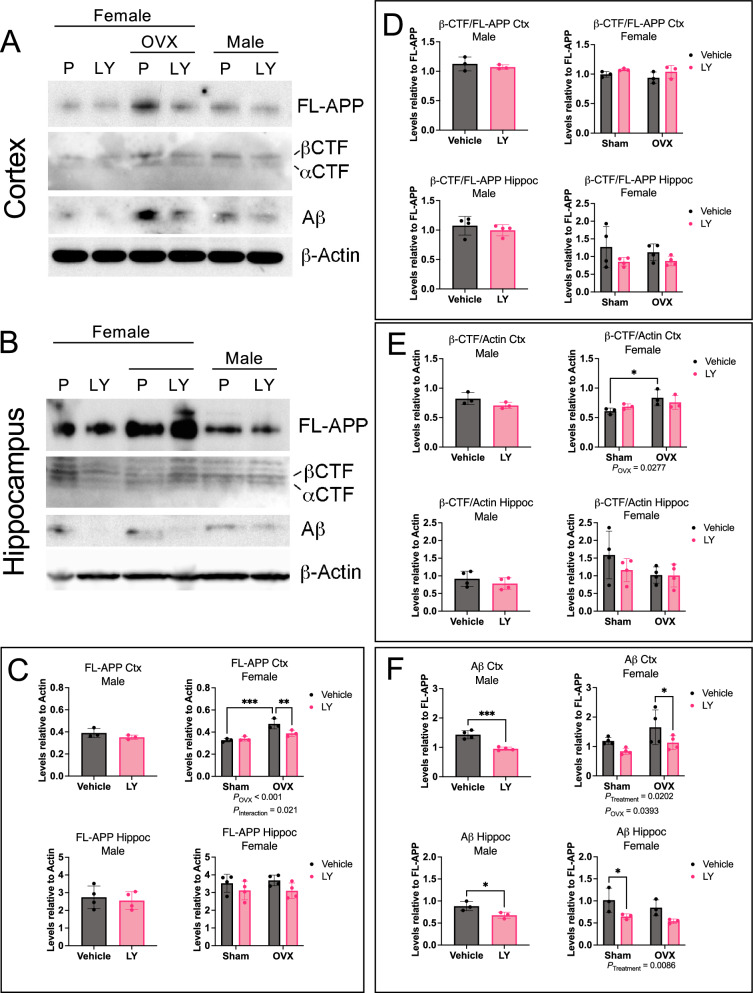
We found that Female App mice had higher soluble Aβ levels in cortex and hippocampus than males and more activated microglia. ERβ activation protected against amyloid pathology and cognitive decline in both male and female App mice. Although ovariectomy increased soluble amyloid beta (Aβ) in cortex and insoluble Aβ in hippocampus, as well as sustained neuroinflammation after ERβ activation, it had otherwise limited effects on pathology. We further identified that ERβ did not alter APP processing, but rather exerted its protection at least partly via microglia activation in a sex-specific manner.
Combined, we provide new understanding to the sex differences in AD by demonstrating that ERβ protects against AD pathology differently in males and females, warranting reassessment of ERβ in combating AD.
绝经后神经保护性激素的丧失被认为是导致阿尔茨海默病(AD)性别差异的原因之一。雌激素受体β(ERβ)的激活可能具有临床意义,因为它可避免ERα激活带来的全身性不良影响。然而,极少有研究探讨ERβ介导的AD神经保护作用,也尚无关于其在AD性别差异中作用的相关信息。在本研究中,我们专门探究了ERβ在淀粉样变性的App基因敲入小鼠模型中介导针对AD病理的性别特异性保护作用,以及手术绝经(卵巢切除术)是否会调节该模型中的病理变化。
我们用具有临床相关性的选择性ERβ激动剂LY500307处理雄性和雌性App基因敲入小鼠。一部分雌性小鼠在治疗前进行了卵巢切除术。采用Y迷宫和情境恐惧条件反射试验评估记忆表现,并用qPCR、免疫组织化学、蛋白质免疫印迹和多重免疫测定等生化分析方法评估淀粉样病理变化。
我们发现雌性App小鼠大脑皮质和海马中的可溶性Aβ水平高于雄性,且小胶质细胞的激活程度更高。ERβ激活可预防雄性和雌性App小鼠的淀粉样病理变化和认知能力下降。虽然卵巢切除术增加了大脑皮质中的可溶性淀粉样β蛋白(Aβ)和海马中的不溶性Aβ,以及ERβ激活后的持续性神经炎症,但它对病理变化的影响在其他方面有限。我们进一步确定,ERβ并未改变APP的加工过程,而是至少部分地通过以性别特异性方式激活小胶质细胞发挥其保护作用。
综合来看,我们通过证明ERβ在雄性和雌性中对AD病理的保护作用不同,为AD的性别差异提供了新的认识,这使得有必要重新评估ERβ在对抗AD中的作用。