Zhang Shuang, Dong Ningning, Wang Lu, Lu Yu, Chen Xiaoyou
Department of Pharmacology, Beijing Key Laboratory of Drug Resistance Tuberculosis Research, Beijing Chest Hospital, Capital Medical University, Beijing Tuberculosis and Thoracic Tumor Research Institute, Beijing, People's Republic of China.
Infectious Diseases Department, Beijing Ditan Hospital, Capital Medical University, Beijing, People's Republic of China.
Infect Drug Resist. 2025 Apr 25;18:2065-2078. doi: 10.2147/IDR.S519211. eCollection 2025.
Anti-tuberculosis drug-induced liver injury (ATB-DILI) is a common adverse reaction associated with tuberculosis (TB) treatment, significantly impacting treatment adherence and therapeutic outcomes. However, large-scale studies on hospitalized patients in China remain limited.
To characterize the clinical features and liver injury patterns in hospitalized TB patients with ATB-DILI and to identify risk factors associated with severe ATB-DILI.
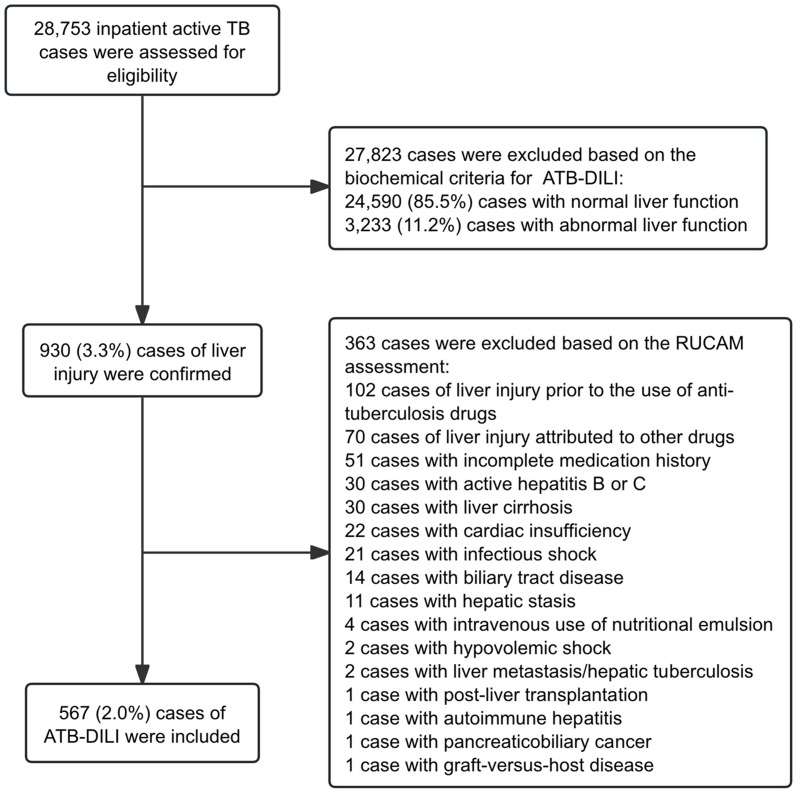
We retrospectively reviewed 28,753 hospitalized TB patients at Beijing Chest Hospital from 2014 to 2023. ATB-DILI was diagnosed in 567 patients (2.0%) based on serum biochemical criteria and causality assessment. Demographic, clinical, and laboratory data were analyzed to characterize liver injury types and identify risk factors for severe cases. Subgroup analyses based on liver injury patterns were performed to further evaluate the association between age and severe ATB-DILI.
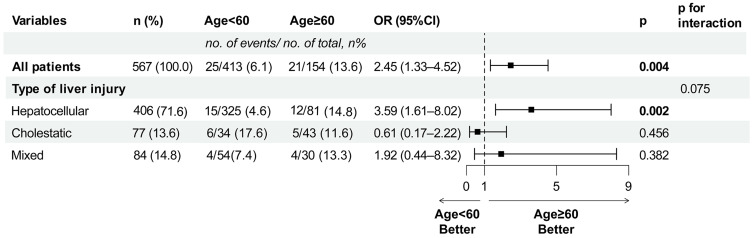
Overall, 567 cases with ATB-DILI (2.0%) were analyzed. Hepatocellular injury was the most common type (71.4%), followed by cholestatic (13.8%) and mixed (14.8%) injury patterns. Most patients (68.4%) were asymptomatic and diagnosed via routine biochemical monitoring; jaundice occurred in 18.2%. Patients with hepatocellular damage were significantly younger, while those with cholestatic injury were older (p < 0.001). Severe ATB-DILI occurred in 46 patients (8.1%), with advanced age (≥60 years) identified as an independent risk factor (OR = 2.45, 95% CI: 1.33-4.52, p = 0.004). Subgroup analysis showed that this association between age and severe ATB-DILI was significant in the hepatocellular injury type (unadjusted OR = 3.59, 95% CI: 1.61-8.02, p = 0.002), while no statistically significant association was observed in cholestatic or mixed types, which may reflect limited statistical power in these subgroups.
Routine liver function monitoring and age-specific risk assessment are essential for early identification and management of ATB-DILI in hospitalized TB patients.
抗结核药物性肝损伤(ATB-DILI)是与结核病(TB)治疗相关的常见不良反应,对治疗依从性和治疗结果有重大影响。然而,中国关于住院患者的大规模研究仍然有限。
描述住院的ATB-DILI结核病患者的临床特征和肝损伤模式,并确定与严重ATB-DILI相关的危险因素。
我们回顾性分析了2014年至2023年在北京胸科医院住院的28753例结核病患者。根据血清生化标准和因果关系评估,567例患者(2.0%)被诊断为ATB-DILI。对人口统计学、临床和实验室数据进行分析,以描述肝损伤类型并确定严重病例的危险因素。基于肝损伤模式进行亚组分析,以进一步评估年龄与严重ATB-DILI之间的关联。
总体而言,分析了567例ATB-DILI病例(2.0%)。肝细胞损伤是最常见的类型(71.4%),其次是胆汁淤积型(13.8%)和混合型(14.8%)损伤模式。大多数患者(68.4%)无症状,通过常规生化监测确诊;18.2%的患者出现黄疸。肝细胞损伤患者明显更年轻,而胆汁淤积型损伤患者年龄更大(p<0.001)。46例患者(8.1%)发生严重ATB-DILI,高龄(≥60岁)被确定为独立危险因素(OR=2.45,95%CI:1.33-4.52,p=0.004)。亚组分析表明,年龄与严重ATB-DILI之间的这种关联在肝细胞损伤类型中具有统计学意义(未调整OR=3.59,95%CI:1.61-8.02,p=0.002),而在胆汁淤积型或混合型中未观察到统计学上的显著关联,这可能反映了这些亚组中统计效力有限。
常规肝功能监测和特定年龄的风险评估对于住院结核病患者ATB-DILI的早期识别和管理至关重要。