Chen Chao-Chao, Tan Ming-Shi, Yin Jiang-Tao, Li Jian-Ming, Li Ying
Department of Pathology, Sun Yat-Sen Memorial Hospital, Sun Yat-Sen University, Guangzhou, China.
Department of Pathology, Soochow University Medical School, Suzhou, China.
Front Neurosci. 2025 Apr 15;19:1547010. doi: 10.3389/fnins.2025.1547010. eCollection 2025.
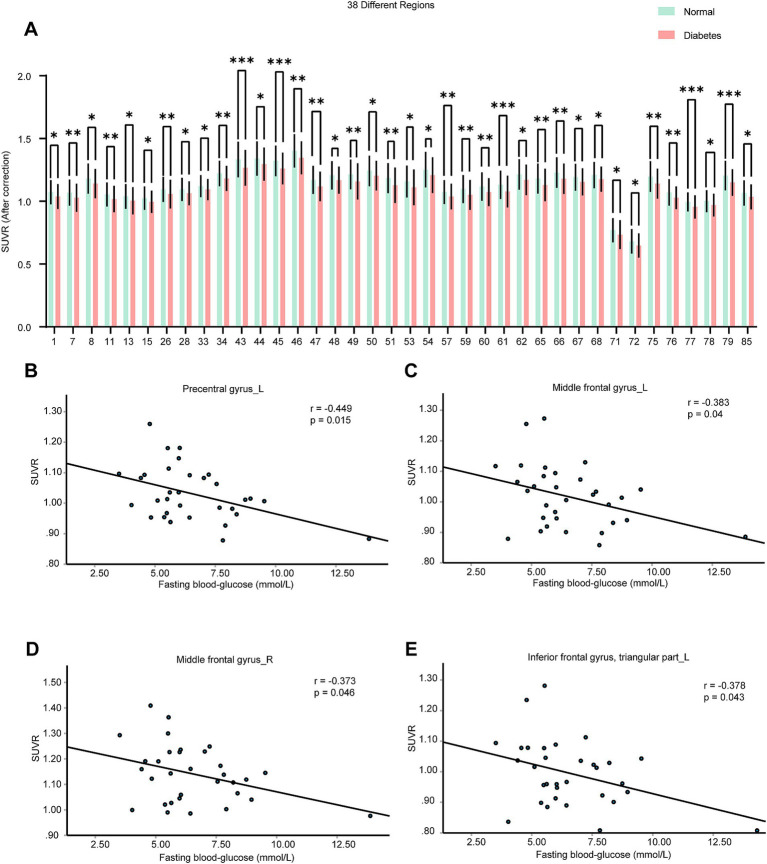
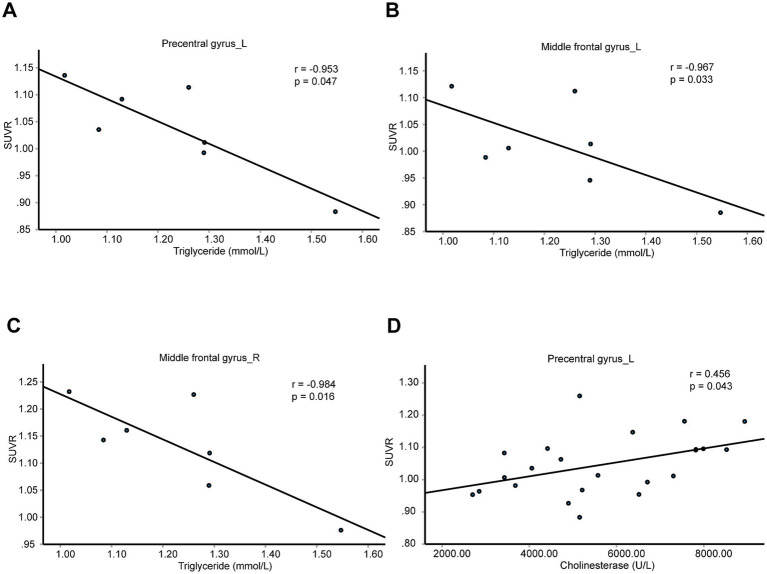
The global prevalence of metabolic diseases, including hypertension, type 2 diabetes mellitus (T2DM), gout, and obesity, has significantly increased over the past two decades. The brain plays a central role in regulating both human behavior and metabolism. Understanding the potential connections among these metabolic diseases and the involvement of the brain in their progression presents an intriguing and critical area of research. In this study, we analyzed PET-CT images and clinical biomarkers from 112 cases of hypertension, 56 cases of T2DM, 11 cases of obesity, and 14 cases of gout. Standardized uptake value ratios (SUVRs) were extracted from various brain regions using the Spatial-Normalization-of-Brain-PET-Images (SNBPI) software. The SUVRs were calculated using the standard methodology, where the mean standardized uptake value (SUV) of each region of interest (ROI) was divided by the mean SUV of the reference region, that is the whole cerebellum. The SNBPI tool was employed for intensity normalization. Partial correlation analysis was conducted to examine the relationships between SUVRs in different brain regions and clinical biomarkers, adjusting for sex, age, and BMI. Brain network metabolic connectivity was assessed using Permutation_IHEP software and visualized with BrainNet Viewer. Our results indicate that SUVRs in most brain regions were decreased in patients with hypertension or T2DM but increased in patients with obesity or gout. Specifically, SUVRs in brain regions associated with blood pressure were correlated with blood uric acid, creatinine, potassium, and apolipoprotein B. SUVRs in brain regions related to blood glucose were associated with blood triglycerides and cholinesterase. SUVRs in BMI-related brain regions correlated with blood urea nitrogen, aspartate aminotransferase, and alkaline phosphatase. SUVRs in brain regions associated with gout were correlated with fasting blood glucose, glutamic oxalacetic transaminase, total bilirubin, and alkaline phosphatase. Furthermore, brain network metabolic connectivity was reduced in patients with hypertension, T2DM, or obesity but increased in patients with gout. Our findings suggest that uric acid may negatively relate with blood pressure and glucose levels, while blood glucose and blood lipid levels may be positively correlated with each other. Gout appears distinct from other metabolic diseases and may offer a protective effect on brain function. The right superior parietal gyrus may be implicated in impaired renal function during the progression of hypertension. The left precentral gyrus and bilateral middle frontal gyri may relate to dyslipidemia and the potential development of atherosclerotic cardiovascular disease in patients with T2DM. In conclusion, our study highlights potential relationships among metabolic diseases and suggests the possible regulatory roles of specific brain regions in the progression of these conditions. These insights could pave the way for novel therapeutic strategies targeting brain metabolism in the management of metabolic diseases.

在过去二十年中,包括高血压、2型糖尿病(T2DM)、痛风和肥胖症在内的代谢性疾病的全球患病率显著上升。大脑在调节人类行为和新陈代谢方面起着核心作用。了解这些代谢性疾病之间的潜在联系以及大脑在其进展中的作用,是一个有趣且关键的研究领域。在本研究中,我们分析了112例高血压患者、56例T2DM患者、11例肥胖症患者和14例痛风患者的PET-CT图像及临床生物标志物。使用脑PET图像空间归一化(SNBPI)软件从各个脑区提取标准化摄取值比率(SUVR)。SUVR采用标准方法计算,即每个感兴趣区域(ROI)的平均标准化摄取值(SUV)除以参考区域(即整个小脑)的平均SUV。SNBPI工具用于强度归一化。进行偏相关分析以检验不同脑区的SUVR与临床生物标志物之间的关系,并对性别、年龄和BMI进行校正。使用Permutation_IHEP软件评估脑网络代谢连通性,并用BrainNet Viewer进行可视化。我们的结果表明,高血压或T2DM患者大多数脑区的SUVR降低,而肥胖症或痛风患者的SUVR升高。具体而言,与血压相关脑区的SUVR与血尿酸、肌酐、钾和载脂蛋白B相关。与血糖相关脑区的SUVR与血甘油三酯和胆碱酯酶相关。与BMI相关脑区的SUVR与血尿素氮、天冬氨酸转氨酶和碱性磷酸酶相关。与痛风相关脑区的SUVR与空腹血糖、谷草转氨酶、总胆红素和碱性磷酸酶相关。此外,高血压、T2DM或肥胖症患者的脑网络代谢连通性降低,而痛风患者的脑网络代谢连通性增加。我们的研究结果表明,尿酸可能与血压和血糖水平呈负相关,而血糖和血脂水平可能呈正相关。痛风似乎与其他代谢性疾病不同,可能对脑功能有保护作用。右顶上叶可能与高血压进展过程中的肾功能损害有关。左中央前回和双侧额中回可能与T2DM患者的血脂异常和动脉粥样硬化性心血管疾病的潜在发展有关。总之,我们的研究突出了代谢性疾病之间的潜在关系,并提示了特定脑区在这些疾病进展中的可能调节作用。这些见解可为代谢性疾病管理中针对脑代谢的新型治疗策略铺平道路。