Wu Ying, Xv Rui, Chen Qinyun, Zhang Ranran, Li Min, Shao Chen, Jin Guoxi, Hu Xiaolei
The Department of Endocrinology, The First Affiliated Hospital of Bengbu Medical University, Bengbu, Anhui, China.
The Department of Endocrinology, The Second Affiliated Hospital of Bengbu Medical University, Bengbu, Anhui, China.
Front Endocrinol (Lausanne). 2025 Apr 15;16:1539039. doi: 10.3389/fendo.2025.1539039. eCollection 2025.
To analyze the correlation between preoperative time-in-range (TIR) levels and postoperative infection in patients with type 2 diabetes mellitus (T2DM) and to evaluate the value of the TIR as a predictor of postoperative infection in patients with T2DM.
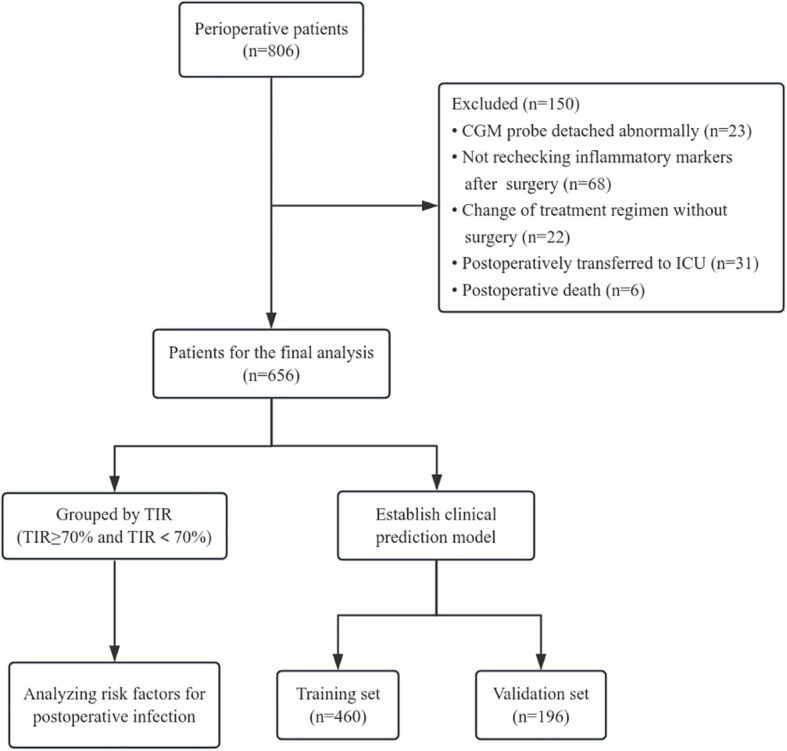
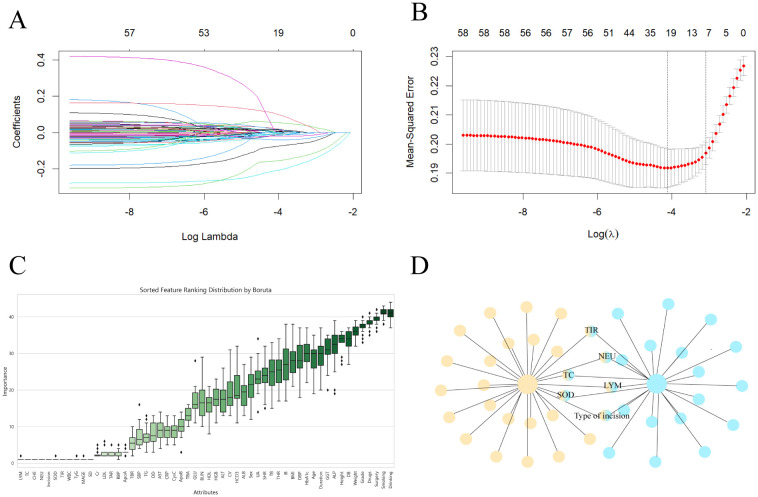
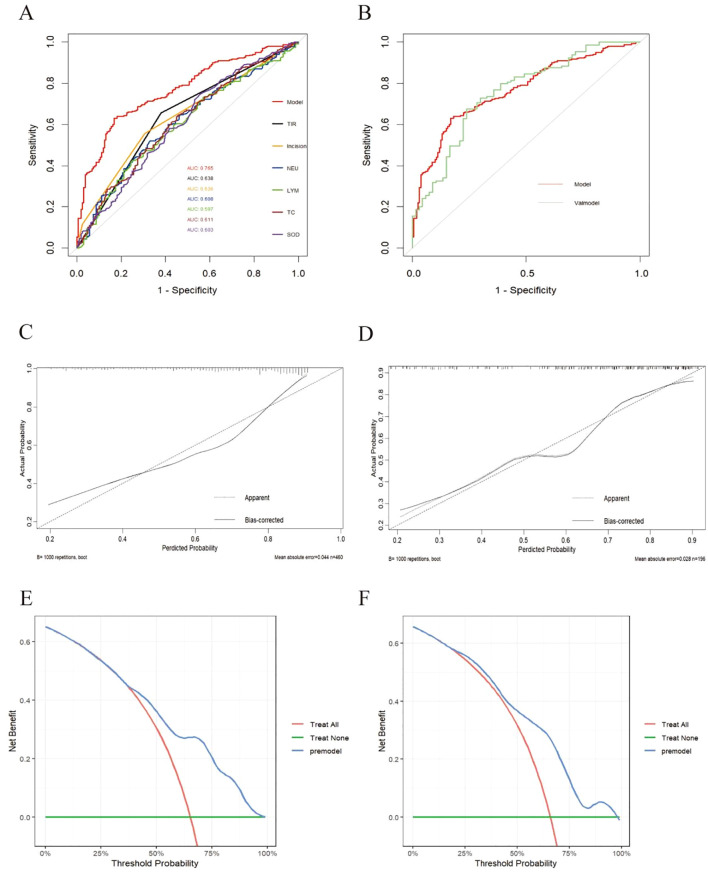
A total of 656 patients with T2DM during the perioperative period were divided into a TIR standard group (TIR≥70%) and a TIR nonstandard group (TIR<70%) according to the TIR value. Modified Poisson regression was used to analyze postoperative risk factors in patients with T2DM. All patients were subsequently divided into a training set and a validation set at a ratio of 7:3. LASSO regression and the Boruta algorithm were used to screen out the predictive factors related to postoperative infection in T2DM patients in the training set. The discrimination and calibration of the model were evaluated by the area under the receiver operating characteristic curve (ROC) and calibration curve, and the clinical net benefit of the model was evaluated and verified through the decision analysis (DCA) curve. Finally, a forest plot was used for relevant subgroup analysis.
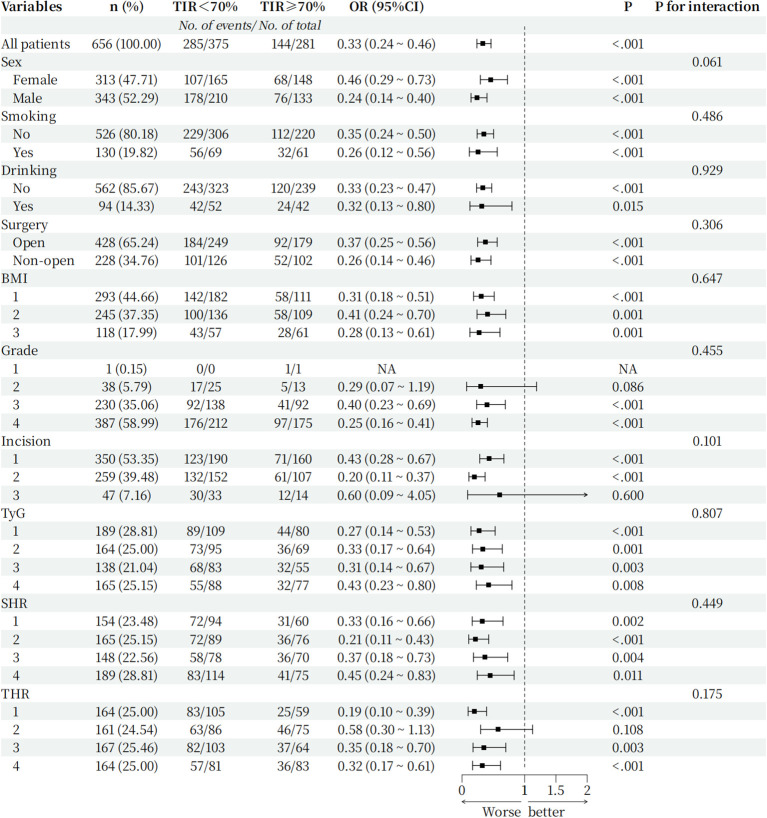
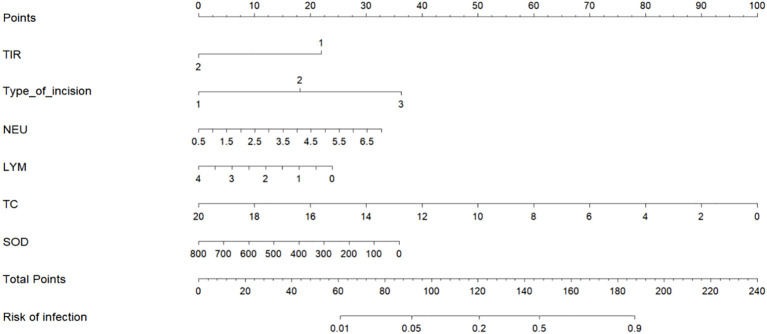
Modified Poisson regression analysis revealed that the TIR was a risk factor for postoperative infection in T2DM patients, and when the TIR was <70%, the risk of postoperative infection increased by 52.2% (P <0.05). LASSO regression and Boruta algorithm screening variables revealed that the TIR, lymphocytes, neutrophils, total serum cholesterol, superoxide dismutase and type of incision were predictive factors for postoperative infection in patients with T2DM (P<0.05). The calibration curve confirmed that the model predictions were consistent with reality, and the decision curve confirmed that the model had better clinical benefits. Finally, the results of the subgroup analysis revealed that in each subgroup, the risk of postoperative infection was greater when the TIR was <70% than when the TIR was ≥70%, and there was no interaction between subgroups.
The TIR is related to postoperative infection and can be used as a new indicator to predict the risk of postoperative infection in patients with type 2 diabetes mellitus.
分析2型糖尿病(T2DM)患者术前血糖在目标范围内时间(TIR)水平与术后感染之间的相关性,并评估TIR作为T2DM患者术后感染预测指标的价值。
将656例围手术期T2DM患者根据TIR值分为TIR达标组(TIR≥70%)和TIR未达标组(TIR<70%)。采用修正泊松回归分析T2DM患者术后危险因素。随后将所有患者按7:3的比例分为训练集和验证集。采用LASSO回归和Boruta算法筛选训练集中T2DM患者术后感染相关的预测因素。通过受试者工作特征曲线(ROC)下面积和校准曲线评估模型的区分度和校准度,并通过决策分析(DCA)曲线评估和验证模型的临床净效益。最后,采用森林图进行相关亚组分析。
修正泊松回归分析显示,TIR是T2DM患者术后感染的危险因素,当TIR<70%时,术后感染风险增加52.2%(P<0.05)。LASSO回归和Boruta算法筛选变量显示,TIR、淋巴细胞、中性粒细胞、总血清胆固醇、超氧化物歧化酶和切口类型是T2DM患者术后感染的预测因素(P<0.05)。校准曲线证实模型预测与实际情况一致,决策曲线证实模型具有更好的临床效益。最后,亚组分析结果显示,在各亚组中,TIR<70%时术后感染风险高于TIR≥70%时,且亚组间无交互作用。
TIR与术后感染相关,可作为预测2型糖尿病患者术后感染风险的新指标。