Petersdotter Linn, Miller Lindsey, Johansson Mikael, Hammar Åsa
Department of Psychology, Faculty of Social Sciences, Lund University, Lund, Sweden.
Department of Clinical Sciences Lund, Psychiatry, Faculty of Medicine, Lund University, Lund, Sweden.
Sci Rep. 2025 Apr 30;15(1):15215. doi: 10.1038/s41598-025-99564-x.
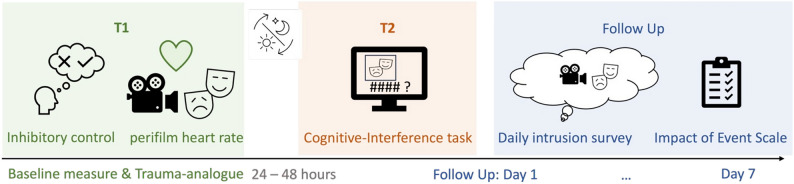
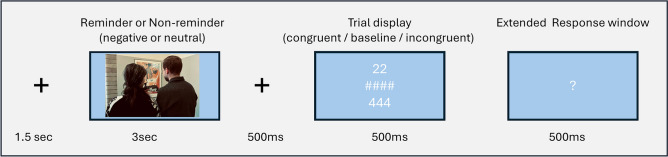
The reasons why some individuals who experience trauma develop post-traumatic stress disorder (PTSD) while others do not remain poorly understood, highlighting the complex interplay of encoding-related and intrapersonal factors. This study aimed to examine factors predicting variability in trauma-related symptom development. Using a trauma film paradigm in a healthy sample (N = 32), we investigated how inhibitory control and peritraumatic responses relate to the development of intrusive memories and self-assessed event impact. Peritraumatic heart rate was associated with more frequent, vivid, and distressing memory intrusions during the week following trauma-analogue exposure. It also predicted hyperarousal and avoidance symptoms, with the latter further linked to lower inhibitory control. In a cognitive-interference task conducted approximately one day after trauma-analogue exposure, negative trauma reminders increased response latencies. This reduced interference control was predicted by both lower inhibitory control and higher peritraumatic heart rate, and it was especially pronounced in individuals who reported a heightened overall event impact. In conclusion, inhibitory control and peritraumatic heart rate emerged as predictors of subsequent reminder interference, intrusions, and self-assessed event impact. These findings provide insights into physiological and behavioural mechanisms underlying variability in the development of trauma-analogue symptoms and related cognitive interference when exposed to trauma reminders in a healthy sample without a trauma history.
一些经历过创伤的人会患上创伤后应激障碍(PTSD),而另一些人则不会,其原因仍未得到充分理解,这凸显了编码相关因素和个体内部因素的复杂相互作用。本研究旨在探讨预测创伤相关症状发展差异的因素。在一个健康样本(N = 32)中使用创伤电影范式,我们研究了抑制控制和创伤期间反应如何与侵入性记忆的发展以及自我评估的事件影响相关。创伤期间的心率与创伤模拟暴露后一周内更频繁、生动和痛苦的记忆侵入有关。它还预测了过度警觉和回避症状,后者进一步与较低的抑制控制相关。在创伤模拟暴露后约一天进行的认知干扰任务中,负面创伤提示增加了反应潜伏期。较低的抑制控制和较高的创伤期间心率都预测了这种干扰控制的降低,并且在报告整体事件影响增强的个体中尤为明显。总之,抑制控制和创伤期间心率成为后续提示干扰、侵入和自我评估事件影响的预测因素。这些发现为在没有创伤史的健康样本中接触创伤提示时创伤模拟症状发展差异及相关认知干扰的生理和行为机制提供了见解。