
基于运动前快速眼动睡眠行为障碍的存在,帕金森病患者独特的肠道微生物群特征和动态变化
Distinct gut microbiome characteristics and dynamics in patients with Parkinson's disease based on the presence of premotor rapid-eye movement sleep behavior disorders.
作者信息
Lee Jae-Yun, Jo Sungyang, Lee Jihyun, Choi Moongwan, Kim Kijeong, Lee Sangjin, Kim Hyun Sik, Bae Jin-Woo, Chung Sun Ju
机构信息
Department of Biology and Department of Life and Nanopharmaceutical Science, Kyung Hee University, Seoul, 02447, Republic of Korea.
Department of Neurology, Asan Medical Center, University of Ulsan College of Medicine, Seoul, 05505, Republic of Korea.
出版信息
Microbiome. 2025 Apr 30;13(1):108. doi: 10.1186/s40168-025-02095-w.
BACKGROUND
Alpha-synuclein aggregation, a hallmark of Parkinson's disease (PD), is hypothesized to often begin in the enteric or peripheral nervous system in "body-first" PD and progresses through the vagus nerve to the brain, therefore REM sleep behavior disorder (RBD) precedes the PD diagnosis. In contrast, "brain-first" PD begins in the central nervous system. Evidence that gut microbiome imbalances observed in PD and idiopathic RBD exhibit similar trends supports body-first and brain-first hypothesis and highlights the role of microbiota in PD pathogenesis. However, further investigation is needed to understand distinct microbiome changes in body-first versus brain-first PD over the disease progression.
RESULTS
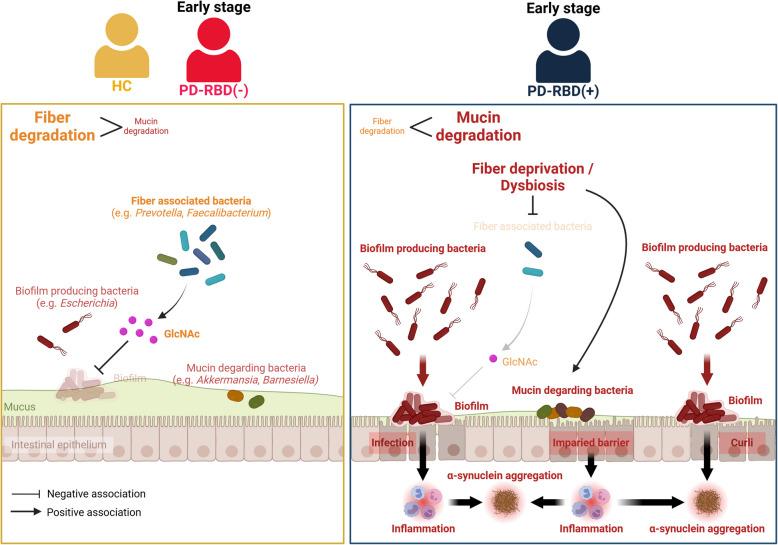
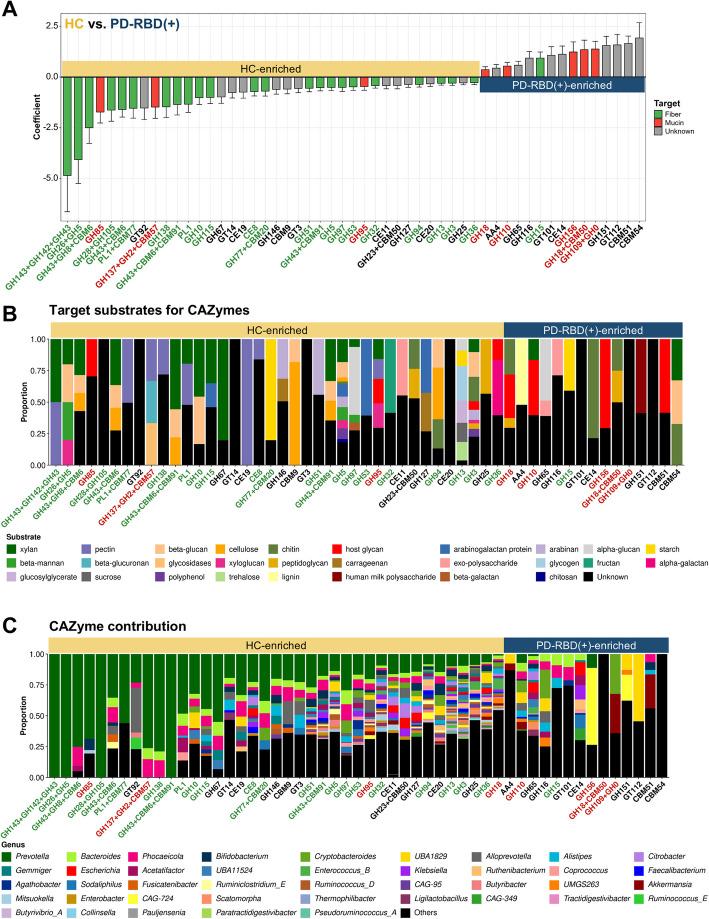
Our investigation involved 104 patients with PD and 85 of their spouses as healthy controls (HC), with 57 patients (54.8%) categorized as PD-RBD(+) and 47 patients (45.2%) as PD-RBD(-) based on RBD presence before the PD diagnosis. We evaluated the microbiome differences between these groups over the disease progression through taxonomic and functional differential abundance analyses and carbohydrate-active enzyme (CAZyme) profiles based on metagenome-assembled genomes. The PD-RBD(+) gut microbiome showed a relatively stable microbiome composition irrespective of disease stage. In contrast, PD-RBD(-) microbiome exhibited a relatively dynamic microbiome change as the disease progressed. In early-stage PD-RBD(+), Escherichia and Akkermansia, associated with pathogenic biofilm formation and host mucin degradation, respectively, were enriched, which was supported by functional analysis. We discovered that genes of the UDP-GlcNAc synthesis/recycling pathway negatively correlated with biofilm formation; this finding was further validated in a separate cohort. Furthermore, fiber intake-associated taxa were decreased in early-stage PD-RBD(+) and the biased mucin-degrading capacity of CAZyme compared to fiber degradation.
CONCLUSION
We determined that the gut microbiome dynamics in patients with PD according to the disease progression depend on the presence of premotor RBD. Notably, early-stage PD-RBD(+) demonstrated distinct gut microbial characteristics, potentially contributing to exacerbation of PD pathophysiology. This outcome may contribute to the development of new therapeutic strategies targeting the gut microbiome in PD. Video Abstract.
背景
α-突触核蛋白聚集是帕金森病(PD)的一个标志,据推测在“身体优先型”PD中,它通常始于肠道或外周神经系统,并通过迷走神经进展至大脑,因此快速眼动睡眠行为障碍(RBD)先于PD诊断出现。相比之下,“大脑优先型”PD始于中枢神经系统。在PD和特发性RBD中观察到的肠道微生物群失衡呈现相似趋势的证据支持了身体优先和大脑优先假说,并突出了微生物群在PD发病机制中的作用。然而,需要进一步研究以了解在疾病进展过程中身体优先型与大脑优先型PD中不同的微生物群变化。
结果
我们的研究纳入了104例PD患者及其85名配偶作为健康对照(HC),根据PD诊断前是否存在RBD,将57例患者(54.8%)归类为PD-RBD(+),47例患者(45.2%)归类为PD-RBD(-)。我们通过基于宏基因组组装基因组的分类学和功能差异丰度分析以及碳水化合物活性酶(CAZyme)谱,评估了这些组在疾病进展过程中的微生物群差异。PD-RBD(+)肠道微生物群显示出相对稳定的微生物群组成,与疾病阶段无关。相比之下,PD-RBD(-)微生物群随着疾病进展呈现出相对动态的微生物群变化。在早期PD-RBD(+)中,分别与致病性生物膜形成和宿主粘蛋白降解相关的大肠杆菌和阿克曼氏菌富集,功能分析支持了这一点。我们发现UDP-GlcNAc合成/再循环途径的基因与生物膜形成呈负相关;这一发现在另一个队列中得到了进一步验证。此外,与纤维摄入相关的分类群在早期PD-RBD(+)中减少,并且与纤维降解相比,CAZyme对粘蛋白的降解能力存在偏差。
结论
我们确定,PD患者肠道微生物群的动态变化取决于运动前RBD的存在情况。值得注意的是,早期PD-RBD(+)表现出独特的肠道微生物特征,可能导致PD病理生理学的恶化。这一结果可能有助于开发针对PD肠道微生物群的新治疗策略。视频摘要。


 Zotero 插件