Zhang Jiafang, Yip Rowena, Taioli Emanuela, Flores Raja M, Henschke Claudia I, Yankelevitz David F, Schwartz Rebecca M
Department of Diagnostic, Molecular, and Interventional Radiology, Mount Sinai School of Medicine, New York, NY.
Department of Thoracic Surgery, Mount Sinai School of Medicine, New York, NY.
JTCVS Open. 2025 Jan 21;24:383-393. doi: 10.1016/j.xjon.2025.01.007. eCollection 2025 Apr.
Limited research exists comparing the impacts of robotic-assisted thoracic surgery (RATS) and video-assisted thoracic surgery (VATS) on patients' physical and mental health-related quality of life (QoL).
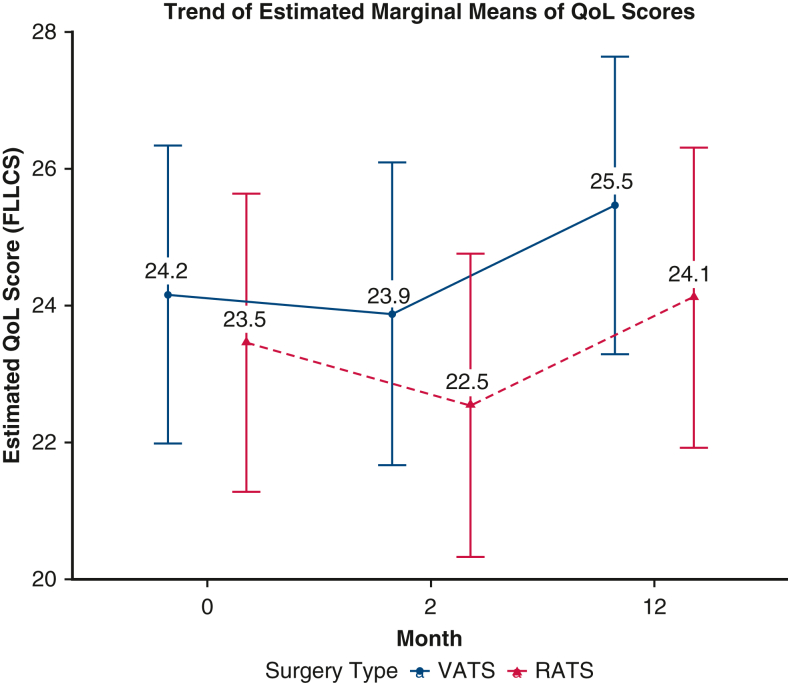
A prospective cohort of stage IA non-small cell lung cancer (NSCLC) patients in the Initiative for Early Lung Cancer Research on Treatment from Mount Sinai Health System had QoL measured before surgery and at 2, 6, and 12 months post-treatment using the Medical Outcomes Study Short-Form 12 (SF-12), with Physical Component Summary (PCS) and Mental Component Summary (MCS); the Functional Assessment of Cancer Therapy-Lung Cancer Subscale (FACT-LCS); and Patient Health Questionnaire-4 (PHQ-4; for depression/anxiety). A locally weighted smoothing curve was fitted to identify the best interval knot for post-treatment QoL trends. A piecewise linear mixed-effects model was developed to estimate differences in baseline, 2-month, and 12-month QoL scores and rates of change, adjusting for age, sex, race, ethnicity, smoking status, pack-years, nodule size/consistency, comorbidities, and surgical extent.
The study cohort comprised 698 patients, including 458 (65.6%) who underwent VATS and 240 (34.4%) who underwent RATS. The RATS group exhibited a more significant initial decline in physical health at 2 months post-surgery but showed significant recovery by 12 months, achieving similar or slightly higher physical scores compared to baseline. No significant differences in mental health scores over time were seen between the groups. Both groups displayed consistent anxiety and depression scores, with significant improvements in anxiety symptoms at the 2-month mark. The RATS group had fewer postoperative complications and conversion to open thoracotomy.
RATS and VATS offer similar long-term QoL outcomes for early-stage NSCLC patients, though RATS patients may experience a sharper initial decline in physical health.
关于机器人辅助胸外科手术(RATS)和电视辅助胸外科手术(VATS)对患者身心健康相关生活质量(QoL)影响的比较研究有限。
西奈山医疗系统早期肺癌治疗研究计划中的IA期非小细胞肺癌(NSCLC)患者前瞻性队列,在手术前以及治疗后2、6和12个月使用医学结局研究简表12(SF - 12)测量生活质量,包括身体成分总结(PCS)和心理成分总结(MCS);癌症治疗功能评估 - 肺癌子量表(FACT - LCS);以及患者健康问卷 - 4(PHQ - 4;用于评估抑郁/焦虑)。拟合局部加权平滑曲线以确定治疗后生活质量趋势的最佳间隔节点。建立分段线性混合效应模型,以估计基线、2个月和12个月生活质量得分及变化率的差异,并对年龄、性别、种族、民族、吸烟状况、吸烟包年数、结节大小/质地、合并症和手术范围进行调整。
研究队列包括698名患者,其中458名(65.6%)接受了VATS,240名(34.4%)接受了RATS。RATS组在术后2个月时身体健康状况出现更显著的初始下降,但在12个月时显示出显著恢复,身体得分与基线相比达到相似或略高水平。两组之间心理健康得分随时间无显著差异。两组的焦虑和抑郁得分均保持一致,在2个月时焦虑症状有显著改善。RATS组术后并发症和转为开胸手术的情况较少。
RATS和VATS为早期NSCLC患者提供了相似的长期生活质量结果,尽管RATS患者在身体健康方面可能会经历更明显的初始下降。