Zhang Ruoxuan, Huang Huihong, Zhang Yi, Xia Yi, Huang Jiayu, Jiang Chuanhe, Wang Luxiang, Lu Haiyang, Pan Zengkai, Wang Gaoxiang, Yang Yang, Ma Yilei, Mo Xiaodong, Shi Wei, Hu Xiaoxia, Cao Yang
Department of Hematology, Tongji Hospital, Tongji Medical College, Huazhong University of Science and Technology, Wuhan, Hubei, 430030, China.
State Key Laboratory of Medical Genomics, Shanghai Institute of Hematology, National Research Center for Translational Medicine, Shanghai Rui Jin Hospital, Shanghai Jiao Tong University School of Medicine, Shanghai, 200025, China.
Blood Cancer J. 2025 May 2;15(1):84. doi: 10.1038/s41408-025-01293-x.
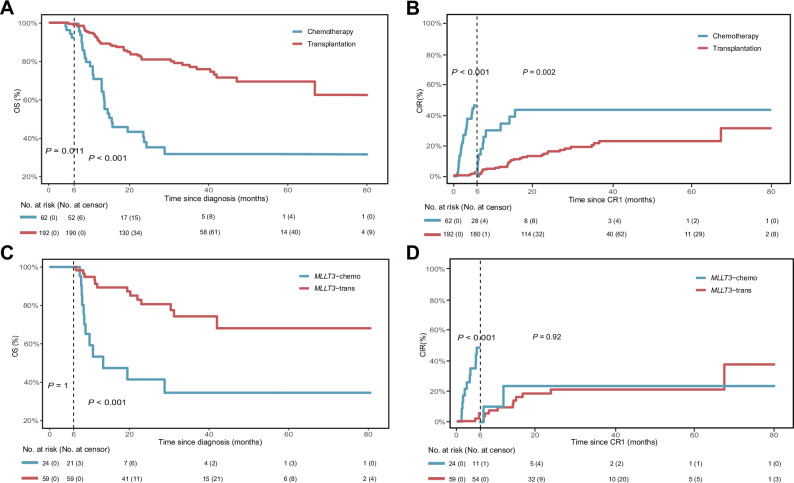
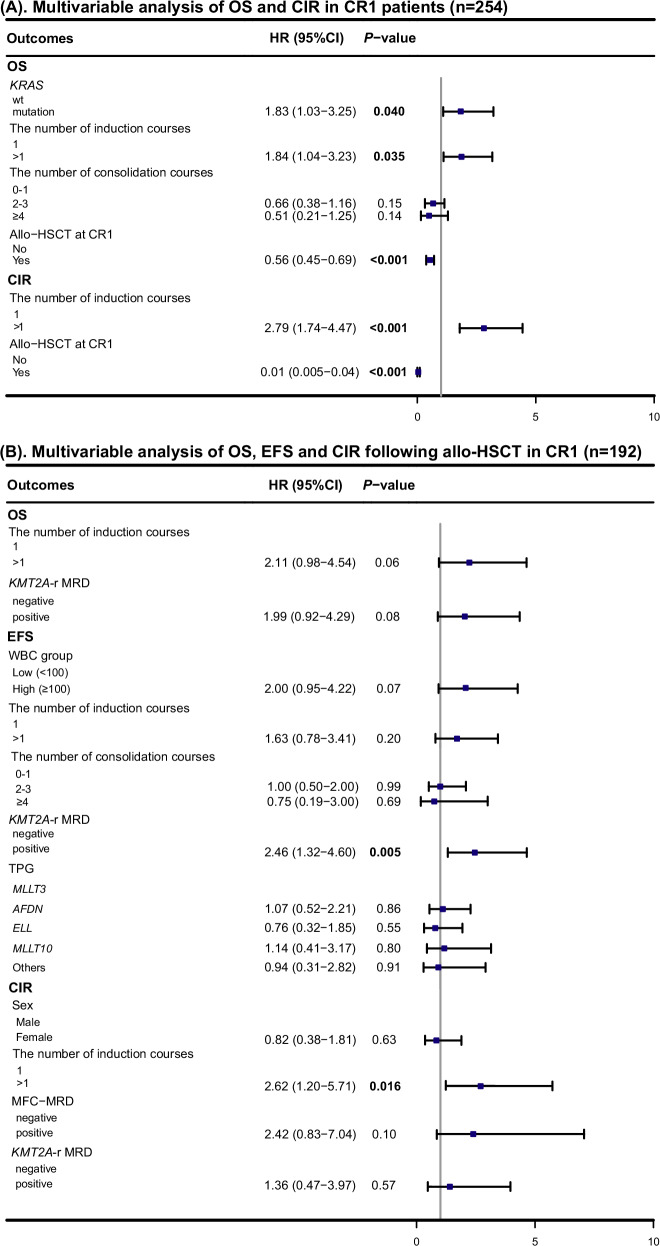
Acute myeloid leukemia (AML) with KMT2A rearrangement (KMT2A-r) is associated with poor prognosis, but the benefit of allogeneic hematopoietic stem cell transplantation (allo-HSCT) for KMT2A-r AML is unclear. We reviewed adult AML patients treated within the TROPHY group and identified 292 cases of KMT2A-r AML, 254 (87.0%) of whom achieved first complete remission (CR1) and 192 (75.6%) of CR1 patients underwent allo-HSCT. We show that allo-HSCT is an independent favorable prognostic factor in CR1 patients for both overall survival (OS) (hazard ratio [HR] = 0.56, 95% confidence interval [CI]: 0.45-0.69, P < 0.001) and cumulative incidence of relapse (CIR) (HR = 0.01, 95% CI: 0.005-0.04, P < 0.001). Among allo-HSCT recipients, survival outcomes were comparable between patients with KMT2A::MLLT3 and those with other 11q23/KMT2A rearrangements (3-year OS: 74.3% vs. 77.5%, P = 0.97; 3-year event-free survival [EFS]: 55.2% vs. 62.2%, P = 0.34; 3-year CIR: 24.4% vs. 20.8%, P = 0.32). Both multiparameter flow cytometry-based measurable residual disease (MFC-MRD) and KMT2A-r MRD determined by quantitative PCR prior to allo-HSCT were associated with worse transplant outcomes. Multivariable analysis identified detectable KMT2A-r MRD at allo-HSCT as a significant risk factor for reduced EFS (HR = 2.46, 95% CI: 1.32-4.60, P = 0.005). These findings confirm the survival benefit of allo-HSCT in adult patients with KMT2A-r AML and underscore the prognostic value of KMT2A-r MRD prior to transplantation.
伴有KMT2A重排(KMT2A-r)的急性髓系白血病(AML)预后较差,但异基因造血干细胞移植(allo-HSCT)对KMT2A-r AML的益处尚不清楚。我们回顾了TROPHY组治疗的成年AML患者,确定了292例KMT2A-r AML患者,其中254例(87.0%)首次获得完全缓解(CR1),192例(75.6%)CR1患者接受了allo-HSCT。我们发现,allo-HSCT是CR1患者总生存期(OS)(风险比[HR]=0.56,95%置信区间[CI]:0.45-0.69,P<0.001)和累积复发率(CIR)(HR=0.01,95%CI:0.005-0.04,P<0.001)的独立有利预后因素。在allo-HSCT受者中,KMT2A::MLLT3患者与其他11q23/KMT2A重排患者的生存结局相当(3年OS:74.3%对77.5%,P=0.97;3年无事件生存期[EFS]:55.2%对62.2%,P=0.34;3年CIR:24.4%对20.8%,P=0.32)。基于多参数流式细胞术的可测量残留病(MFC-MRD)和allo-HSCT前通过定量PCR测定的KMT2A-r MRD均与较差移植结局相关。多变量分析确定allo-HSCT时可检测到的KMT2A-r MRD是EFS降低的显著危险因素(HR=2.46,95%CI:1.32-4.60,P=0.005)。这些发现证实了allo-HSCT对成年KMT2A-r AML患者的生存益处,并强调了移植前KMT2A-r MRD的预后价值。