Ali Sardar Jaffar, Iqbal Javed, Khan Faheem, Moon Yeon-Kug
Department of AI Systems Engineering, Sungkyunkwan University, Suwon, 16419, South Korea.
Department of Computer Software Engineering, National University of Sciences and Technology (NUST), Islamabad, 44000, Pakistan.
Sci Rep. 2025 May 2;15(1):15400. doi: 10.1038/s41598-025-96830-w.
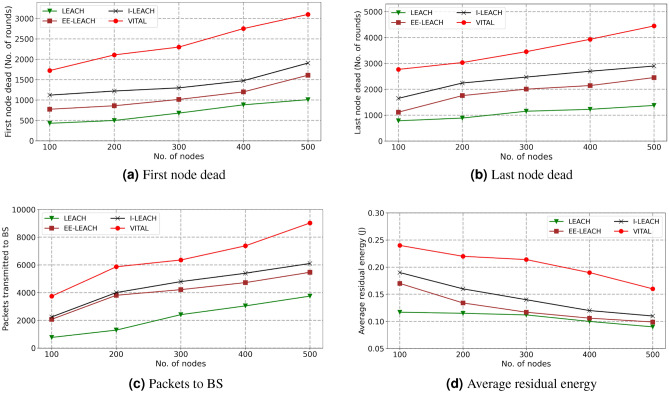
Energy consumption in Wireless Sensor Networks (WSNs) has become a critical concern due to the proliferation of sensors in internet-connected devices. Existing solutions often address energy efficiency in isolation, failing to consider the complex interplay of factors affecting WSN performance. In this context, this study proposes an integrated approach, Vigorous Technique for Augmented Lifetime (ViTAL), which holistically addresses the challenges of node positioning, network topology, radio conditions, and node mobility to optimize energy efficiency in WSNs. The proposed approach consists of three phases: minimizing the number of nodes to cover a specific area, constructing a Connected Dominating Set (CDS) for packet routing, and integrating the 4-factor Cluster Head (CH) selection model in the WSNs. This multi-faceted approach is necessary to overcome the limitations of existing methods that often focus on single aspects of WSN optimization, leading to suboptimal overall performance. The results demonstrate that ViTAL's integrated approach, which combines optimized deployment through HSA and efficient routing using CDS, significantly outperforms traditional protocols in both static and mobile scenarios. In static environments, ViTAL achieves average improvements of 80.9%, 62%, and 58% in network lifetime compared to LEACH, EE-LEACH, and I-LEACH respectively, when using optimized deployment. The overall throughput experiences average increases of 83%, 59%, and 52%, while the average residual energy is enhanced by 68%, 58%, and 41%, respectively. In mobile scenarios, ViTAL extends the lifespan of the first node by 68.2%, 49%, and 42%, and increases the number of rounds before the last node becomes inactive by 74%, 52%, and 36% compared to LEACH, EE-LEACH, and I-LEACH. The throughput in mobile environments improves by 57%, 50%, and 37%, respectively, showcasing ViTAL's adaptability to node mobility.
由于连入互联网的设备中传感器数量激增,无线传感器网络(WSN)中的能量消耗已成为一个关键问题。现有解决方案往往孤立地解决能源效率问题,未能考虑影响WSN性能的各种因素之间的复杂相互作用。在此背景下,本研究提出了一种综合方法——增强寿命的活力技术(ViTAL),该方法全面应对节点定位、网络拓扑、无线电条件和节点移动性等挑战,以优化WSN中的能源效率。所提出的方法包括三个阶段:最小化覆盖特定区域的节点数量、构建用于数据包路由的连通支配集(CDS)以及在WSN中集成四因素簇头(CH)选择模型。这种多方面的方法对于克服现有方法的局限性是必要的,现有方法通常只关注WSN优化的单个方面,导致整体性能次优。结果表明,ViTAL的综合方法,即通过HSA进行优化部署并使用CDS进行高效路由,在静态和移动场景中均显著优于传统协议。在静态环境中,使用优化部署时,与LEACH、EE - LEACH和I - LEACH相比,ViTAL在网络寿命方面平均提高了80.9%、62%和58%。总体吞吐量平均增加了83%、59%和52%,而平均剩余能量分别提高了68%、58%和41%。在移动场景中,与LEACH、EE - LEACH和I - LEACH相比,ViTAL将第一个节点的寿命延长了68.2%、49%和42%,并使最后一个节点变为非活动状态之前的轮数增加了74%、52%和36%。移动环境中的吞吐量分别提高了57%、50%和37%,展示了ViTAL对节点移动性的适应性。