Tello Betzabé, Hernández Herminio, Dueñas-Espín Iván, Tejera Eduardo
Center for Research on Health in Latin America (CISeAL), Facultad de Salud y Bienestar, Pontificia Universidad Católica del Ecuador, Quito, 1076, Ecuador.
Facultad de Medicina Alberto Hurtado, Universidad Peruana Cayetano Heredia, Av. Honorio Delgado 430, San Martín de Porres 15102, Lima, Perú.
BMC Pregnancy Childbirth. 2025 May 2;25(1):525. doi: 10.1186/s12884-025-07651-8.
Breast milk is the optimal food for humans, however, many mothers face challenges in sustaining exclusive breastfeeding (EBF). Prenatal education (PE) has been suggested as a strategy to promote EBF, but there is evidence that its impact on EBF duration remains inconclusive. This study aimed to evaluate the effect of PE on EBF continuation among mothers who gave birth in private and public hospitals in Quito, Ecuador, and to identify modifiable risk factors associated with EBF discontinuation.
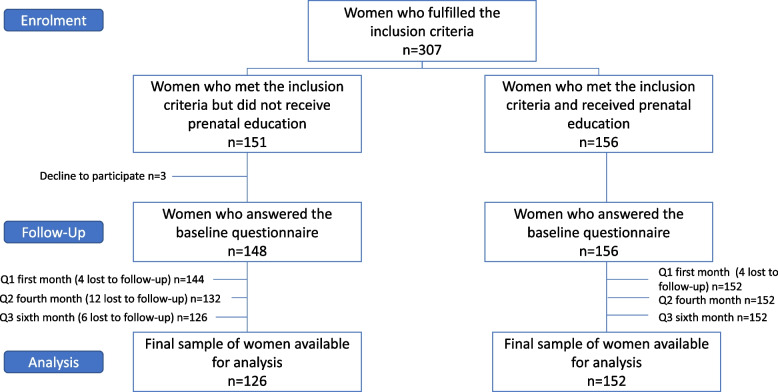
A prospective cohort study was conducted, recruiting 278 mothers, of whom 152 received PE and 126 did not. Participants were followed from birth to six months postpartum. Data collection included a structured survey, with baseline clinical information obtained through face-to-face interviews before hospital discharge and follow-up telephone interviews at one, four, and six months postpartum.
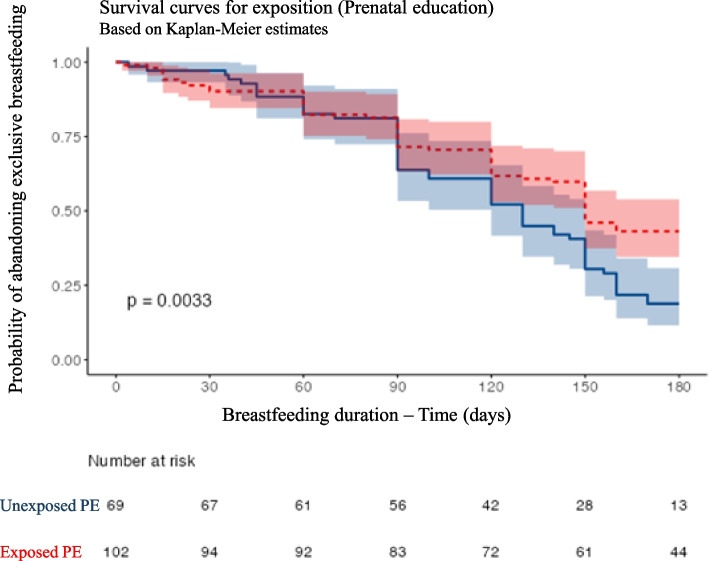
Comparisons between the PE and non-PE groups revealed significant differences in education level, health insurance, antenatal care visits, rooming-in rates, parity, and maternal breastfeeding (BF) intentions. Participants who received PE had a significantly longer mean EBF duration (89.4 ± 77.2 days vs. 66.1 ± 70.2 days, p = 0.004). The incidence rate of EBF abandonment was 11.81 per 100 person-months in the PE group and 14.91 per 100 person-months in the non-PE group. Cox survival analysis indicated a lower risk of EBF cessation among mothers who received PE (adjusted hazard ratio [aHR] = 0.58, 95% CI = 0.40-0.84, p = 0.004). Other factors associated with EBF discontinuation included delivery at a public health facility, postpartum depression, insufficient milk supply, return to work, healthcare provider recommendations, family advice, and negative BF experiences.
Standardized PE programs have a significant and independent positive impact on EBF duration among mothers in Quito, Ecuador. Integrating PE into routine prenatal care and providing comprehensive postpartum support is essential to promoting BF continuation. Targeted interventions should address modifiable risk factors, such as postpartum mental health, return-to-work policies, and healthcare provider recommendations regarding BF.
母乳是人类的最佳食物,然而,许多母亲在维持纯母乳喂养(EBF)方面面临挑战。产前教育(PE)已被建议作为促进纯母乳喂养的一种策略,但有证据表明其对纯母乳喂养持续时间的影响仍不明确。本研究旨在评估产前教育对在厄瓜多尔基多私立和公立医院分娩的母亲纯母乳喂养持续情况的影响,并确定与纯母乳喂养中断相关的可改变风险因素。
进行了一项前瞻性队列研究,招募了278名母亲,其中152名接受了产前教育,126名未接受。对参与者从出生到产后6个月进行随访。数据收集包括一项结构化调查,通过出院前面对面访谈以及产后1个月、4个月和6个月的随访电话访谈获取基线临床信息。
产前教育组和非产前教育组之间的比较显示,在教育水平、医疗保险、产前检查次数、母婴同室率、产次和母亲母乳喂养意愿方面存在显著差异。接受产前教育的参与者平均纯母乳喂养持续时间显著更长(89.4±77.2天对66.1±70.2天,p = 0.004)。产前教育组纯母乳喂养中断的发生率为每100人月11.81次,非产前教育组为每100人月14.91次。Cox生存分析表明,接受产前教育的母亲纯母乳喂养停止的风险较低(调整后风险比[aHR]=0.58,95%置信区间=0.40 - 0.84,p = 0.004)。与纯母乳喂养中断相关的其他因素包括在公共卫生机构分娩、产后抑郁、乳汁供应不足、重返工作岗位、医疗保健提供者的建议、家人的建议以及负面的母乳喂养经历。
标准化的产前教育项目对厄瓜多尔基多母亲的纯母乳喂养持续时间有显著且独立的积极影响。将产前教育纳入常规产前护理并提供全面的产后支持对于促进母乳喂养的持续至关重要。针对性干预应解决可改变的风险因素,如产后心理健康、重返工作政策以及医疗保健提供者关于母乳喂养的建议。