Berkemeier Ann-Cristin, Matuschek Isabell, Hartlieb Katrin, Albert Thilo, Marquardt Natascha, Oldenburg Johannes, Pezeshkpoor Behnaz
Institute of Experimental Hematology and Transfusion Medicine, Medical Faculty, University Hospital Bonn, University of Bonn, Bonn, Germany.
Center for Rare Diseases Bonn (ZSEB), University Clinic Bonn, Bonn, Germany.
Haemophilia. 2025 Jul;31(4):625-633. doi: 10.1111/hae.70056. Epub 2025 May 5.
Acquired haemophilia A (AHA) is a rare autoimmune disorder caused by autoantibodies against coagulation factor VIII (FVIII), resulting in significant bleeding risks.
To characterize the anti-FVIII antibody profile in AHA patients by assessing isotypes, subclasses, and correlations with key clinical parameters.
Eighty AHA patients were retrospectively analysed by assessing FVIII inhibitor levels, antibody isotypes (IgG, IgA, IgM), IgG subclasses, and domain specificity using a bead-based assay. Clinical data were correlated with antibody profiles. IgG domain profiles were compared with a congenital haemophilia A (CHA) cohort.
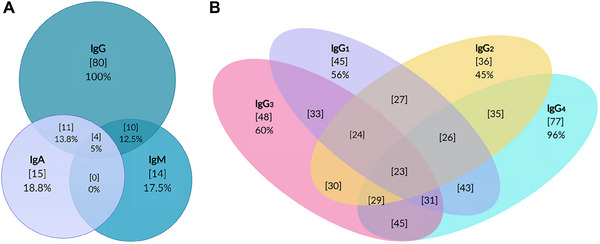
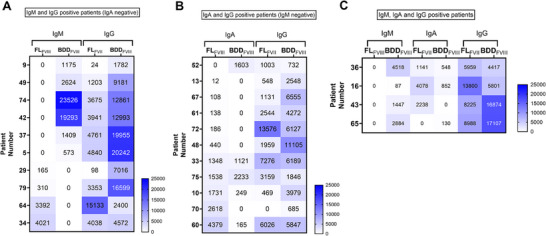
The cohort had a median age of 74 years, with 60% males. Idiopathic cases accounted for 67%, and 17% had bleeding linked to medical interventions. Major bleeding sites were musculoskeletal/retroperitoneal (45%) and skin (36%). Within six months, 18% of patients died, mostly from sepsis. Anti-FVIII IgG antibodies were present in all patients, with IgG (96%) and IgG (60%) being the most common subclasses. IgM and IgA anti-FVIII antibodies were detected in 17.5% and 18.8% of patients, respectively, with IgM positivity associated with higher mortality (33%). IgG subclass correlated significantly with inhibitor titres (r = 0.54; p < 0.001). Compared to CHA, AHA showed a higher prevalence of C1C2 domain-targeting antibodies (49% vs. 77%), associated with NBA levels (r = 0.51; p < 0.001).
Anti-FVIII antibody profiling reveals distinct patterns in AHA, with IgG linked to higher inhibitor levels. The C1C2 domain specificity of the anti-FVIII antibodies suggests a potential role of this FVIII domain in the immunopathology of AHA patients, warranting further investigation to improve prognostic tools.
获得性血友病A(AHA)是一种罕见的自身免疫性疾病,由针对凝血因子VIII(FVIII)的自身抗体引起,导致显著的出血风险。
通过评估抗体亚型、亚类以及与关键临床参数的相关性,来描述AHA患者的抗FVIII抗体谱。
采用基于磁珠的检测方法,对80例AHA患者进行回顾性分析,评估FVIII抑制物水平、抗体亚型(IgG、IgA、IgM)、IgG亚类和结构域特异性。将临床数据与抗体谱进行相关性分析。将IgG结构域谱与先天性血友病A(CHA)队列进行比较。
该队列的中位年龄为74岁,男性占60%。特发性病例占67%,17%的患者出血与医疗干预有关。主要出血部位为肌肉骨骼/腹膜后(45%)和皮肤(36%)。六个月内,18%的患者死亡,主要死于败血症。所有患者均存在抗FVIII IgG抗体,其中IgG1(96%)和IgG4(60%)是最常见的亚类。分别在17.5%和18.8%的患者中检测到IgM和IgA抗FVIII抗体,IgM阳性与较高的死亡率(33%)相关。IgG亚类与抑制物滴度显著相关(r = 0.54;p < 0.001)。与CHA相比,AHA患者中靶向C1C2结构域的抗体患病率更高(49%对77%),且与NBA水平相关(r = 0.51;p < 0.001)。
抗FVIII抗体谱分析揭示了AHA的独特模式,IgG与较高的抑制物水平相关。抗FVIII抗体的C1C2结构域特异性表明该FVIII结构域在AHA患者免疫病理学中可能起作用,需要进一步研究以改进预后工具。