Williams Michael E, Banche Niclot Federica, Rota Sara, Lim Jaesang, Machado Janaina, de Azevedo Ricardo, Castillo Katia, Adebiyi Samuel, Sreenivasan Ranga, Kota Daniel, Mcculloch Patrick C, Taraballi Francesca
Center for Musculoskeletal Regeneration, Houston Methodist Academic Institute, Houston, TX, USA.
Orthopedics and Sports Medicine, Houston Methodist Hospital, Houston, TX, USA.
BMC Mol Cell Biol. 2025 May 6;26(1):15. doi: 10.1186/s12860-025-00539-7.
Mesenchymal stem cells (MSCs) are promising for cell-based therapies targeting a wide range of diseases. However, challenges in translating MSC-based therapies to clinical applications necessitate standardized protocols following Good Manufacturing Practices (GMP) guidelines. This study aimed at developing GMP-complained protocols for FPMSCs isolation and manipulation, necessary for translational research, by (1) optimize culture of MSCs derived from an infrapatellar fat pad (FPMSC) condition through animal-free media comparison and (2) establish feasibility of MSC isolation, manufacturing and storage under GMP-compliance (GMP-FPMSC).
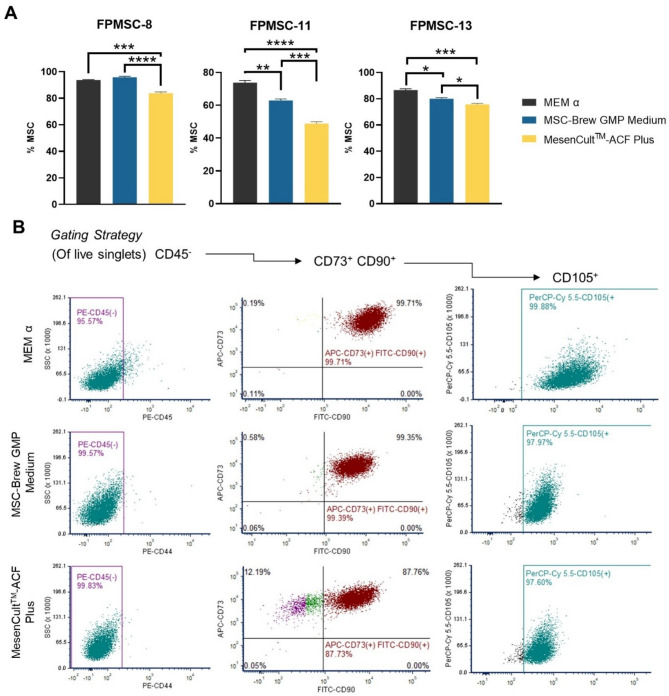
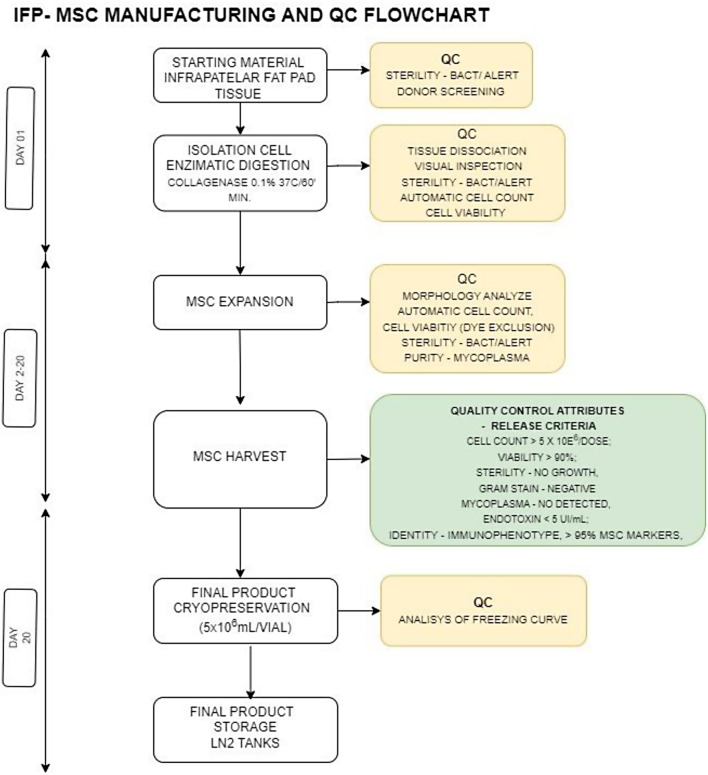
FPMSCs from three different patients were isolated following established protocols and the efficacy of two animal component-free media formulations in the culturing media were evaluated. The impact of different media formulations on cell proliferation, purity, and potency of MSCs was evaluated through doubling time, colony forming unit assay, and percentage of MSCs, respectively. Furthermore, the isolation and expansion of GMP-FPMSCs from four additional donors were optimized and characterized at each stage according to GMP requirements. Viability and sterility were checked using Trypan Blue and Bact/Alert, respectively, while purity and identity were confirmed using Endotoxin, Mycoplasma assays, and Flow Cytometry. The study also included stability assessments post-thaw and viability assessment to determine the shelf-life of the final GMP-FPMSC product. Statistical analyses were conducted using one-way ANOVA with Tukey's Multiple Comparisons.
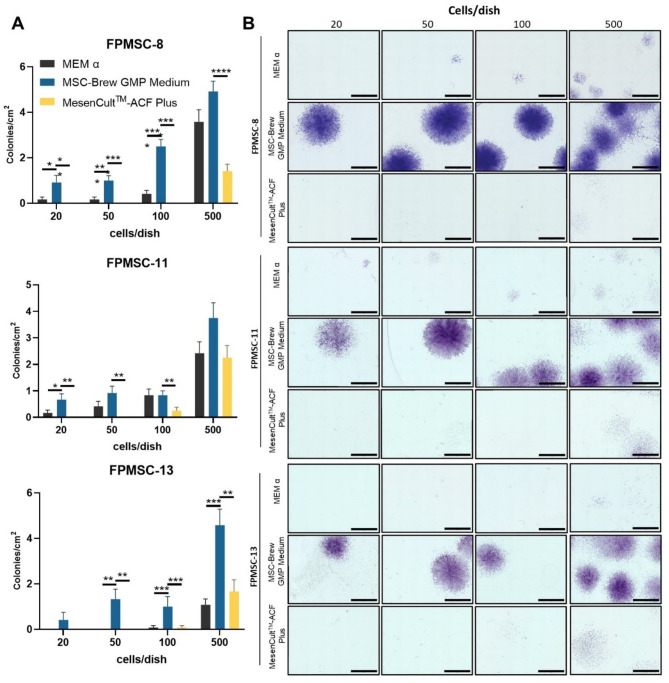
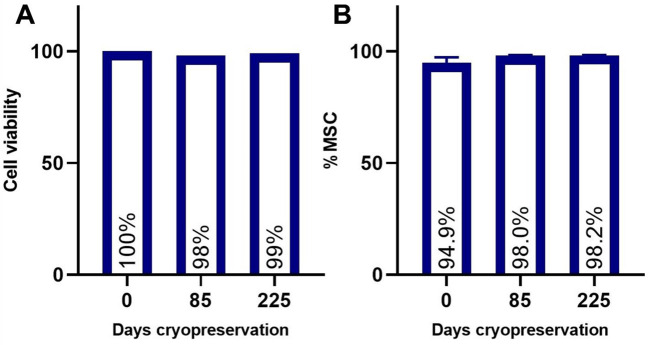
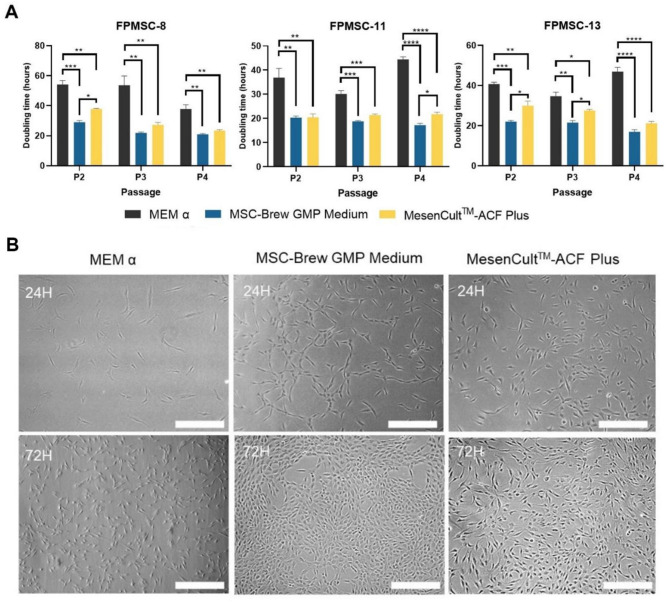
The study demonstrated that FPMSCs exhibited enhanced proliferation rates when cultured in MSC-Brew GMP Medium compared to standard MSC media. Cells cultured in this media showed lower doubling times across passages, indicating increased proliferation. Additionally, higher colony formation in FPMSCs cultured in MSC-Brew GMP Medium were observed, supporting enhanced potency. Data from our GMP validation, including cells from 4 different donors, showed post-thaw GMP-FPMSC maintained stem cell marker expression and all the specifications required for product release, including > 95% viability (> 70% is required) and sterility, even after extended storage (up to 180 days), demonstrating the reproducibility and potential of GMP-FPMSCs for clinical use as well as the robustness of the isolation and storage protocols.
The study underscores the feasibility of FPMSCs for clinical uses under GMP conditions and emphasizes the importance of optimized culture protocols to improve cell proliferation and potency in MSC-based therapies.
间充质干细胞(MSCs)在针对多种疾病的细胞疗法中具有广阔前景。然而,将基于MSCs的疗法转化为临床应用面临挑战,这就需要遵循药品生产质量管理规范(GMP)指南制定标准化方案。本研究旨在通过以下方式制定符合GMP的髌下脂肪垫来源的间充质干细胞(FPMSCs)分离和操作方案,这对于转化研究是必要的:(1)通过无动物成分培养基比较优化源自髌下脂肪垫的间充质干细胞(FPMSC)的培养条件;(2)确立在符合GMP条件下(GMP-FPMSC)进行间充质干细胞分离、生产和储存的可行性。
按照既定方案分离三名不同患者的FPMSCs,并评估两种无动物成分培养基配方在培养基中的效果。通过倍增时间、集落形成单位测定以及间充质干细胞百分比,分别评估不同培养基配方对间充质干细胞增殖、纯度和效能的影响。此外,对来自另外四名供体的GMP-FPMSCs进行分离和扩增,并根据GMP要求在每个阶段进行表征。分别使用台盼蓝和Bact/Alert检查活力和无菌性,同时使用内毒素、支原体检测和流式细胞术确认纯度和身份。该研究还包括解冻后的稳定性评估和活力评估,以确定最终GMP-FPMSC产品的保质期。使用单因素方差分析和Tukey多重比较进行统计分析。
研究表明,与标准间充质干细胞培养基相比,FPMSCs在MSC-Brew GMP培养基中培养时增殖率更高。在这种培养基中培养的细胞在各代中显示出更低的倍增时间,表明增殖增加。此外,观察到在MSC-Brew GMP培养基中培养的FPMSCs有更高的集落形成,支持其效能增强。我们的GMP验证数据,包括来自4名不同供体的细胞,显示解冻后的GMP-FPMSC即使在延长储存(长达180天)后仍保持干细胞标志物表达以及产品放行所需的所有规格,包括活力>95%(要求>70%)和无菌性,证明了GMP-FPMSCs用于临床的可重复性和潜力以及分离和储存方案的稳健性。
该研究强调了在GMP条件下FPMSCs用于临床的可行性,并强调了优化培养方案对于提高基于间充质干细胞疗法中细胞增殖和效能的重要性。