Sala Danila Cristina Paquier, Tanaka Oswaldo Yoshimi, Luz Reginaldo Adalberto, Balsanelli Alexandre Pazetto, Venancio Sonia Isoyama, Louvison Marília Cristina Prado, Baumann Ana A
Paulista School of Nursing, Federal University of São Paulo, São Paulo, Brazil.
Faculty of Public Health, University of São Paulo, São Paulo, Brazil.
BMC Public Health. 2025 May 6;25(1):1659. doi: 10.1186/s12889-025-22889-9.
There are high incidence and mortality rates of breast cancer in Brazil. Brazilian's social and economic disparities, along with complexities of its health system pose challenges to the appropriate implementation of mammography screening as a public policy for the population. In 2015, the Ministry of Health updated the recommendations for the early detection of breast cancer, which had, until then, been based on specialists' consensus, maintaining biennial screening mammography for women aged 50-69 years. However, the screening coverage did not exceed 25% of the expected number of exams for the Brazilian population who use the public health system. The objective of this study was to analyze barriers and facilitators (determinants) of opportunistic mammography screening in the Brazilian public health system.
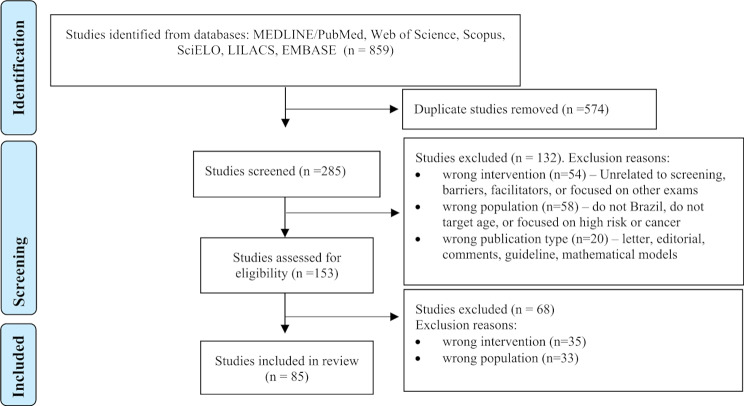
We conducted a scoping review to examine the extent to which guidelines have been implemented from 2015 to 2025, excluding those that (1) did not include the population aged 50 to 69 years, (2) did not discuss mammographic screening in the Brazilian public health system, (3) included populations with cancer or at high risk of cancer. Results were coded into the domains of the Consolidated Framework for Implementation Research (CFIR).
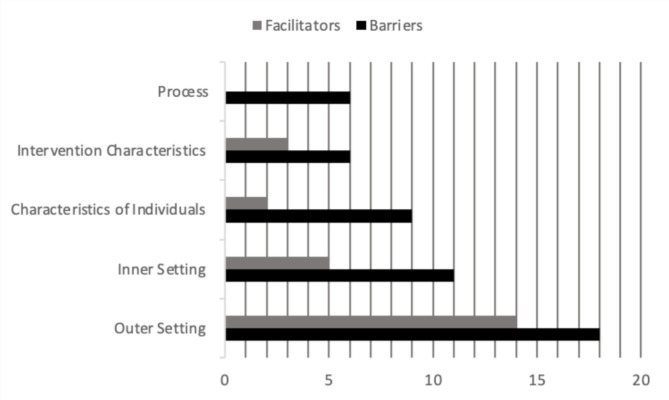
In the 85 articles selected, we coded 74 determinants, 50 referring to barriers and 24 to facilitators. The barriers were related to the outer setting 18(24.3%), inner setting 11(14.9%), characteristics of individuals 9(12.2%), process 6(8.1%), and intervention characteristics 6(8.1%). The facilitators were related to the outer setting 14(18.9%), inner setting 5(6.8%), intervention characteristics 3(4.1%) and individual characteristics 2(2.7%).
Using CFIR helps understand the multiple interrelated factors that affect the implementation of opportunistic mammographic screening in the Brazilian public health system. Our results can provide initial data for further studies that aim to improve and organize the implementation of mammography screening in Brazil.
巴西乳腺癌的发病率和死亡率很高。巴西的社会经济差异及其卫生系统的复杂性,给将乳房X光筛查作为一项面向民众的公共政策的适当实施带来了挑战。2015年,卫生部更新了乳腺癌早期检测的建议,在此之前,这些建议一直基于专家共识,维持对50至69岁女性每两年进行一次乳房X光筛查。然而,筛查覆盖率未超过使用公共卫生系统的巴西人口预期检查次数的25%。本研究的目的是分析巴西公共卫生系统中机会性乳房X光筛查的障碍和促进因素(决定因素)。
我们进行了一项范围综述,以研究2015年至2025年期间指南的实施程度,排除那些(1)未纳入50至69岁人群的研究,(2)未讨论巴西公共卫生系统中乳房X光筛查的研究,(3)纳入了癌症患者或癌症高危人群的研究。结果被编码到实施研究综合框架(CFIR)的各个领域。
在所选的85篇文章中,我们编码了74个决定因素,其中50个与障碍相关,24个与促进因素相关。障碍与外部环境相关的有18个(24.3%),内部环境相关的有11个(14.9%),个体特征相关的有9个(12.2%),过程相关的有6个(8.1%),干预特征相关的有6个(8.1%)。促进因素与外部环境相关的有14个(18.9%),内部环境相关的有5个(6.8%),干预特征相关的有3个(4.1%),个体特征相关的有2个(2.7%)。
使用CFIR有助于理解影响巴西公共卫生系统中机会性乳房X光筛查实施的多个相互关联的因素。我们的结果可为旨在改进和组织巴西乳房X光筛查实施的进一步研究提供初始数据。