Sun Jibo, Jia Qingqing, Lv Wenting, Zhang Shijie, Liu Sitong, Wang Dongguang, Wang Lian, Tong Xiang, Chen Jiehao, Chen Xiaoting, Tang Yongjiang, Fan Hong
Department of Pulmonary and Critical Care Medicine, West China Hospital, Sichuan University, Chengdu, 610041, China.
State Key Laboratory of Respiratory Health and Multimorbidity, Chengdu, 610041, China.
Ann Clin Microbiol Antimicrob. 2025 May 6;24(1):30. doi: 10.1186/s12941-025-00798-4.
Few studies have investigated the impact of carbapenem-resistant Pseudomonas aeruginosa (CRPA) on long-term outcomes in bronchiectasis. This study aimed to analyze acute exacerbations and mortality in bronchiectasis patients with CRPA isolation.
This retrospective study included bronchiectasis patients with PA-positive cultures from January 1, 2014, to July 31, 2023, at West China Hospital of Sichuan University. PA was isolated from sputum or bronchoalveolar lavage fluid (BALF) and classified into CRPA and non-CRPA groups based on antimicrobial susceptibility testing. Multivariate logistic regression was used to assess risk factors for acute exacerbations, while multivariate Cox regression identified independent risk factors for all-cause and cause-specific mortality.
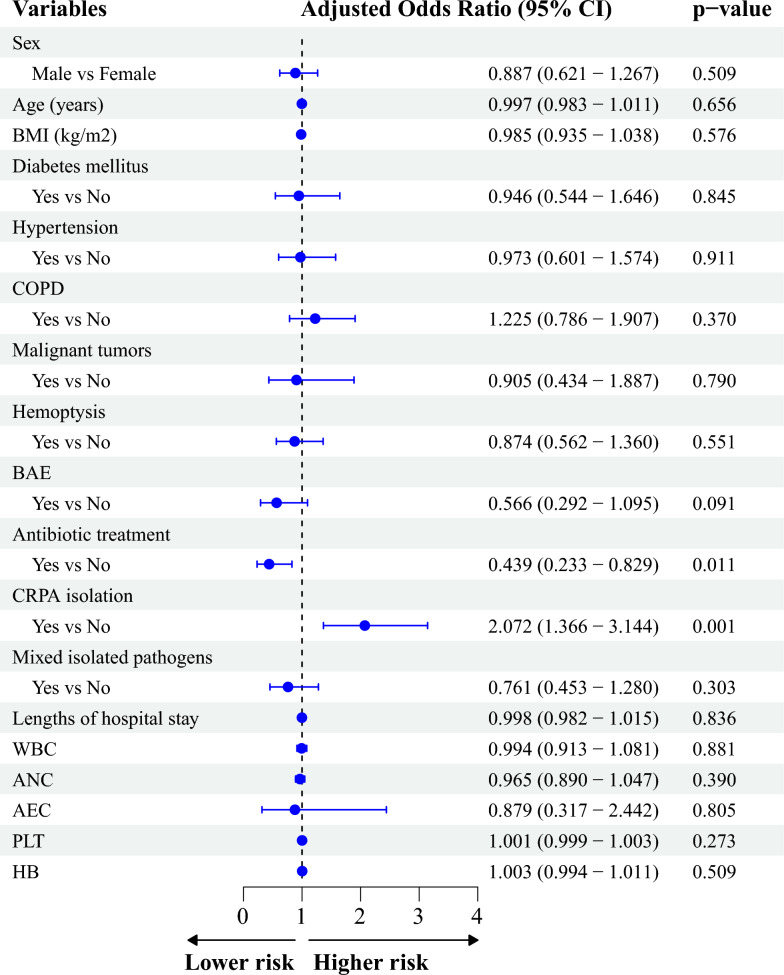
Among 564 patients with PA-positive isolates, 143 (25.36%) harbored CRPA strains. CRPA isolation was associated with an increased risk of acute exacerbations (adjusted odds ratio [aOR] 2.072, p = 0.001), while antibiotic treatment reduced the risk of exacerbations (aOR 0.439, p = 0.011). CRPA isolation was an independent risk factor for all-cause (adjusted hazard ratio [aHR] 1.488, p = 0.031) and cause-specific mortality (aHR 1.882, p = 0.010). The 1-, 3-, 5-, and 7-year cause-specific survival rates in the CRPA group were 88.6%, 79.8%, 73.2%, and 68.0%, respectively, versus 95.4%, 91.0%, 85.6%, and 81.8% in the non-CRPA group (p = 0.001).
CRPA isolation was significantly associated with an increasing risk of acute exacerbations, overall and cause-specific mortality. These findings underscored the urgent need to strengthen antibiotic stewardship to reduce the emergence of CRPA and to implement early detection and targeted management strategies to improve outcomes for patients with CRPA.
很少有研究调查耐碳青霉烯类铜绿假单胞菌(CRPA)对支气管扩张症长期预后的影响。本研究旨在分析分离出CRPA的支气管扩张症患者的急性加重情况和死亡率。
这项回顾性研究纳入了2014年1月1日至2023年7月31日在四川大学华西医院痰培养或支气管肺泡灌洗液(BALF)中铜绿假单胞菌(PA)呈阳性的支气管扩张症患者。根据药敏试验将从痰液或支气管肺泡灌洗液中分离出的PA分为CRPA组和非CRPA组。采用多因素逻辑回归分析评估急性加重的危险因素,多因素Cox回归分析确定全因死亡率和病因特异性死亡率的独立危险因素。
在564例PA分离株阳性的患者中,143例(25.36%)携带CRPA菌株。分离出CRPA与急性加重风险增加相关(调整优势比[aOR]为2.072,p = 0.001),而抗生素治疗可降低加重风险(aOR为0.439,p = 0.011)。分离出CRPA是全因死亡率(调整风险比[aHR]为1.488,p = 0.031)和病因特异性死亡率(aHR为1.882,p = 0.010)的独立危险因素。CRPA组1年、3年、5年和7年的病因特异性生存率分别为88.6%、79.8%、73.2%和68.0%,而非CRPA组分别为95.4%、91.0%、85.6%和81.8%(p = 0.001)。
分离出CRPA与急性加重、总体死亡率和病因特异性死亡率的风险增加显著相关。这些发现强调迫切需要加强抗生素管理以减少CRPA的出现,并实施早期检测和针对性管理策略以改善CRPA患者的预后。