Yang Yaqi, Yang Fan, Gan Jinghuan, Liu Shuai, Wen Chen, Liu Lixin, Ren Tianjiao, Wang Jiarui, Ji Yong
Department of Neurology, Tianjin Huanhu Hospital, Clinical College of Neurology, Neurosurgery and Neurorehabilitation, Tianjin Medical University, Tianjin, China.
Department of Neurology, Beijing Friendship Hospital, Capital Medical University, Beijing, China.
J Alzheimers Dis Rep. 2025 May 4;9:25424823251339132. doi: 10.1177/25424823251339132. eCollection 2025 Jan-Dec.
Visual hallucinations (VH) are an important neuropsychiatric feature of dementia. The association between VH and cognition remains controversial.
To investigate the differences in clinical correlates of VH and explore the associations between VH and cognitive functional decline in individuals with dementia with Lewy bodies (DLB) and Alzheimer's disease (AD).
Outpatient medical records of 154 patients with DLB and 297 patients with AD between January 2017 and December 2023 were reviewed. We collected demographic characteristics and used neuropsychological assessments and semi-structured detailed interviews to evaluate cognition and VH. Multiple linear regression and mediation analyses were employed to analyze the data, adjusting for confounding variables.
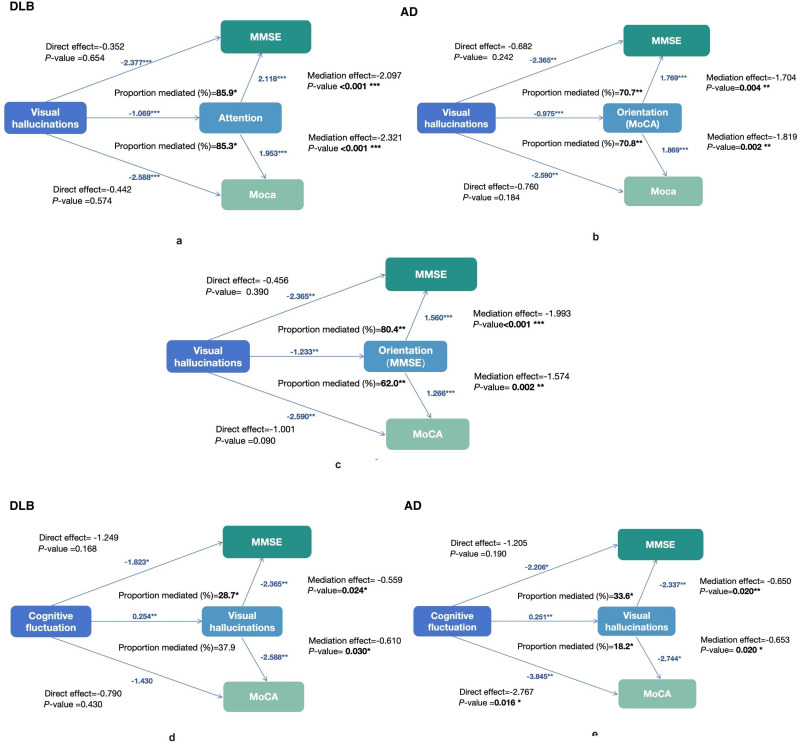
DLB patients had a higher prevalence of VH than AD patients (p < 0.01). The presence of VH predicted lower Mini-Mental State Examination (MMSE) and Montreal Cognitive Assessment (MoCA) scores in both DLB and AD patients (p < 0.01). In DLB patients, VH were associated with lower attention function scores after adjustment (p = 0.027). In AD patients, VH were related to worsened orientation ability after adjustment (p = 0.033). Attention function partially mediated the association between VH and cognition in DLB patients (p < 0.01), whereas orientation function partially mediated this association in AD patients (p < 0.01).
VH may independently correlate with deterioration in global cognitive performance. In DLB patients with VH, attentional function appears to be more impaired, whereas in AD patients, orientation function is the most affected. Different cognitive domains may help distinguish between DLB and AD patients with VH.
视幻觉(VH)是痴呆症的一项重要神经精神特征。VH与认知之间的关联仍存在争议。
研究VH临床相关因素的差异,并探讨路易体痴呆(DLB)和阿尔茨海默病(AD)患者中VH与认知功能衰退之间的关联。
回顾了2017年1月至2023年12月期间154例DLB患者和297例AD患者的门诊病历。我们收集了人口统计学特征,并使用神经心理学评估和半结构化详细访谈来评估认知和VH。采用多元线性回归和中介分析对数据进行分析,并对混杂变量进行校正。
DLB患者的VH患病率高于AD患者(p < 0.01)。VH的存在预示着DLB和AD患者的简易精神状态检查表(MMSE)和蒙特利尔认知评估量表(MoCA)得分较低(p < 0.01)。在DLB患者中,校正后VH与较低的注意力功能得分相关(p = 0.027)。在AD患者中,校正后VH与定向能力恶化相关(p = 0.033)。注意力功能在DLB患者中部分介导了VH与认知之间的关联(p < 0.01),而定向功能在AD患者中部分介导了这种关联(p < 0.01)。
VH可能与整体认知功能衰退独立相关。在伴有VH的DLB患者中,注意力功能似乎受损更严重,而在AD患者中,定向功能受影响最大。不同的认知领域可能有助于区分伴有VH的DLB和AD患者。