
用于提高葡萄酒中2-苯乙醇和乙酸2-苯乙酯产量的适应性实验室进化。
Adaptive laboratory evolution of for enhanced production of 2-Phenylethanol and 2-Phenylethyl acetate in wine.
作者信息
Lei Xingmeng, Chen Yu, Gao Binghong, Zhao Xixi, Sun Qing, Qin Yi, Song Yuyang, Jiang Jiao, Liu Yanlin
机构信息
College of Enology, Northwest A & F University, Yangling, China.
Shaanxi Engineering Research Center for Viti-Viniculture, Yangling, Shaanxi 712100, China.
出版信息
Food Chem X. 2025 Apr 21;27:102483. doi: 10.1016/j.fochx.2025.102483. eCollection 2025 Apr.
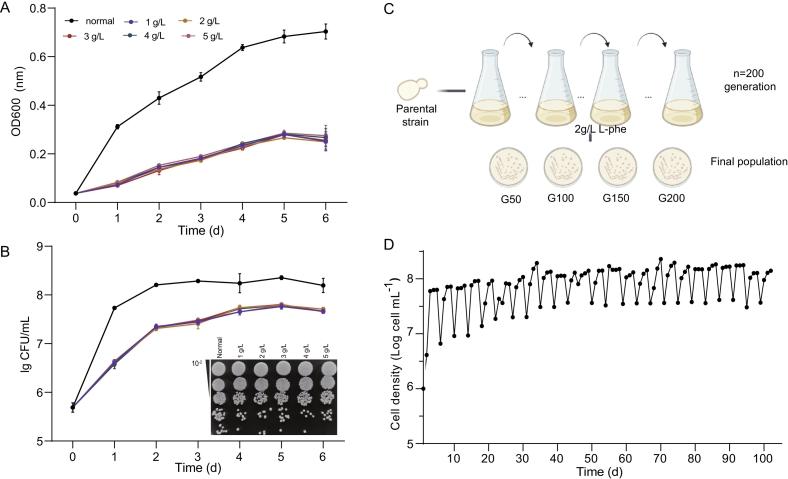
2-Phenylethyl alcohol (2-PE) and 2-phenylethyl acetate (2-PEA), responsible for "rose," "fruity" and "floral" aromas in wine, are derived from -phenylalanine (L-Phe). , a common yeast used in wine fermentation, has a limited ability to utilize L-Phe, restricting 2-PE and 2-PEA production. This study aimed to evolve an L. A38 strain with enhanced L-Phe utilization through ALE, in order to increase the production of the wine aroma compounds 2-PE and 2-PEA. After 200 generations of adaptive laboratory evolution (ALE), four mutants were selected, exhibiting an 82.8 % increase in 2-PE (from 15.06 to 28.22 mg/L) and a 2.07-fold increase in 2-PEA (from 75.73 to 157.27 μg/L) in chemically defined grape juice medium (CDGJM). The evolved strains also showed improved tolerance to high sugar concentrations, SO, ethanol, and pH. In wine micro-vinification, they produced 14.02-fold (from 47.63 to 667.96 mg/L) more 2-PEA and 4.10-fold more 2-PE than the original strain, surpassing the commercial yeast CT10. This study demonstrates ALE as an effective strategy for boosting 2-PE and 2-PEA production in wine.
2-苯乙醇(2-PE)和乙酸2-苯乙酯(2-PEA)是葡萄酒中“玫瑰”“水果”和“花香”香气的来源,它们由L-苯丙氨酸(L-Phe)衍生而来。酿酒酵母是葡萄酒发酵中常用的一种酵母,其利用L-Phe的能力有限,限制了2-PE和2-PEA的产生。本研究旨在通过适应性实验室进化(ALE)培育出一株L. A38菌株,该菌株对L-Phe的利用率更高,以增加葡萄酒香气化合物2-PE和2-PEA的产量。经过200代适应性实验室进化后,筛选出了四个突变体,在化学限定葡萄汁培养基(CDGJM)中,它们的2-PE产量增加了82.8%(从15.06毫克/升增至28.22毫克/升),2-PEA产量增加了2.07倍(从75.73微克/升增至157.27微克/升)。进化后的菌株对高糖浓度、二氧化硫、乙醇和pH的耐受性也有所提高。在葡萄酒微型酿造中,它们产生的2-PEA比原始菌株多14.02倍(从47.63毫克/升增至667.96毫克/升),2-PE比原始菌株多4.10倍,超过了商业酵母CT10。本研究证明ALE是提高葡萄酒中2-PE和2-PEA产量的有效策略。



 Zotero 插件