Abssy S S, Bosma R, Miles S, Clarke H, Moayedi M
Centre for Multimodal Sensorimotor and Pain Research, Faculty of Dentistry, University of Toronto, Toronto, Ontario, Canada.
University of Toronto Centre for the Study of Pain, University of Toronto, Toronto, Ontario, Canada.
Can J Pain. 2025 May 2;9(1):2486835. doi: 10.1080/24740527.2025.2486835. eCollection 2025.
One in five Canadians experiences chronic pain, at a cost of $40.3 billion in 2019. Despite this significant burden, there are few effective treatments for pain. This gap has been recognized by Health Canada, which has put forth the . Advancing our understanding of pain mechanisms and clinical trials to identify novel therapeutics are essential to address this treatment gap. However, it remains unknown whether the recommendations of the have increased research investments.
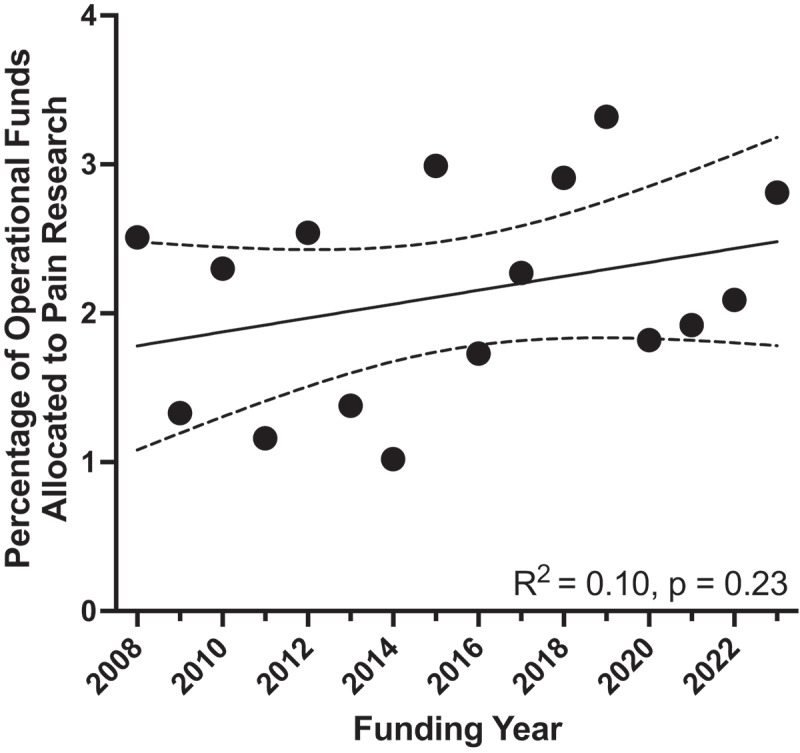
We investigate research investments in pain by the Canadian Institutes of Health Research (CIHR) based on publicly available data. We performed a systematic database search focused on operating funds from competitions between 2008 and 2023 and tabulated pain funding as a proportion of total CIHR operational funds granted each year. Next, we examined the proportion of pain funding across CIHR institutes aggregated across funding years.
We identified 20,126 operational grants, of which 459 were pain focused. The highest level of pain funding was 3.32% in 2019, and the average (SD) was 2.13% (0.70%). Funding was stagnant from 2008 to 2023 ( = 0.10, = 0.23). The Institute of Musculoskeletal Health and Arthritis allocated the largest proportion of funding to pain research (11.40%). Eight of the 13 institutes allocated less than 1% of their operating funds to pain research.
In sum, CIHR pain research funding does not match the socioeconomic burden posed by pain. We propose three action items to improve pain research funding and to ultimately relieve the burden of pain in Canada.
五分之一的加拿大人患有慢性疼痛,2019年的花费达403亿加元。尽管负担如此沉重,但有效的疼痛治疗方法却很少。加拿大卫生部已经认识到了这一差距,并提出了……。深入了解疼痛机制以及开展临床试验以确定新的治疗方法对于填补这一治疗空白至关重要。然而,尚不清楚……的建议是否增加了研究投入。
我们根据公开数据调查了加拿大卫生研究院(CIHR)对疼痛研究的投入。我们进行了系统的数据库搜索,重点关注2008年至2023年竞赛的运营资金,并将疼痛研究资金列为每年授予的CIHR总运营资金的比例。接下来,我们研究了各资助年份汇总的CIHR各研究所的疼痛研究资金比例。
我们确定了20126项运营资助,其中459项以疼痛为重点。2019年疼痛研究资金的最高水平为3.32%,平均(标准差)为2.13%(0.70%)。2008年至2023年资金停滞不前(F = 0.10,P = 0.23)。肌肉骨骼健康与关节炎研究所分配给疼痛研究的资金比例最大(11.40%)。13个研究所中有8个将其运营资金的不到1%用于疼痛研究。
总之,CIHR的疼痛研究资金与疼痛造成的社会经济负担不匹配。我们提出了三项行动建议,以改善疼痛研究资金状况,并最终减轻加拿大的疼痛负担。