González-Casanova Jorge Enrique, Navarro-Marquez Mario, Saez-Tamayo Tamara, Angarita Lissé, Durán-Agüero Samuel, Fuentes-Barría Héctor, Bermúdez Valmore, Rojas-Gómez Diana Marcela
Facultad de Ciencias de la Salud, Instituto de Ciencias Biomédicas, Universidad Autónoma de Chile, Santiago 8910060, Chile.
Escuela de Química y Farmacia, Facultad de Medicina, Universidad Andres Bello, Santiago 8370321, Chile.
Int J Mol Sci. 2025 Apr 14;26(8):3690. doi: 10.3390/ijms26083690.
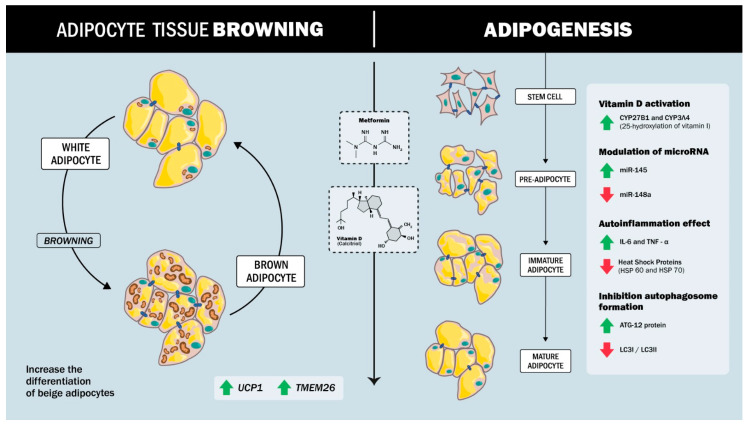
Metformin, a widely used antidiabetic drug, modulates the cellular physiology and metabolism of various body tissues, including adipose tissue. Adipogenesis, a complex process in which mesenchymal stem cells (MSC) differentiate into functional adipocytes, plays a key role in metabolic health and represents a potential therapeutic target for diverse metabolic disorders. Notably, recent evidence suggests that metformin modulates adipocyte differentiation. This narrative review explores the effects of metformin on cellular metabolism, with a particular focus on adipogenesis. The findings compiled in this review show that metformin regulates glucose and lipid metabolism in multiple tissues, including skeletal muscle, adipose tissue, liver, and intestine. Furthermore, metformin modulates adipogenesis through AMP-activated protein kinase (AMPK)-dependent and independent mechanisms in 3T3-L1 cells and adipose-derived stem cells. The review also emphasizes that metformin can promote or inhibit adipogenesis and lipid accumulation, depending on its concentration. Additionally, metformin attenuates inflammatory pathways by reducing the production of proinflammatory cytokines such as IL-6, MCP-1, and COX-2. Finally, evidence supports that vitamin D enhances the anti-inflammatory actions of metformin and promotes cell differentiation toward a beige adipocyte phenotype. In summary, this review examines the molecular actions of metformin to propose potential new therapeutic strategies for managing obesity and related metabolic diseases.
二甲双胍是一种广泛使用的抗糖尿病药物,可调节包括脂肪组织在内的各种身体组织的细胞生理和代谢。脂肪生成是一个复杂的过程,其中间充质干细胞(MSC)分化为功能性脂肪细胞,在代谢健康中起关键作用,是多种代谢紊乱的潜在治疗靶点。值得注意的是,最近的证据表明二甲双胍可调节脂肪细胞分化。这篇叙述性综述探讨了二甲双胍对细胞代谢的影响,特别关注脂肪生成。本综述汇总的研究结果表明,二甲双胍可调节包括骨骼肌、脂肪组织、肝脏和肠道在内的多种组织中的葡萄糖和脂质代谢。此外,二甲双胍通过3T3-L1细胞和脂肪来源干细胞中依赖和不依赖AMP激活蛋白激酶(AMPK)的机制来调节脂肪生成。该综述还强调,二甲双胍根据其浓度可促进或抑制脂肪生成和脂质积累。此外,二甲双胍通过减少促炎细胞因子如IL-6、MCP-1和COX-2的产生来减轻炎症途径。最后,有证据支持维生素D可增强二甲双胍的抗炎作用,并促进细胞向米色脂肪细胞表型分化。总之,本综述研究了二甲双胍的分子作用,以提出管理肥胖症和相关代谢疾病的潜在新治疗策略。