Tupps Cara, Curry Dora, Edwards Amanda, Bazant Eva, Moen Ann, Mounts Anthony W, Bresee Joseph
The Task Force for Global Health, Decatur, Georgia, Unites States of America.
PLOS Glob Public Health. 2025 May 7;5(5):e0004417. doi: 10.1371/journal.pgph.0004417. eCollection 2025.
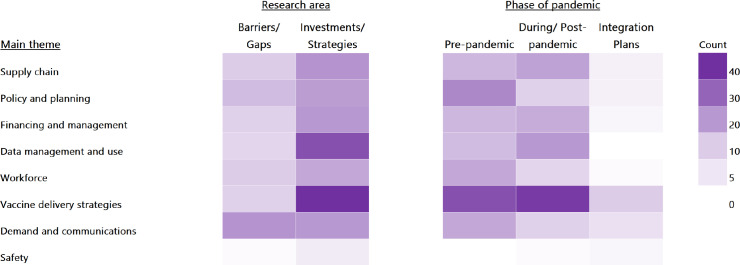
The COVID-19 pandemic challenged health systems in low- and middle-income countries (LMIC) to rapidly deploy vaccines, target adult populations, and integrate the COVID-19 vaccine into existing vaccination programs. This evaluation examined COVID-19 vaccination implementation and planning experiences of six LMICs. We aimed to identify common strategies and investments contributing to country-level readiness to scale up COVID-19 vaccination and gaps in pandemic preparedness. In-depth interviews were conducted with national COVID-19 vaccination program representatives from Côte d'Ivoire, Kyrgyzstan, Moldova, Pakistan, the Philippines, and Zambia. Interview questions covered activities, barriers, and facilitators related to vaccine integration; planning and financing; digital systems; vaccine infrastructure and delivery; adult immunization; the health workforce; and demand and communications. We used the framework analysis method to establish key themes from the recorded data and categorize our results. Countries with influenza vaccine platforms leveraged these to reach adults with COVID-19 vaccines. Community-based platforms were viewed to be an effective approach to vaccinate prioritized populations. Stand-alone delivery platforms and data systems for COVID-19 vaccination were viewed as inefficient and not cost-effective, and vaccine supply delays and shortages were a major issue. Participants highlighted that integrated planning, management, and financing for vaccination activities facilitated the COVID-19 vaccine roll out, and that National Immunization Technical Advisory Groups filled a gap by providing guidance on prioritizing populations for vaccination. Health workers were viewed as key influencers of vaccine uptake by patients and their vaccination was believed by participants to improve public trust in COVID-19 vaccines. These findings informed the following priority areas for targeted investment and technical support. 1. Improve vaccine procurement and supply. 2. Integrate financing and management of national vaccination programs broadly. 3. Digitize and integrate data systems. 4. Build health workforce capacity. 5. Establish and expand adult and life-course vaccination, including health workers. 6. Address hesitancy and misinformation.
新冠疫情对低收入和中等收入国家(LMIC)的卫生系统构成挑战,要求其迅速部署疫苗、针对成年人群体,并将新冠疫苗纳入现有的疫苗接种计划。本评估考察了六个低收入和中等收入国家的新冠疫苗接种实施情况及规划经验。我们旨在确定有助于各国做好扩大新冠疫苗接种准备的共同策略和投资,以及大流行防范方面的差距。我们对来自科特迪瓦、吉尔吉斯斯坦、摩尔多瓦、巴基斯坦、菲律宾和赞比亚的国家新冠疫苗接种计划代表进行了深入访谈。访谈问题涵盖与疫苗整合、规划和融资、数字系统、疫苗基础设施与交付、成人免疫、卫生人力以及需求和宣传相关的活动、障碍和促进因素。我们使用框架分析方法从记录的数据中确定关键主题并对结果进行分类。拥有流感疫苗平台的国家利用这些平台为成年人接种新冠疫苗。基于社区的平台被视为为优先人群接种疫苗的有效途径。独立的新冠疫苗接种交付平台和数据系统被认为效率低下且不具成本效益,疫苗供应延迟和短缺是一个主要问题。参与者强调,疫苗接种活动的综合规划、管理和融资促进了新冠疫苗的推出,国家免疫技术咨询小组通过提供关于确定优先接种人群的指导填补了空白。卫生工作者被视为影响患者疫苗接种率的关键因素,参与者认为他们接种疫苗有助于提高公众对新冠疫苗的信任。这些发现为以下有针对性的投资和技术支持优先领域提供了参考。1. 改善疫苗采购和供应。2. 广泛整合国家疫苗接种计划的融资和管理。3. 数字化并整合数据系统。4. 建设卫生人力能力。5. 建立并扩大成人及全生命周期疫苗接种,包括卫生工作者。6. 解决疫苗犹豫和错误信息问题。